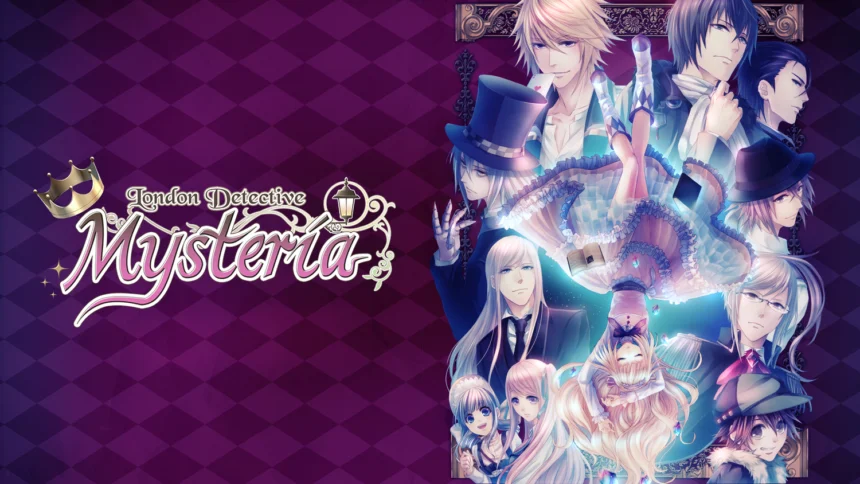
When London Detective Mysteria first released in Japan as Eikoku Tantei Mysteria in 2013, its premise sounded almost too playful to sustain an entire visual novel. Sherlock Holmes’ son, Arsène Lupin’s heir, Miss Marple’s niece, and figures inspired by Japanese detective fiction all attending the same academy could easily have become a novelty that wore thin after a few chapters. Instead, Karin Entertainment spent the following years expanding the game into The Crown, a substantially revised PS Vita edition with additional scenarios, a new artist, and an entirely different Japanese voice cast. The western release published by XSEED is built from that later version, and it benefits from the confidence of a game that had already been given the chance to refine itself.
Emily Whiteley enters Queen Victoria’s detective academy carrying expectations she never actively sought. Personally selected by the Queen and entrusted with a mysterious ring, she joins a school where nearly every student carries the legacy of someone famous. The descendants, relatives, and successors of legendary detectives and criminals aren’t simply references for mystery fans to recognize; the game treats those inherited names as burdens each student has to define for themselves.
That idea proved far more interesting than the murders themselves.
Herlock Holmes spends much of the story wrestling with the impossible standard attached to his surname. Jean Lupin approaches life from the opposite direction, relying on charisma and instinct rather than rigid discipline. Sara Marple inherits her famous aunt’s observational patience, while Kenichirou Akechi and Seiji Kobayashi bring the influence of Edogawa Ranpo’s detective fiction into a setting otherwise dominated by Victorian literature. Even Jack the Ripper appears, a creative decision that sounds ridiculous until the game commits fully enough to its alternate history that questioning it almost becomes pointless.
Rather than constructing one enormous conspiracy from beginning to end, the narrative unfolds through individual investigations that gradually reveal more about both Emily and the people around her. That episodic structure reminded me less of modern visual novels and more of serialized detective fiction, where solving one mystery simply creates an opportunity for the next. It also gives each route enough room to develop its chosen relationship without constantly competing against an overarching plot demanding attention.
The murders themselves are handled with more seriousness than the academy setting initially suggests. Crime scenes contain enough graphic description to justify the game’s content warnings, and some investigations linger on the consequences of violence longer than I expected from an otome game. At the same time, the next scene may pivot directly into playful romance or school-life comedy. The tonal contrast can occasionally feel abrupt, but I eventually accepted it as part of the game’s identity rather than a flaw it was trying to hide.
Emily benefits from remaining more than a passive observer. Although players can rename her, she never disappears into the background as a blank protagonist. Her own family history gradually becomes just as important as the mysteries unfolding around the academy, ensuring that her route through the story feels like more than a vehicle for whichever romance happens to be chosen.
Presentation reflects the game’s unusual development history. The revised artwork introduced in The Crown gives the cast a polished appearance that still holds up well, while murder scenes remain comparatively static, relying on descriptive writing rather than elaborate visual direction. The contrast occasionally reveals the title’s origins on older hardware, but it also keeps attention focused where the game is strongest: its characters.
The voice acting deserves particular credit. Every major character receives full Japanese voice performances, and the ability to adjust each character’s volume individually turned out to be far more useful than I initially expected. Certain performances naturally became favorites, and being able to emphasize those voices without changing the rest of the mix was a thoughtful quality-of-life feature that surprisingly few visual novels offer.
Not every interface decision is as successful. The absence of a dialogue backlog became increasingly noticeable during longer play sessions, especially in scenes with rapid exchanges or interruptions. Missing a line often meant simply moving forward rather than checking what had just been said, a limitation that felt oddly out of place in such a text-heavy game.
One aspect I appreciated after researching the game’s history was how much of the western release reflects XSEED’s confidence in introducing Karin Entertainment to a new audience. Including the ninety-two-page digital art book alongside the game wasn’t essential, but it reinforced the feeling that London Detective Mysteria was being presented as something worth discovering rather than simply another localized visual novel added to an already crowded catalogue.
Verdict
London Detective Mysteria succeeds because it treats its literary crossover premise as more than clever fan service. The descendants of Holmes, Lupin, Marple, and other famous figures are allowed to become characters struggling with inherited identities instead of walking references, and that focus gives the romance and mystery equal opportunity to develop. While the missing dialogue log and occasional tonal shifts prevent it from feeling completely polished, the strength of the cast and the confidence of its alternate Victorian setting make it one of the more distinctive otome mysteries available.