Multi-perspective ensemble storytelling isn’t new to visual novels. Plenty of harem titles let you cycle through different heroines’ viewpoints across a shared timeline. What’s rare is a game willing to give up a single protagonist entirely and hand that same spotlight to fifteen different girls at once. This is an ensemble structure that borrows its calendar-based unlocking from dating sim conventions and its multiple-couples format from anthology romance manga. It assembles those pieces into something considerably more ambitious than either source alone, occasionally chaotic in execution, but confident in its own unusual math.
Lilycle Rainbow Stage!!! hands you fifteen girls, then insists every single one of them is the main character depending on whose perspective the current episode happens to be told from. It’s an unusually democratic structure for the genre, built around a calendar menu running from April through the following March, where episodes unlock over time rather than following a single linear path. The sheer scale of that ensemble is both the game’s boldest choice and its most immediate obstacle. The opening prologue throws all fifteen girls at me simultaneously during a group picnic, and I found that introduction overwhelming before the episodic structure settles into something easier to track.
Once it does, the game reveals itself as a collection of six distinct yuri couples plus one central love triangle. Tamaki, a kind, slightly bumbling teacher-in-training, and Yuno, an energetic idol, both vie for Saeka, a quiet, endearing presence torn between the two of them, with your own choices ultimately determining which of the pair she ends up with. The wider cast splits across two sister schools, fourteen of the fifteen girls attending one, with Tamaki alone studying at the other while training to become a teacher herself. Every couple gets real room to breathe across their own dedicated episodes, and the writing does an impressive job giving each pairing a distinct emotional flavor. Ayumi’s calm, cat-loving senpai energy plays well against Waka’s much more excitable devotion to her, a contrast that sets the tone for how differently each remaining pair gets written against the others. Alice Kugayama and Ibuki Oribe get their own dynamic further down the roster, one more example of the game finding a distinctly different emotional register for a pairing that could easily have blurred into whichever couple came before it.
Chronology is the structure’s real weak point. The calendar interface lets me freely bounce between episodes and couples rather than enforcing a strict timeline, and I found the overall sense of story progression muddled at points because of it. Both potential Saeka pairings, for instance, start generating couple-specific episodes that technically shouldn’t be happening in the same continuity, yet they appear side by side on the same calendar anyway. The game also doesn’t chase deep plot or dramatic stakes at any point, staying committed to light, slice-of-life warmth throughout, which will suit anyone looking for exactly that comfort but will leave anyone hoping for substantial narrative tension wanting more.
Developer PARTICLE built this as its debut title, releasing it in Japan in April 2016 as a visual adaptation of an existing Lilycle audio CD drama series rather than an original concept built from scratch. MangaGamer announced its western localization at a 2018 Anime Expo panel, bringing the English release out on March 14, 2019, with a Japanese-language option added to the Steam version later, in June 2022, as a separate selectable mode.
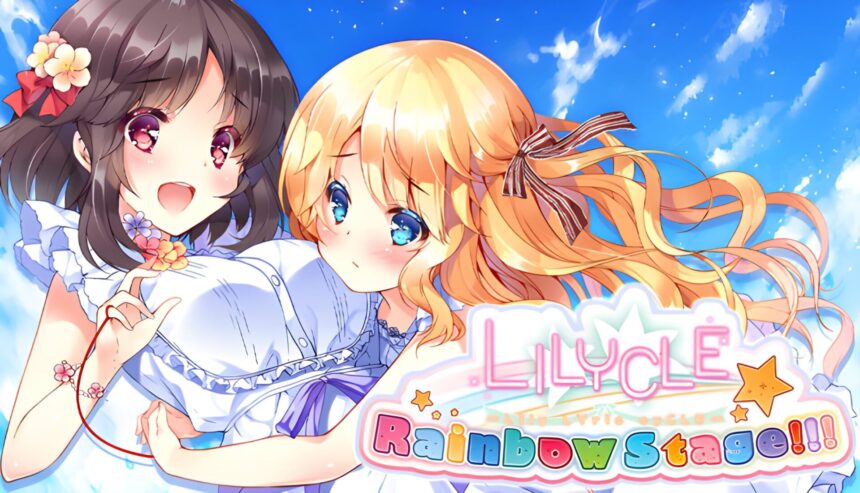
Character art from Sakura Miwabe, also known for illustrating the light novel I’m Giving the Disgraced Noble Lady I Rescued a Crash Course in Naughtiness, carries real detail across all fifteen designs. Animated eyes and multiple outfit variations per character reward close attention, spread across 68 base CG illustrations. The trade-off shows up in sprite posing, though, with most characters limited to only a couple of static body positions even as their expressive faces shift constantly, a noticeable stiffness that pulls against how lively everything else about the presentation feels. The CG gallery more than makes up for that limitation on its own terms, holding up as some of the densest, most consistent artwork I’ve come across in the genre for a cast this size.
Voice acting draws from a real powerhouse roster of Japanese talent. Juri Kimura voices Yuuno, MAO voices Tamaki, and Haruka Terui voices Saeka, the three anchoring the central triangle. Shiori Mikami, Natsumi Takamori, Azumi Asakura, Maaya Uchida, Aya Uchida, Yuka Otsubo, Rumi Okubo, Aya Suzaki, Eriko Matsui, Saki Fujita, Hisako Kanemoto, and Chinatsu Akasaki round out the remaining twelve. Several carry real pedigree from outside this specific role, Aya Uchida’s work in Love Live! and Danganronpa 2 among them, and that caliber shows in how much weight even minor emotional beats carry. The game lets you disable individual characters’ voices if desired, and bonus recordings from the cast, fully subtitled, extend the vocal content well past the main story itself. A separate Lilycle Vocal Collection and an Original Soundtrack are both sold as their own items alongside the base game on Steam, for anyone who wants the music and vocal work in isolation.
The soundtrack itself, while fitting the game’s cheerful aesthetic well, leans cute to the point that its limited rotation of tracks became grating for me personally across a runtime that comfortably runs past nineteen hours for full completion. A handful of illustrations do carry brief moments of fan service, swimsuit scenes mostly, though the story keeps its romantic content largely to kissing rather than anything more explicit throughout the vast majority of its runtime.
Verdict
Lilycle Rainbow Stage!!! succeeds as a warm, ensemble-driven celebration of yuri romance, using its unusual calendar structure to give all fifteen girls real individual spotlight rather than sidelining most of the cast in favor of a single central couple. Miwabe’s character art and a powerhouse lineup of voice talent carry the presentation, even as stiff sprite posing and a chronologically confusing episode structure keep the experience from feeling as polished as its individual routes deserve. It’s not interested in deep plotting or dramatic stakes, staying purely in comforting slice-of-life territory throughout, but for anyone specifically seeking that kind of gentle, character-focused yuri comfort, it delivers an unusually generous amount of it.