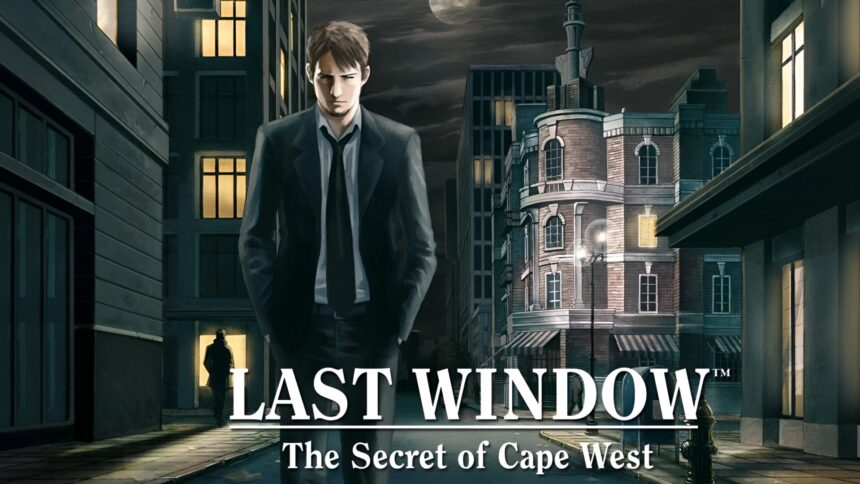
Getting to hold your handheld sideways like an actual paperback was a real clever gimmick when Hotel Dusk: Room 215 introduced it back in 2007. Last Window: The Secret of Cape West inherits that exact physical conceit for its sequel, right down to the same “novel you’re playing” framing that made its predecessor stand out on the DS. Known in Japan as Mayonaka no Yakusoku, or Midnight Promise, it’s a mystery whose story unfortunately never received an official North American localization, leaving it as one of the more overlooked entries in the DS’s surprisingly rich catalog of graphic-adventure-visual-novel hybrids.
Picking up a year after the events of Hotel Dusk, the story follows Kyle Hyde, ex-NYPD detective turned reluctant door-to-door salesman. He gets fired, learns his apartment building is scheduled for demolition, and receives an anonymous letter demanding he track down a long-lost object called the Scarlet Star, all within the span of a single very bad day. Where its predecessor spread its mystery across the transient guests of an isolated motel over the course of one night, Last Window narrows its focus onto Kyle’s own neighbors at the Cape West Apartments in 1980s Los Angeles. The story unfolds across ten separate chapters spread over multiple days rather than compressing everything into a single night the way Hotel Dusk did. That structural shift by itself gives the story more room to build lived-in history between Kyle and the people around him. By extension, this becomes a story more interested in Kyle’s personal past and unresolved questions about his father’s death than in solving a mystery about strangers passing through. Chris Hyde, Kyle’s own father, was murdered twenty five years earlier while working as a safecracker, a case that’s remained unsolved ever since and clearly still shapes how Kyle carries himself.
Cing, the small Japanese studio behind both games, filed for bankruptcy on March 1, 2010, and Last Window would end up being the developer’s final release before that happened. Director and character designer Taisuke Kanasaki, who held the same role on Hotel Dusk, has described the visual technique behind both games directly, photographing real people and tracing their movements to produce the rotoscoped look that gives every character such a distinct, hand-drawn quality. Additional art came from Keisuke Sakamoto, with Rika Suzuki serving as lead writer and game designer alongside co-writers Yu Tominaga and Shunichi Nakagaki, under producer Takuya Miyagawa and co-producer Satoshi Kira. Nintendo published the game in Japan on January 14, 2010, with a European release following that September, though Cing’s collapse meant the North American release many who’d played Hotel Dusk were expecting never materialized.
That shift in focus pays off in specific, meaningful ways. Watching apartments that clearly reflect their occupants’ personalities, some cluttered with personal history, others deliberately, revealingly bare, gives the mystery a sense of place that a hotel full of one-night guests couldn’t replicate. The conversational puzzle-solving at the game’s core benefits considerably from an added Ignore feature layered on top of the original’s questioning system. Rather than every line of dialogue being mandatory, I could now choose to let certain lines of inquiry go entirely. Figuring out when to push a reluctant, gossipy neighbor versus when to back off and preserve their goodwill becomes a real, rewarding layer of character-reading that elevates the interrogation sequences well beyond simple dialogue trees. Mila Evans, a returning face from Hotel Dusk now studying at art school in Seattle, and newcomers like the gentlemanly but faintly condescending Will White and the mysterious, unusually well-informed Rex Foster all get pulled into that same web of careful questioning and careful restraint.
I didn’t find this entry improving meaningfully on its predecessor across the board, and that’s the part of the experience that stuck with me most by the end. The traditional item-based puzzles felt less inspired than Hotel Dusk’s more creative use of the DS hardware to me, occasionally relying on lateral-thinking leaps that landed closer to frustrating trial and error than satisfying eureka moments. More seriously, Kyle himself read as having lost some of the sharper, more compelling edge that defined him in the original. Whether that’s a real writing regression or simply the natural result of a character already fully introduced once before is hard to say for certain. A returning supporting character from the first game also gets reduced to little more than a phone-a-friend research tool this time around, a step down from the fuller characterization she received previously.
An in-universe interactive novel that unlocks new chapters as you progress stands as the game’s signature new addition, and it functions as considerably more than a simple recap tool. Framed as being written by a character from the first game, this expanded prose adds real depth to Kyle’s inner monologue and delivers an epilogue that resolves plot threads the core gameplay itself leaves dangling. Its framing device deliberately leaves open the possibility that some of what it reveals is embellished rather than strictly canonical, though, an intriguing bit of narrative ambiguity worth sitting with rather than treating every detail as gospel.
Presentation carries over the first game’s distinctive rotoscoped, pencil-sketch art style largely unchanged, a smart decision given how well that aesthetic suited the original’s noir atmosphere, and characters continue to animate with real, expressive range during key emotional beats. Satoshi Okubo and Yuhki Mori composed the score together, credited alongside T’s Music Co., Ltd. It suits individual scenes well enough, but no official soundtrack release ever followed, leaving dedicated listeners to rip the music themselves and label tracks using the in-game jukebox’s own song names.
Cing’s closure didn’t end the Kyle Hyde style of mystery entirely. Several former staff members, including Kanasaki, went on to work under Arc System Works, which released a spiritual successor called Chase in 2016 built by many of the same people. Rika Suzuki, for her part, went on to found her own company producing digital novels.
Verdict
Last Window: The Secret of Cape West delivers a worthy, if imperfect, continuation of Hotel Dusk’s distinctive noir-mystery formula. It deepens its focus on Kyle Hyde’s personal history and adds real, thoughtful conversational mechanics even as its traditional puzzles and central protagonist lose some of the sharper edge that made the original stand out. Never receiving an official North American release remains a real, unfortunate barrier to access, and this entry falls just short of the high bar its predecessor set. Anyone willing to seek out slow-burn, dialogue-driven mystery gets a real, well-crafted send-off here, from a studio that clearly understood what made its best work special.