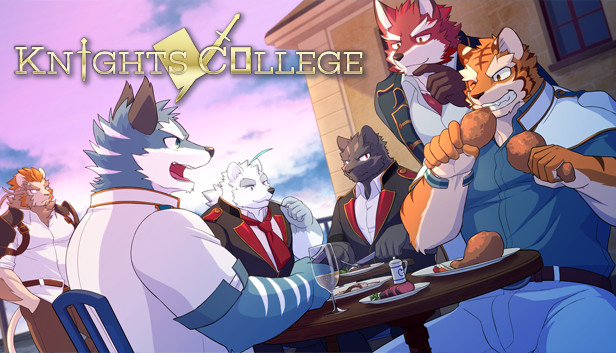
Being invited somewhere you have spent years imagining should feel like validation. It becomes much less comfortable when everyone around you looks qualified to be there and you still cannot explain why your own name made the list. This is especially true since excitement and self-doubt can occupy exactly the same seat. Knights College gives that problem to Argo, the son of a fisherman from a quiet rural village who receives an unexpected recommendation to an elite school for aspiring knights. He has admired the college for years, but the invitation makes little sense to him until his unusual cardification ability enters the picture. Moving into the dormitory means learning how to use that power while studying alongside other knight candidates, and I was immediately more interested in Argo’s uncertainty than in the prestige of the school itself. He has been handed the opportunity he wanted without first earning the confidence to believe he belongs there.
Cards turn that uncertainty into the game’s central mechanic. Movement, conversations, and other choices are represented by cards Argo has collected, while acquiring more can unlock new places, interactions, and routes or increase affection with characters. It is a clever match between story and interface because the strange ability responsible for Argo’s admission also determines how I interact with his new life. I started paying attention whenever another card appeared because collecting one meant more than filling an inventory. It could change what Argo was able to do next.
That structure runs across six chapters and an epilogue, with nine Steam achievements including milestones for clearing chapters and completing card and heart collections. I enjoyed the collection side more than I expected, especially when a new card opened a conversation I previously could not access. At the same time, the novelty of presenting nearly everything as cards eventually wore thinner than the initial concept suggested. Once I understood the system, some selections felt like familiar visual novel choices wearing a much more attractive interface. The mechanic still fits Argo unusually well, but I wanted the story to push the implications of his ability further.
Life at the college should have provided plenty of room for that. Argo attends lectures, trains with swords and guns, lives in the dormitory, takes part in activities away from campus, and can experience events such as students exchanging rooms. Frontail students also share the college with people studying abroad from the rival country of Harshreich, while professors and the country’s guardian dragon widen the setting beyond Argo’s immediate classmates. There is a lot sitting on the table, which made it frustrating whenever the school felt more like a convenient meeting place than somewhere I was steadily learning to understand. I wanted more of its routines, rivalries, training culture, and the differences between the people gathered there.
The cast partly compensates for that. Grantly and Oscar are among Argo’s earliest companions as he enters this unfamiliar environment, while professors such as Diederich and Celio give him relationships outside his fellow students. Character designer and event artist Rossi Tsukigata gives the group an immediately recognizable kemono identity, with species, builds, clothing, and silhouettes doing a lot of work before a conversation even begins. I had no trouble telling these characters apart, and the designs made browsing unlocked interactions more inviting because each person brings a different visual presence to the screen.
That visual variety sometimes made the writing feel safer by comparison. Several personalities settle into recognizable types quickly, and I kept waiting for certain relationships to complicate the first impression I had formed of them. Some do get more room as the chapters progress, but with so many characters competing for Argo’s attention, the development can feel uneven. This bothered me more because the dormitory setup naturally invites small recurring interactions. I wanted conversations that made classmates feel increasingly familiar through repetition and change, rather than encounters that sometimes seemed designed mainly to move me toward the next card.
Oodaru handled direction, scenario writing, and programming, while Rossi Tsukigata was responsible for character design and event art. That compact creative setup helps explain why the card system, character presentation, and story feel so closely connected. The English translation is credited to and_is_w, with separate translators credited for Traditional Chinese, Spanish, French, and Vietnamese. Korean was added alongside French and Vietnamese in a September 2022 update, bringing the Steam version to eight supported text languages. I noticed occasional moments where the English phrasing felt less smooth than the artwork surrounding it, but the broader character voices remained easy enough to follow.
There is no full voice track on the version of the game i played on Steam, so conversations rely on the writing, character art, interface, and sound rather than performed dialogue. I did miss voices during some of the longer character exchanges. With such visually distinct personalities, hearing them differentiated through performance could have added another layer to the cast, particularly when the writing itself was not giving every character equal depth.
Music is present throughout the game, with individual cues used for locations and situations including the dormitory, carriage, church, bath, afternoon scenes, and chapter menu. I preferred the quieter everyday tracks because they supported the school-life side without fighting for attention. The score does its job as part of the atmosphere, although no composer credit was established strongly enough for me to attach a name to it.
The original Windows release arrived on Steam on January 15, 2021, developed and published by KAIJYU-09. The studio describes Knights College as a series built around knights, school life, and cards, with Oodaru responsible for planning, scenario writing, and programming across KAIJYU-09’s work and Rossi Tsukigata responsible for Knights College’s design. A later Android edition brought the first game to Google Play in 2025 as a buy-to-own release containing the six chapters and epilogue without additional in-app purchases. I like that the mobile version preserves the card-selection structure because the interface already feels naturally suited to tapping through a collection.
By the end, my biggest frustration was still the distance between what Knights College promises and how deeply it explores those ideas. An elite academy shared by students from different countries, a protagonist admitted because of a strange power he barely understands, dormitory life, knight training, and a choice system physically tied to that ability give the story several strong foundations. I kept wanting the school and cardification concept to challenge Argo more than they did. His uncertainty about belonging carried more weight for me because it gave those systems a personal reason to exist, and the quieter moments where he starts forming connections worked better than simply collecting another option for its own sake.
KAIJYU-09 eventually returned to Argo rather than leaving his education at that point. Knights College 2 released on November 27, 2025 and continues his story after he advances to his second year, retaining the card-selection concept while adding new encounters. Knowing the series eventually had room to continue makes the first game’s restraint easier to understand, but it does not erase how often I wanted this opening year to dig further into the college already surrounding me.
Verdict
Knights College gave me a card system that fits its protagonist far better than I expected, along with Rossi Tsukigata’s varied character designs and a school setting I wanted to know much more about. The weaker point is the writing, which does not always push its large cast or academy premise beyond familiar territory. Argo’s uncertainty about why he belongs among elite knight candidates kept me invested when those surrounding ideas felt underused. I enjoyed my time at the college, but I left wishing the first year had demanded more from both Argo and the world built around him.