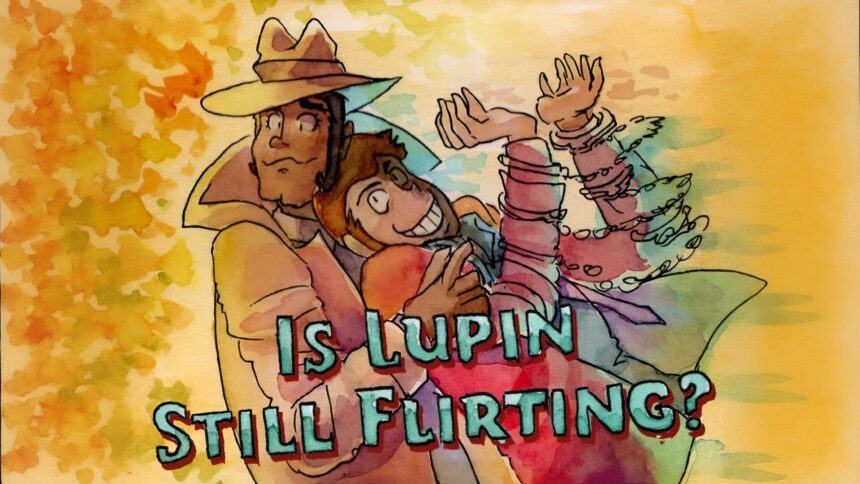
Inspector Zenigata has finally managed to handcuff Lupin the Third, and the two are stuck together on a train headed toward prison. Lupin has no gang or elaborate gadget waiting to solve the problem for him. Instead, he decides to exploit something much more personal, Zenigata’s longstanding crush on the thief he has spent so much of his life chasing. The setup is ridiculous enough to work as a joke immediately, but I was surprised by how quickly the joke turned into a believable excuse to examine their relationship.
That balance comes largely from the writing. AlexisRoyce and Tsushi split the roughly 14,000-word script between them, with Royce later describing the target as mostly the energy of the English dub with a smaller amount of the original Japanese characterization mixed in. I could feel that preference in the speed of the exchanges. Lupin keeps pushing because confidence is his strongest weapon here, while Zenigata has to maintain the authority of the man who finally caught him without pretending that their history means nothing. Their banter kept me smiling, but the better lines were the ones that made the flirting feel like an extension of a rivalry rather than a completely different relationship pasted on top of it.
I also appreciated that the game does not need a huge cast to keep that conversation moving. Lupin and Zenigata are the point, and confining so much of the story to their train ride forces the script to keep finding new angles on the same pair. One choice can make Lupin more brazen, another can let a softer implication hang for a moment, and the responses gradually reveal how much emotional leverage exists underneath the chase. Because the developers wanted the comedy to carry the energy of Lupin the Third Part II’s English dub, the silliness never felt accidental to me. It is built into the version of these characters the game wants to celebrate.
The art gives that celebration its own identity before the choices have much time to branch. Every visual asset was traditionally painted in watercolor and then scanned, with fountain pen also used in the presentation. AlexisRoyce handled the artwork and even pushed the watercolor approach into the menus instead of limiting it to portraits or occasional CGs. That commitment mattered to me because the slight physical irregularity of traditional media fits two characters whose expressions need to carry so much of a dialogue-heavy game. I kept noticing faces and poses rather than treating the sprites as placeholders between lines, which is exactly what I want when most of my time is spent watching two people talk.
That visual workload becomes more impressive in context. Is Lupin Still Flirting? was made for NaNoRenO 2021, and the project was built over the course of March as a deliberately smaller game. Royce was working on sprites, backgrounds, CGs, and GUI elements in watercolor during development, with Tsushi and Cammie also helping on the project. The finished release arrived at the start of April with four endings. I would normally expect a one-month production schedule to expose obvious compromises, yet the hand-painted presentation never gave me the feeling that the art was merely there to satisfy a deadline.
Choices matter most once I start testing how far Lupin can push the conversation. Four endings give the short story enough variation that replaying does not feel absurd for something whose itch.io page lists an average session around half an hour. I liked being able to go back with a different attitude and see another direction without committing to another long visual novel route. Completing more endings also fills out achievements, and there is a secret unlockable bonus scene for players who keep digging. A sprite gallery provides another small reward for completion, and an early bug that hid its bottom row was fixed in version 1.01 just after launch.
The soundtrack takes a much simpler role. The official description calls it jazzy, and that is the part of the audio presentation I could attach most clearly to the game’s playful tone. It never competed with the watercolor art for my attention, but I preferred that restraint here. A short conversation-driven comedy does not need its music constantly announcing how funny or romantic a scene is, and I was happier letting the rhythm of Lupin and Zenigata’s exchanges stay in front.
There is no performed voice cast carrying those exchanges. Instead, the Ren’Py build includes self-voicing, which can be activated with the V key so dialogue and interface buttons can be read aloud. I liked seeing that functionality in such a small free project, although it has a real limitation. The developer has explained that the interface still requires mouse use rather than allowing every option to be reached entirely through keyboard navigation, and the game does not include image descriptions. That makes the feature useful without turning it into something more comprehensive than it actually is.
By the time I had seen the relationship bend in several directions, the part I cared about most was no longer whether Lupin could escape. The script lets Zenigata’s feelings exist as more than a punchline, and that changed how I read the comedy around them. I could laugh at his frustration without feeling that the game itself was laughing at him for caring. When warmer moments arrived, they felt earned by all the sparring that came first. I will not identify which choices or endings push that side furthest, because discovering where each version of the conversation leads is most of the reason to replay it.
Verdict
Is Lupin Still Flirting? worked for me because it understands that the joke and the affection do not have to compete. The short train ride gives Lupin and Zenigata enough room to be ridiculous, stubborn, and unexpectedly warm without stretching the premise past its limit. Its watercolor presentation gives the fangame a visual identity I remembered immediately, while the branching choices make revisiting the conversation worthwhile. The mystery is not whether these two matter to each other. The fun is seeing how much either one is willing to admit once there is nowhere on the train to hide.