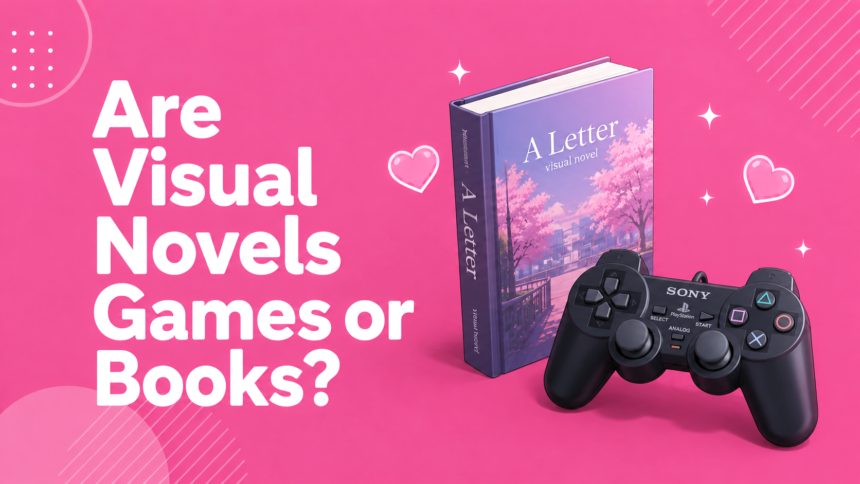
The first time someone encounters a visual novel, they usually reach for the nearest familiar category. It looks like a game — it runs on a console or a PC, it is sold on Steam, it has a menu screen and a save system. But then you start playing and realize you are mostly just reading. So maybe it is a book? It has music, voiced characters, and illustrated artwork that shifts with every scene. Sometimes it asks you to make choices that change where the story goes.
So are visual novels games or books? Are they interactive fiction? A graphic novel? An anime you participate in?
The honest answer is that a visual novel is not cleanly any of these things — and forcing it into one category tends to obscure what makes the medium genuinely interesting. This article takes that question seriously: not to arrive at a tidy label, but to understand what visual novels actually are by examining what they share with other mediums, where they depart from them, and what that departure makes possible.
The Case That Visual Novels Are Games
By almost every practical and commercial measure, visual novels are video games.
They are developed using game engines and sold in gaming storefronts — Steam, the PlayStation Store, the Nintendo eShop. Gaming publications review them, gaming databases catalogue them, and physical retailers shelve them in the games section. The people who make them are game developers, and the people who experience them are, at minimum, called “players.”
Visual novels also share structural features with games: menus, save slots, settings screens, and achievement systems. They are interactive — players make decisions that affect outcomes. They have multiple endings, which is a game design concept. The completionist culture around visual novels — the drive to see every route, unlock every CG, reach every ending — is thoroughly game-like in its orientation.
When Visual Novels Are Genuinely Games
Some visual novels are substantially games in the action sense. Phoenix Wright: Ace Attorney has investigation segments and cross-examination mechanics. Danganronpa includes minigame sequences during class trials. 999: Nine Hours, Nine Persons, Nine Doors is built around escape room puzzles. These titles blend visual novel storytelling with interactive gameplay in a way nobody would hesitate to call a game.
The “it’s a game” argument is not wrong. It is just incomplete.
The Case That Visual Novels Are Books
Here is what the “it’s a game” framing misses: the primary activity in a visual novel is reading. Not reacting, not strategizing, not competing — reading.
Sit down with Clannad, Steins;Gate, or The House in Fata Morgana and what you are doing, for the vast majority of your time with it, is reading prose — narration, dialogue, a character’s inner thoughts. The text is the substance of the experience in a way that simply is not true of almost any other game. In most games, text is supplementary — lore you can ignore, tutorials you skip, dialogue you click through to get back to the action. In a visual novel, the text is the action.
Visual Novels as Literature
This makes visual novels far more literary in orientation than games typically are. The craft that matters most in a great visual novel is writing craft: the quality of the prose, the depth of the characterization, the architecture of the plot, the management of tone, pacing, and theme. When fans discuss why Steins;Gate is brilliant or why Clannad’s After Story is devastating, they reach for the language of literary criticism — narrative structure, character arc, thematic resonance — not the language of game design.
The length of major visual novels also aligns them with literature rather than games. A typical commercial visual novel runs 30 to 80 hours. Fate/stay night contains roughly 800,000 words across its three routes — comparable to the complete works of a substantial novelist. You do not experience something for that long the way you play a shooter or a platformer. You read it. You live with it.
Many visual novels are explicitly literary in ambition too. They are not trying to be fun the way games are fun. They are trying to be affecting the way great novels are affecting — to leave the reader changed, moved, unsettled, or enlarged.
The “it’s a book” argument is not wrong either. It is also just incomplete.
Where the Categories Break Down
The problem with forcing visual novels into either category is that doing so requires ignoring the parts that do not fit.
Call it a game, and you have to explain why it barely has any gameplay. The interactivity is minimal — choices are narrative rather than skill-based, and for long stretches there are no choices at all, just reading. If gameplay defines a game, visual novels are games in name only.
Call it a book, and you have to explain the music, the voice acting, the artwork, the save system, the branching structure, the CG gallery, and the multiple endings. A book does not have a soundtrack that shifts with the scene. A book does not have a character whose voice you can hear or whose expression you can watch change in real time. A book does not ask you to replay it to uncover paths you missed.
Neither category accommodates what visual novels actually do — and that is not a failure. It is a sign that visual novels are doing something neither books nor games do.
What Visual Novels Actually Do
To understand what visual novels are, it helps to examine what each component contributes and what happens when those elements work together.
The Text Does What Literature Does
The prose in a visual novel does everything prose does in a novel. It builds character through voice and observation, creates interiority — access to a protagonist’s thoughts and emotional life that cinema and conventional games rarely achieve — and uses pacing, rhythm, imagery, and structure to generate meaning. It can be written well or badly, and the difference matters enormously to the experience.
Visual novel writers are, in a meaningful sense, novelists. The best of them — Kinoko Nasu, Jun Maeda, Ryukishi07 — have literary sensibilities and literary ambitions. They are not designing systems. They are writing stories.
The Visuals Do What Cinema Does
The art in a visual novel gives the world and its characters a concrete aesthetic identity. You see what the protagonist sees and watch a character’s expression shift as they receive difficult news. You absorb the atmosphere of a setting — a twilit school corridor, a cluttered basement laboratory, a meadow in summer — in an instant, the way a film shot establishes a location.
The CG system — full-screen illustrations appearing at key moments — functions like the close-up in cinema. It signals importance. It says: this moment matters, look at it carefully. The emotional impact of a CG landing at exactly the right story beat is something unique to visual novels, something neither a purely textual description nor a conventional cinematic shot quite replicates.
The Music Does What Film Scores Do — But More So
In cinema, music is a supporting element. In visual novels, it is closer to a co-equal one. Because the visual presentation is largely static — backgrounds and sprites rather than animation — the soundtrack carries more of the moment-to-moment emotional weight than it would in a film. The music tells you how to feel about what you are reading before the text fully delivers its meaning. It creates anticipation, shifts atmosphere, and can make a quiet scene feel peaceful or ominous depending entirely on what is playing underneath.
The best visual novel composers understand this deeply. A piece of music in a visual novel is not illustrating action — it is inhabiting an emotional space and inviting the reader into it. When a theme associated with a character throughout dozens of hours plays at their most significant moment, the accumulated emotional weight of every previous hearing arrives all at once.
The Interactivity Does Something Unique
Here is where visual novels depart most sharply from books, and where asking are visual novels games or books becomes most interesting.
The choices in a visual novel are not skill challenges. There are no puzzles with correct answers — just decisions, the same kind you make in your own life, often without clear right answers and often with consequences you cannot fully anticipate. This means the interactivity serves a specifically narrative purpose: it creates investment. When you choose how your protagonist responds to a situation, you become responsible for what happens next. The story is no longer entirely someone else’s — you participated in it.
This is fundamentally different from the interactivity of conventional games, where agency operates in a physical or strategic sense — movement, combat, resource allocation. In a visual novel, the interactivity is internal. It is about identification, investment, and emotional stakes. You are not controlling a character so much as inhabiting one. When things go wrong — a bad ending, a character’s death, a relationship that fails — the failure feels personal in a way that game failure typically does not. You were there. You made those choices.
The Specific Things Visual Novels Can Do That Nothing Else Can
This combination of elements creates capabilities unique to the medium.
They Can Sustain Interiority at Scale
A first-person visual novel can spend 80 hours inside a single character’s head, giving the reader access to every thought, every doubt, and every moment of private emotion. Books are capable of this in principle, but visual novels achieve it with an additional layer of sensory reinforcement — the character’s face is visible, their voice is audible, the music reflects their emotional state — making the immersion deeper and more total.
By the time a long visual novel ends, the reader knows the protagonist with an intimacy that few other narrative forms can approach. The relationship is not like watching a character in a film or following one through a novel. It is closer to having lived alongside someone for months.
They Can Use Medium Conventions as Narrative Material
Because players arrive at visual novels with genre expectations — an understanding of how the format works and what its conventions are — clever writers can use those expectations as raw material for the story itself.
Doki Doki Literature Club! is the most famous example. It presents itself as a cheerful school romance, follows that genre’s conventions with apparent sincerity, and then systematically turns the player’s familiarity with them against them. Events unfold that are only possible in a visual novel — things that break the fiction of the game itself, implicate the player directly, and could not be replicated in any other medium. The horror of DDLC is not just content horror. It is medium horror, unsettling in a way specific to what visual novels are.
This kind of meta-narrative play is possible in any medium — postmodern novels break the fourth wall too — but visual novels achieve it with unusual intimacy and immediacy because the player is already more invested, more implicated, and more present than a passive reader typically is.
They Can Make Emotional Payoffs Hit Harder Through Accumulated Time
A film has two hours to make you care about its characters. A novel has however many pages you read over a few days or weeks. A visual novel has 60 or 80 hours of continuous, concentrated attention — and every one of those hours can be used to build characters, deepen relationships, and accumulate emotional weight before the most important moments arrive.
The payoffs in great visual novels hit with a force directly proportional to that investment. When something devastating happens in Clannad, Little Busters!, or Steins;Gate, it lands with a power those works earned — not through shock or manipulation, but through the simple fact that you have spent many hours genuinely caring about these people. The medium’s length is not a flaw. It is how the most affecting experiences in visual novels become possible.
They Can Tell Multiple Complete Stories Within One Work
The multi-route structure of most visual novels allows a single work to contain multiple complete narratives. Each route is its own story, arc, and emotional journey. Together they create something richer than any single narrative — a world explored from multiple perspectives, with multiple facets of its characters illuminated through different story paths.
Some visual novels use this structure brilliantly, designing routes that comment on each other, reveal information that recontextualizes everything read before, and build toward a true ending that synthesizes all that came before it. Ever17: Out of Infinity and Umineko When They Cry are perhaps the most elaborate examples — works whose full meaning only becomes accessible once you have navigated their entire structure.
No book works this way. No film works this way. It is a structural capability unique to interactive narrative, and visual novels have developed it further than any other format.
The Medium That Grew Up in the Gap
Visual novels did not emerge from a deliberate attempt to create a new medium. They grew organically from the limitations and possibilities of Japanese personal computing in the 1980s — from the gap between what early hardware could do visually (not much) and what it could do textually (quite a lot). Developers filled that gap with writing, and the result turned out to have capabilities neither books nor games possessed.
This origin matters because visual novels are not a compromise between two better things. They are a form that emerged from specific constraints and developed its own expressive logic.
Why the Apparent Weaknesses Are Actually Features
The visual novel’s perceived limitations, seen from the outside, are actually features of its design. The static imagery is not a substitute for animation — it allows the music and text to carry emotional weight they could not carry if the visuals were competing with them. The minimal gameplay is not a failure to be a real game — it is a choice to prioritize narrative investment over mechanical engagement. The long runtime is not self-indulgence — it is how the medium builds the emotional depth it needs to achieve what it sets out to do.
Why Comparing Visual Novels to Other Mediums Gets Them Wrong
Critics who approach visual novels as games tend to find them lacking — not enough gameplay, too much reading, too passive. By game standards, that critique is coherent. Critics who approach visual novels as books tend to find them padded and slow, reliant on genre conventions, and insufficiently literary. By the standards of prose fiction, that critique is also coherent.
Both miss the point because they evaluate visual novels against the wrong criteria. A visual novel is not trying to be a good game or a good book. It is trying to be a good visual novel — and that is a different project with different criteria for success.
The question that matters when evaluating a visual novel is not “does it have satisfying gameplay?” or “is the prose at the level of literary fiction?” The real question is whether the combination of writing, art, music, and interactivity creates a genuine and affecting emotional experience. Does it make you care about characters as people? Does it use its unique structural capabilities to tell a story that could not be told in any other form? Does it leave you different from how it found you?
By those standards, the greatest visual novels rank among the most powerful storytelling experiences available in any medium — achieved not by approximating something else, but by being fully and confidently what they are.
So, Are Visual Novels Games or Books?
They are something in between — but “in between” undersells it. In between implies a compromise, a middle ground, a place that is less than either pole. Visual novels are not less than games or less than books. They are more than either, combining the interiority of literature, the aesthetic experience of cinema, the emotional power of music, and the personal investment of interactive choice into a single form.
The space they occupy is not a gap between existing categories. It is a territory those categories do not cover. Over forty years of development, the visual novel medium has built something substantial in that territory — a body of work that has moved millions of readers, influenced anime, manga, games, and film, and demonstrated again and again that a form can be more powerful precisely because it refuses to be any one thing.
Visual novels are their own thing. That is the answer. And it is a more interesting answer than either alternative.