Yes — visual novels are interactive. But the more useful answer to that question is that interactivity in visual novels works differently from interactivity in most games, exists on a wide spectrum across different titles, and is a more contested and interesting concept than the simple yes or no suggests.
If you are wondering whether visual novels require any input from you, or whether they are passive like films and books, this article explains exactly what kind of interaction is involved, how much it varies between titles, and what it actually means to be an interactive reader in this medium.
The Baseline: Even Advancing Text Is Interaction
Every visual novel, without exception, requires you to do something to move the story forward. You click, tap, or press a button. The story does not continue until you tell it to. This distinguishes visual novels from every passive medium — a film plays whether you engage or not; a visual novel waits.
This sounds trivial, but it is not. The pacing of every scene is in your hands. You control how long you spend with each line of dialogue, whether you read slowly or advance quickly, when you pause and when you continue. The text box is persistent, not timed. That simple act of advancing text, repeated across tens of thousands of individual lines in a major visual novel, is a genuine form of participation — one that creates a reading rhythm unique to the reader, different every time.
As researchers Camingue, Cartendottir, and Melcer noted in their academic survey of visual novel definitions, even the most minimal visual novel remains distinct from its non-interactive counterparts because it shows one piece of text at a time as the player interacts with it, rather than presenting a finished fixed object.
The Main Layer: Choices and Branching Narratives
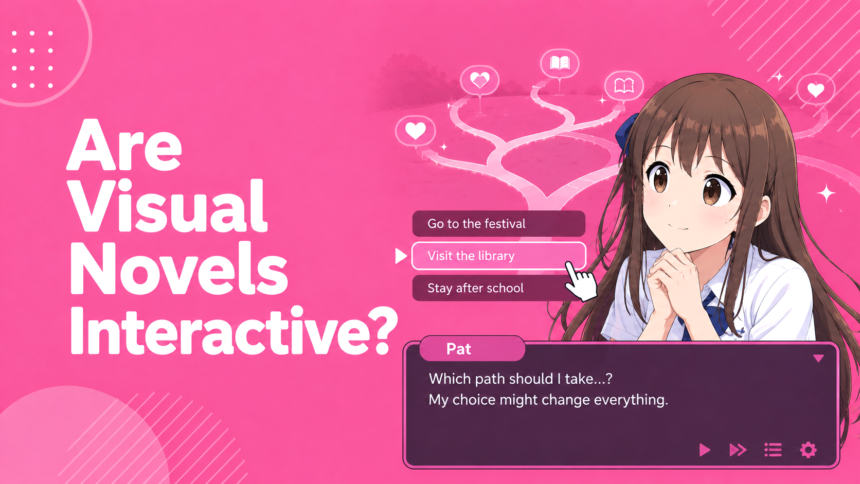
Most visual novels go substantially further than text advancement. The majority feature choice points — moments where a menu appears and you select from two or more options, each leading the story in a different direction.
These choices vary enormously in what they do. Some immediately branch the narrative into a completely different scene. Some shift the story only slightly at the moment of selection but accumulate across many choices to produce a different outcome at the end. Some appear to have no immediate effect but quietly adjust relationship variables or hidden story flags that determine which ending the player reaches. And some, of course, lead directly to dead ends — the “bad endings” that send you back to try again with a different approach.
Steins;Gate is a particularly well-regarded example of non-obvious choice design. Its meaningful decisions come not from traditional choice menus but from your character’s phone: which text messages you respond to, which calls you answer. The interactivity is woven into the fiction rather than presented as an external menu, making it feel more organic. 428: Shibuya Scramble takes this further still — it tells five simultaneous storylines and the choices in each one affect what other characters in other storylines can do, creating a puzzle-like interlock that makes the whole structure feel like a game in the traditional sense.
At the more expansive end, Clannad contains dozens of branching routes with entirely distinct character stories, each unlocking content that affects the others. Completing all routes is required to unlock the true ending. The full structure of the novel only becomes visible across multiple playthroughs, each revealing something that earlier playthroughs could not. Steins;Gate 0 has six distinct endings and two main story branches. 428: Shibuya Scramble can produce 85 different bad endings depending on choices across its five parallel storylines.
This branching structure is why the medium is described as interactive fiction rather than simply fiction, and it is also what makes visual novels genuinely replayable in a way that books and films are not. For more on how the reading experience compares to other formats, our piece on whether visual novels count as reading explores this connection in depth.
The Exception: Kinetic Novels
A minority of visual novels have no choices at all. These are called kinetic novels — a term that originated from Visual Arts’ KineticNovel label, which used it to distinguish their linear titles from branching ones. The name stuck and is now the standard term for any fully linear visual novel.
In a kinetic novel, the only interaction is advancing the text. There are no choice menus, no routes, no alternate endings. The story proceeds from start to finish as a single fixed narrative. planetarian: the reverie of a little planet is perhaps the most beloved example — a three-to-four-hour story with no branching that is widely regarded as one of the finest examples of what the format can do as pure storytelling. The original releases of Higurashi: When They Cry are also kinetic novels, despite being among the most celebrated entries in the medium.
Kinetic novels sit at the low-interactivity end of the spectrum but are not passive. The reader still controls pace, still decides when to continue, still brings their full interpretive attention to the text — they simply do not change the direction of the story. Whether that constitutes meaningful interactivity is a genuine question, which is part of why kinetic novels are sometimes considered a distinct format from visual novels proper. Our dedicated article on what a kinetic novel is covers this format in full.
The High End: Gameplay Hybrids
At the opposite end of the spectrum from kinetic novels are visual novel hybrids that incorporate substantial gameplay alongside the reading experience.
The Ace Attorney series weaves courtroom cross-examination and crime scene investigation into its visual novel structure. The Danganronpa series adds minigame-style class trials, investigation sequences, and action elements between its novel segments. The Zero Escape series — 999, Virtue’s Last Reward, and Zero Time Dilemma — combines extensive escape room puzzle sections with branching narrative that requires solving both the puzzles and the story structure to reach the true ending. Some titles incorporate rhythm games, strategy RPG battles, fighting game mechanics, or management sim elements.
These hybrids are visual novels in structure and sensibility — story-led, character-focused, text-heavy — but they offer mechanical depth that takes interactivity well beyond narrative choice into traditional game territory. They are often the most accessible entry points for readers coming from conventional gaming backgrounds, because the mechanical engagement provides familiarity while the visual novel format delivers the storytelling.
The existence of these hybrids alongside fully kinetic novels is one reason why the question of whether visual novels are interactive resists a simple answer. The medium covers an extraordinary range.
What Interactivity in Visual Novels Actually Feels Like
The interactivity in a branching visual novel produces a specific kind of experience that no other medium quite replicates. When you make a choice and then live with its consequences across the next several hours of story, the responsibility feels personal. When a bad ending arrives because of decisions you made, it is your bad ending. When you finally reach the resolution you were working toward after multiple attempts, the satisfaction carries weight that a passive reader watching the same story cannot feel in the same way.
Researchers who study this describe it as a form of agency — the sense that your input shapes what happens, even when the actual range of outcomes was determined by the writer long before you arrived. Game theorist Jesper Juul’s framework for what constitutes a game — systems, goals, and variable outcomes shaped by player input — applies to branching visual novels directly: the narrative branching constitutes the system, reaching specific endings constitutes the goal, and choices produce the variable outcomes. Even when the choices feel constrained, the feeling of influence is real enough to deepen investment.
This is also why visual novels are described as interactive fiction rather than simply interactive. The interactivity is in service of the fiction — it is a tool for deepening your relationship with the story and characters, not a mechanical challenge in its own right. Understanding this shifts how you engage with the medium. You are not solving a puzzle when you make choices; you are exploring a world with genuine stakes, and the choices determine which parts of that world you see.
The Debate: Are Visual Novels Interactive Enough?
The question of how interactive visual novels are — and whether that interactivity is sufficient to call them games — has been discussed since the medium began reaching Western audiences. Critics of the format argue that limited choices and no mechanical challenge do not constitute meaningful interactivity. Fans of the format argue that narrative agency is a legitimate and underrated form of interaction, and that the definition of interactivity should not be limited to reflexes and mechanics.
This debate is extensively explored in our article on whether visual novels are games or books, which covers the full range of positions. The short version is that the answer depends heavily on what you think interactivity means — and that visual novels complicate narrow definitions in ways that reveal more about the limits of those definitions than about the medium itself.
What is not in serious dispute is that visual novels require ongoing engagement from the reader, respond to reader input, and can produce different outcomes based on choices made during play. By any reasonable definition, that is interaction. The degree and form of that interaction varies enormously across the spectrum of the medium — which is arguably one of visual novels’ most interesting qualities.
How to Engage With the Interactive Elements
If you are new to visual novels and want to get the most from the interactive layer, a few practical notes help.
Save frequently, especially near obvious choice points. The ability to return to any decision and explore a different outcome is one of the most powerful features of the format, and it costs nothing. Most visual novels have no penalty for saving anywhere, and using multiple save slots lets you branch freely.
Do not treat bad endings as failures. They are part of the intended experience — often providing information or emotional beats that the good endings cannot. Completing a visual novel properly means seeing all its endings, not just the best one. Our walkthroughs cover specific titles and help you find content you may have missed.
Pay attention to choices that do not seem immediately significant. Many visual novels use a system of accumulated small choices — relationship points, hidden flags, subtle affinity shifts — that determine which routes and endings become available much later. A choice that appears cosmetic may be doing significant work behind the scenes.
For the full practical guide to how visual novel interfaces work and how to use all their features, our dedicated piece on how to play visual novels covers everything in detail.
The Glossary of Interactivity Terms
Several specific terms describe visual novel interactivity that are worth knowing. A route is a distinct story branch following a specific character or narrative path. An ending — good, bad, or true — is one of the multiple possible conclusions. A flag is a hidden story variable set by a choice that triggers content later. A route lock means certain story paths only become available after completing others. The skip function fast-forwards through already-read content during replays. All of these are defined in the visual novels glossary if you need a reference.
Understanding these terms helps you engage with the interactive architecture of visual novels consciously rather than stumbling through it — and that conscious engagement is where the format’s distinctive pleasures live.