Penrith sits on the outskirts of Sydney, and Doug Lovett is only a few months from finishing high school with university firmly in mind. One night, he heads to a friend’s house to blow off steam. Beneath that routine, an ancient threat has started moving again. The Rainbow Serpent normally poses little danger when left unprovoked, but something has disturbed it, and Doug’s desire to leave Penrith becomes tangled with a problem much older than him.
I liked how Chapter 1 refuses to turn Doug into a heroic problem-solver just because horror has entered his life. He is an average student, prone to procrastination and quick anger, with a real desire to escape the town rather than save it. His resentment toward his father gives that urge somewhere personal to come from. The man moved the family to Penrith when Doug was younger, and drinking has become part of the strain at home. Doug’s mother works as a nurse at the local hospital, while his younger sister Natalia has learned to survive the same household differently.
Natalia became one of the characters I paid closest attention to because the contrast is so clean. She is in Year 9, carries herself with unusual confidence, and keeps looking for good in the people around her. Doug reacts to pressure by becoming angry and desperate to leave, whereas Natalia turns inward and tries to preserve some kindness. Seeing both responses come from the same family made the domestic material feel essential rather than decorative.
Chapter 2 changes the angle rather than simply pushing the timeline forward. Michelle becomes the viewpoint character, and the larger conflict with the Rainbow Serpent looks different once I am inside the head of someone who has spent years withdrawing from other people. She patrols alone and has been waiting years for the Serpent to reappear. That shift made me reconsider scenes I thought I already understood because Doug’s version of events had never given me access to Michelle’s reasoning.
The writing gets more interesting whenever it trusts those differences in perspective. Historia began as a kinetic novel, so Chapter 1 has no conventional choices, but Lucid A96 still uses Ren’Py in less obvious ways. The history log can matter, text can be manipulated, and hidden material rewards attention beyond simply advancing dialogue. I enjoyed being encouraged to watch the presentation instead of assuming every meaningful clue would arrive in a normal text box.
That also explains why the horror worked better on me as uncertainty than spectacle. The Rainbow Serpent is drawn from Australian Aboriginal tradition, but Historia reshapes that material for its own psychological thriller. The project later extended its interest in Aboriginal culture through an in-universe essay attributed to Natalia about bone pointing. I appreciated the effort to make the mythology and setting feel specifically Australian instead of treating the country as interchangeable scenery.
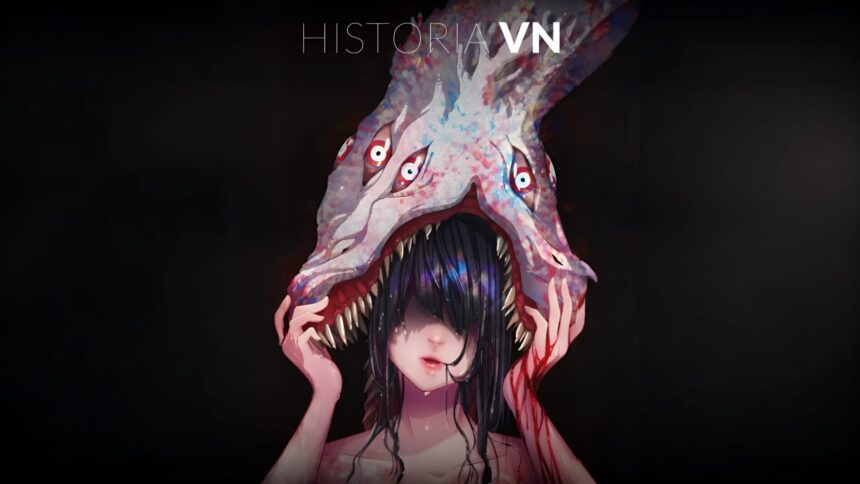
The art gives that setting a clear identity. Historia uses 2D illustrated character art and CG imagery, with NotImportant contributing prominently to the project artwork from early development. The character illustrations lean toward an anime-influenced style, while lighting and scene effects help darker moments feel unstable. Chapter 2 also treats video effects as part of the presentation rather than a separate flourish. Those touches worked best for me when they disturbed an otherwise ordinary scene without explaining themselves.
Sound is even more central. CplCrud handled extensive sound work for Chapter 1, with Beck helping on some effects, and the first chapter used around 150 sound cues. Chapter 2 added more than 150 additional cues. Foley was recorded specifically for the project, including homemade effects rather than relying entirely on stock libraries. I noticed those small noises more than I expected, especially when a quiet scene suddenly made me question whether something important had happened offscreen.
The soundtrack exists separately from that sound design, with high-resolution WAV releases made available during development, but the effects were what stayed with me. Horror often loses me when every tense moment is announced by music. Historia is more effective when an altered sound or brief audio cue makes me second-guess what I heard.
Voice work is limited rather than absent. Chapter 2 added Naba to the team for a voice contribution, but Historia is not built around a fully voiced cast. Most of my time with Doug, Natalia, Michelle, Max, and the others still came through text, art, music, and effects. That suited a story already asking me to scrutinize written information closely.
Lucid A96 grew from a much smaller beginning. Cam “CplCrud” O’Neill started Historia in early 2018 after Winter Comiket, then gathered an international group of artists, musicians, programmers, and writers around it. He had previously joined the Katawa Shoujo project in 2007 and co-wrote Hanako’s path with Suriko, but Historia was established as its own project. Everyone involved in the early production was contributing as a volunteer, and the demo was self-funded before Chapter 1 arrived in January 2020.
That production history became long. Chapter 2 released in January 2022 after the team missed its original Winter Comiket target, with the pandemic disrupting schedules and reducing uninterrupted development time. Chapter 3 took longer. Family changes, unfinished art, testing, and other production work continued through the following years before the complete three-chapter release was announced in October 2025. The later material feels more technically ambitious, which made the long gap easier for me to understand once I saw how much the presentation had expanded.
The final itch.io release now packages all three chapters together for Windows, macOS, and Linux. I would not want to read them out of order. The perspective shifts depend on earlier knowledge, and some of the most satisfying moments come from realizing that an apparently settled detail was only settled because I had seen it through one person’s eyes. Emotionally, that is where Historia stayed strongest for me. I was less frightened by the idea of a creature under Penrith than by the possibility that memory, perspective, and personal history could stop giving me reliable ground. Michelle’s chapter sharpened that discomfort, while Doug and Natalia gave it a more personal edge through two very different responses to the same strained home.
The trilogy does ask for patience. Its hidden material, altered perspectives, family drama, mythology, and technical tricks can make the narrative denser than the opening suggests. I occasionally wanted a cleaner line through all of it. Still, the density felt purposeful more often than confusing, and I preferred a story willing to leave me thinking over one that explained every strange detail before the credits.
Verdict
Historia – Chapters 1-3 worked for me because Penrith never became just a backdrop for a monster. Doug’s impatience, Natalia’s resilience, and Michelle’s isolation each changed the way I understood the same town, while the Rainbow Serpent gave those personal problems a larger threat to push against. The visual presentation, detailed sound design, and Ren’Py tricks make the trilogy feel more ambitious than a straightforward kinetic novel, even when its layered mystery becomes demanding. I finished it remembering the people more clearly than the creature, and for this kind of psychological horror, that was the stronger result.