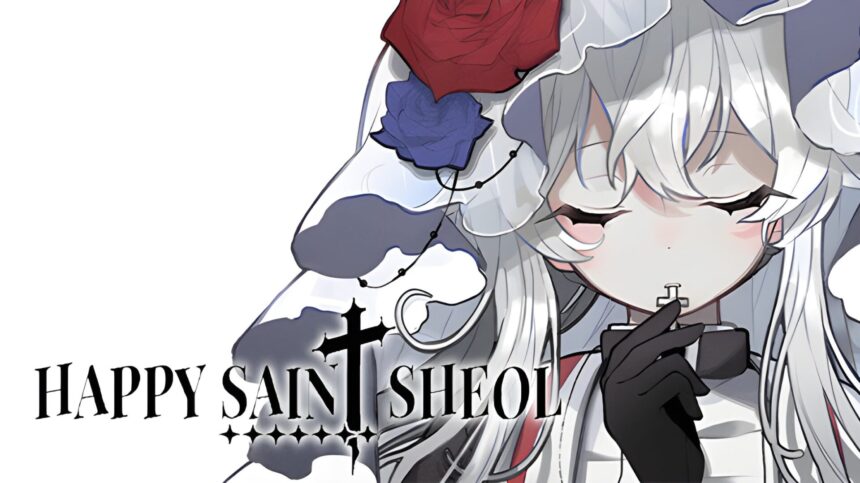
Going in, I expected another moody indie visual novel trading on gothic imagery and a vaguely religious title without much substance behind it. HAPPY SAIN† SHEOL spends its opening hours proving that assumption wrong, one uncomfortable revelation at a time. Two thousand years before the story begins, a catastrophe called the Pestis swept across the world, corrupting nearly everything living and rendering most of the land unfit to survive on. A single male survivor received a message from God alongside a strange scar and used that gift to rebuild a nation from the wreckage. Every person born after that point carries a version of that same mark, a star shaped scar called a Stigmata that appears sometime before adulthood. In the present, only the Capital remains magically shielded from the Pestis, though scattered closed off villages keep clinging to life outside its protection. Belial, the protagonist, leaves one of those villages with a distant relative’s help to start an adult life at the temple of Saint Sheol, the institution built specifically to hold back what the Pestis left behind.
The temple runs on four departments, each managed by its own bishop, and the specifics of each one do real work establishing how this society actually functions. The Magic Department trains exorcists and mages to fight the Pestis directly, and since black hair correlates with strong sacred power here, its ranks lean heavily on old, politically connected bloodlines. That structure gives the story a real institutional backbone too, since which department someone belongs to says as much about their social standing in the Capital as their actual job responsibilities do. The Academics Department studies the Pestis itself alongside whatever fragments of pre-catastrophe humanity survive. The Health Department handles the temple’s wellbeing more broadly, running the cafeteria and laundry alongside its medical duties. The Cleanup Department was reorganized from an older group called the Disposal Team just three years before the story starts. It handles anything too dangerous or grim for a single person to manage alone, corpse retrieval included. New arrivals spend their first month in Cleanup before transferring anywhere else, which is exactly where Belial ends up. He can rename himself from his default name of Belial, nicknamed Bel, right from the start too, a small customization option that lets a reader make the protagonist feel more like their own.
Belial isn’t told the full reason he was brought to the temple. Underneath the cover story sits an arranged marriage already being planned for him with the heir to one of the Capital’s most influential mage families. Maya joins him as a fellow rookie in the Cleanup Department, her timid, insecure personality clashing openly with how harsh the job actually is. That gives Belial at least one person going through the same disorienting introduction to temple life. Haku, the Cleanup Department’s own bishop, brings an airheaded, unhurried presence during the day that shifts into something brighter and considerably less mannered once night falls. Clione, daughter of the wealthy Myosotis family that keeps the temple funded through frequent donations, adds a talkative, overbearing curiosity that pulls Belial into conversations he’d rather avoid. Lavieen, the Academics Department’s own auxiliary bishop, rounds out the group Belial crosses paths with early on, cheerful and talkative despite bouts of sleepwalking tied to lingering Pestis effects. That’s the kind of small physical toll the setting extracts from nearly everyone living close enough to the disaster’s aftermath. All of that groundwork pays off early, when Belial receives a dream visitation from an angel who simply tells him not to worry, a small, disarming moment that plants the mystery driving the rest of the story without giving away where it actually leads.
Writer Hanami balances that mystery against a tonal mix that could easily have collapsed into incoherence: horror, gore, and romance sitting inside the same scenes without the story fully tipping into any single one of them. The worldbuilding carries a lot of that balance, since the political weight behind the Magic Department’s bloodlines and the grim practicality of the Cleanup Department both feel like they’d hold up under more scrutiny than a typical genre visual novel usually invites. The density does ask something of the reader early on, four departments, a two thousand year backstory, and a cast introduced in quick succession is a lot to track before the personal stakes fully click into place. That density pays off once the personal stakes actually click into place though, since every piece of worldbuilding established early ends up mattering again later rather than sitting as pure decoration.
Art direction and general presentation come from RaV², working in a pixel graphics style that stands out immediately against how most horror leaning visual novels in this genre space typically look. It’s an old school aesthetic choice, closer to retro RPG sprite work than the painted CG style this kind of story usually reaches for, and it gives the temple and its cast a distinct visual identity rather than blending into a crowded genre. Facial expressions and small animation touches carry more of the emotional weight than the pixel format might suggest at first glance, working around the style’s inherent limitations rather than fighting against them.
HUNGRYCULT, a doujin circle that went by the name 122pxsheol before rebranding, built HAPPY SAIN† SHEOL as its debut visual novel release. That doujin origin shows in how confidently the game commits to its own specific tone rather than smoothing itself into something more broadly commercial. HUNGRYCULT has since confirmed a prequel, HAPPY SAIN† ZERO, and a spinoff centered on Maya specifically, HAPPY SAIN† SHEOL ~Dead Girl Maya~, both currently in development alongside the planned main series continuation. Between three currently confirmed titles across a single continuity, HUNGRYCULT is building something with real scope for a circle this new to the format.
Composer Puryu backs that visual choice with a score built to shift alongside the story’s genre whiplash, carrying scenes from quiet dread into something warmer without either mode feeling like it belongs to a different game. Individual tracks lean into dissonance during the Cleanup Department’s grimmer moments specifically, then pull back into something almost tender once a scene turns toward one of the temple’s quieter relationships.
There’s no voice acting anywhere in this release, leaving the pixel art and Puryu’s score to carry every scene’s emotional weight on their own. Given how much tonal ground the script covers, performed dialogue could have sharpened some of the harder emotional turns, though the presentation holds up reasonably well without it.
Content warnings are worth taking seriously here too. The game includes graphic gore, amputation among the specific examples the developer flags directly, presented in stark contrast to the otherwise cute character art, though a settings toggle lets readers turn off the display of those gorier scenes entirely if they’d rather skip them. That toggle matters given how much the game leans on the gap between its cute art style and the actually unpleasant content some scenes actually depict.
The version history here is worth knowing before picking it up. Developer HUNGRYCULT, working under the name 122pxsheol, first released the game in Japanese only through booth.pm in August 2022, in a build that included explicit content. That version got delisted in March 2023, replaced by a trimmed down R15 edition that was itself delisted by December of that year. A patch applied in May 2023 further adjusted the adult content before the current build became the official one. Sekai Project brought that version to Steam on September 18, 2024, with English, Korean, and Simplified Chinese localization, and players who want the explicit material back can pick up a separate Content Restoration DLC through Sekai Project rather than finding it baked into the base release. A major update in December 2025 added a cheat menu for easier replays, Steam achievements, and a near complete revamp of the game’s CG artwork. Most of it was either redrawn outright or moderately edited from the original Steam launch build. That steady stream of post launch support, spanning more than a year after the initial Steam release, tracks with a small team still actively refining a project they clearly haven’t considered finished.
This is also the first entry in what’s planned as a larger Happy Saint Sheol series, and it carries the fan shorthand Happisei, or HSSH, among people already following it. A free demo, expanded from an earlier trial release, arrived on Steam in December 2023 ahead of the full launch, giving newcomers a way to sample the temple and its politics before committing to the whole thing. Extras in the full release include a gallery and a dedicated lore mode, useful additions given how much world context the story is working with underneath its central mystery. That lore mode specifically breaks down the four departments and the Pestis backstory into reference entries, useful for anyone who wants to double check a detail without having to scroll back through prior dialogue.
Verdict
HAPPY SAIN† SHEOL is an ambitious debut that earns its density, building a thought out temple hierarchy and a two thousand year backstory around a mystery that starts small and stays compelling. The pixel art sets it apart visually, and the writing juggles horror, gore, and romance more steadily than that combination usually allows, even if the opening hours ask for real patience while everything gets established. Few debut releases from a first time doujin circle commit this fully to a specific, uncompromising tonal identity right out of the gate.