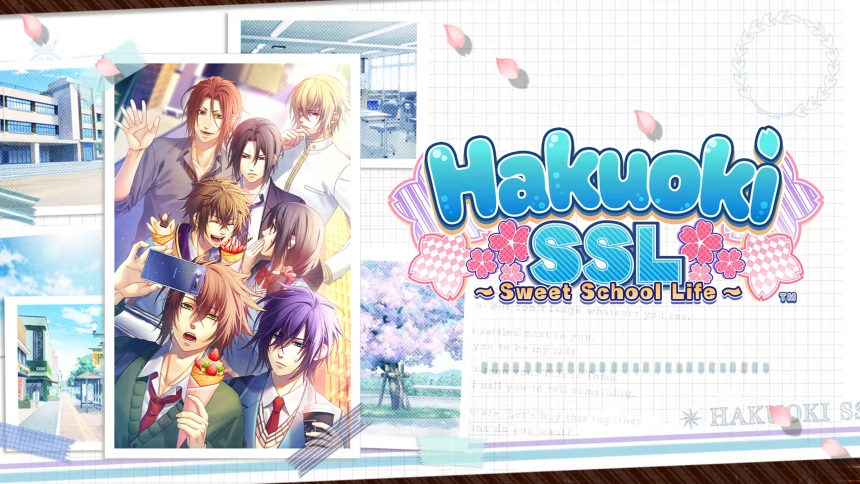
Chizuru Yukimura enters Private Hakuo Academy during its first year as a co-ed school, only to discover that she is its sole female student. Familiar Hakuoki characters surround her, except the Bakumatsu setting has been traded for classes, clubs, festivals, exams, and other pieces of modern school life. Hijikata is the vice principal and a classical literature teacher, Harada teaches health and physical education, Shinpachi teaches math, while Okita, Saito, Heisuke, and others occupy student roles. The personalities underneath those new positions remain recognizable, which kept the alternate universe from feeling like the original cast had simply been dropped into different costumes.
That consistency is where much of the comedy worked for me. Saito’s seriousness fits naturally into school discipline, while Okita still has plenty of opportunities to needle the people around him. Shinpachi becoming a teacher is funny without requiring him to become a completely different person first. I laughed more when familiar personality traits collided with ordinary school problems than when the setting itself supplied the joke, and playing the premise straight kept it from turning into a prolonged parody.
Chizuru benefits from the change just as much. Instead of navigating the violence and political instability associated with the main Hakuoki story, she gets an entire school year of comparatively ordinary milestones. Hakuoki SSL runs from a prologue through seven episodes, with midterms, summer activities, the school festival, winter events, and Valentine’s Day forming parts of that calendar. Once I stopped expecting the story to manufacture larger threats, I started enjoying the simple novelty of seeing these relationships develop when survival was no longer hanging over every interaction.
The trade-off is that removing those stakes exposes how much momentum the historical setting normally provides. Some conflicts felt slight because there simply was not much happening beyond the immediate school problem, and the academy occasionally struck me as less developed than the premise allowed. With clubs, teachers, school rules, friendships, and so many established personalities sharing the same space, I wanted more situations that made Hakuo Academy itself memorable. The martial side particularly left me wanting more. Putting characters associated so strongly with swordsmanship into this setting creates obvious possibilities, and I never felt the school squeezed everything it could from them.
Romance gives the year more direction. Hijikata, Okita, Saito, Heisuke, Harada, and Kazama receive the principal routes, while Sannan, Shinpachi, Yamazaki, and Kaoru have shorter paths. I was especially glad to see some of those additional characters receive dedicated material instead of existing solely around the six main options. Kaoru also remains Chizuru’s twin brother in this setting, which lets his material operate differently from the central romances. The shorter paths naturally have less room to develop, but their presence makes SSL feel more interested in celebrating the wider Hakuoki cast than simply transplanting its most obvious romantic options.
Emails help sell the modern setting mechanically. Characters contact Chizuru during the story, and replying can earn points for Ryunosuke’s shop. Those points can be exchanged for extras such as CGs and system voices, with a mini-game skip ticket becoming available after its unlock requirement is met. Messages can also expire if Chizuru leaves them unanswered for too long. Checking her phone was a small addition, but I enjoyed having modern communication actually affect what I was doing instead of seeing smartphones added merely because the story no longer takes place in the nineteenth century.
The mini-games were much less consistent for me. They appear during various school events, with performance capable of affecting how scenarios proceed. The Valentine’s sequence can require clearing five randomly selected mini-games consecutively, and that turned a cute diversion into frustration much faster than I expected. The eventual ability to use a skip ticket makes repeated playthroughs easier, but by then I already knew which part of SSL I would happily remove from the experience. I wanted to get back to the characters rather than prove myself at another brief mechanical interruption.
At least the artwork embraces the lighter atmosphere completely. Shiki Sakigumi handled the original art, building on Kazuki Yone’s original character designs, while Takuto Sakura contributed chibi illustrations. Cheimi Mita served as background art chief, with Akihiro Hirasawa and Yoko Nakao credited for background layouts. Uniforms, teacher attire, classrooms, and other contemporary spaces do much of the work of establishing the alternate setting without erasing the visual traits that make everyone recognizable. The chibi illustrations were particularly well suited to the comedy, giving exaggerated moments somewhere to go without requiring the regular portraits to become equally cartoonish.
Music follows the same lighter direction. Yuki Tsuruta is credited for the background music, while Aika Yoshioka performs both the opening theme, “Yokan,” and ending theme, “Suisai Gradation.” Yoshie Isogai wrote the lyrics, with Yoshio Tsuru handling composition and arrangement. I preferred hearing SSL establish its own musical personality rather than trying to imitate the dramatic atmosphere of the historical entries. The school setting already asks these characters to occupy a completely different emotional register, and the soundtrack is comfortable making that change with them.
Keeping the Japanese performances intact provided the strongest bridge back to the Hakuoki I already knew. Shinichiro Miki voices Hijikata, Showtaro Morikubo voices Okita, Kosuke Toriumi voices Saito, Hiroyuki Yoshino voices Heisuke, Koji Yusa voices Harada, and Kenjiro Tsuda voices Kazama. Chizuru herself remains unvoiced. Hearing familiar performances attached to such mundane concerns became part of the appeal for me. The actors did not need to turn everyone into exaggerated comedy versions of themselves for the contrast to be funny.
The English version took a remarkably long time to arrive. Idea Factory and Design Factory developed the original PlayStation Vita release, which launched in Japan on March 27, 2014. A Japanese Nintendo Switch version followed on June 15, 2023. Eastasiasoft eventually published the first official English localization for Switch on February 12, 2026, retaining Japanese voiceovers with English text. The English Switch release also supports touch-screen controls, which I found particularly appropriate for some of the interface-heavy and mini-game portions.
By the later school events, the lack of serious conflict had stopped feeling like something the game needed to overcome. It is the reason this spinoff exists. I already know these characters in circumstances where decisions can carry brutal consequences, so watching them worry about exams, messages, festivals, friendships, and romance creates a different kind of attachment. That does make SSL slighter than the mainline experience, and there were stretches where I wanted more substance from the academy itself, but I never wanted it to manufacture tragedy simply to prove that the story mattered.
Verdict
Hakuoki SSL ~Sweet School Life~ works for me as a deliberately smaller visit with characters I already care about. Their personalities survive the move into modern school life well enough that the comedy rarely needs to force itself, while the email system, shorter character paths, Japanese performances, and bright presentation give the alternate setting its own identity. The mini-games wore out their welcome, and Hakuo Academy could have done more with the possibilities created by its cast. Even so, I enjoyed getting to know these characters in a world where an upcoming exam can legitimately qualify as one of their bigger problems.