You don’t see romantic comedies built around a two-timing premise very often, or at least not ones that treat the guilt as seriously as the jokes. Visual novels chasing a laugh a minute usually skip the parts where actions carry real consequences, and the ones that slow down for consequences usually lose the jokes along the way. Futamata Ren’ai: Two Times the Trouble is the rare one that keeps both halves running at full speed at once. I went in ready to roll my eyes at the setup and came out squirming through scenes I still couldn’t stop reading.
ASa Project built Futamata Ren’ai under director and main scenarist Amato, with Youka Nanoka handling scenario writing alongside UI, system, and production work. Amato has said the two-timing premise itself was a deliberate way to set this game apart from similarly styled brands like HOOKSOFT and SMEE. It flips the studio’s own earlier Renai X Royale, where heroines competed for the protagonist’s attention, into a story where the protagonist is the one juggling two people instead. The original Japanese release won the Best Scenario prize at the Moege Award 2022. That made a lot more sense once I’d seen how deliberately the guilt gets built into every scene.
Koga Nao is a sophomore at Aomi University who has spent years confessing his feelings to Nobuta Yua, a habit she mostly meets with arrogant indifference. His not-quite-friend Eiji drags him to a party hoping he will meet someone else. That night Nao wakes up beside Toiro Kirame, a half-Japanese exchange student he barely knows. Enough is missing from her memory of it that she assumes they are now a couple and expects him to take responsibility. Before he can sort that out, Yua responds to one of his confessions out of nowhere and claims him as her boyfriend too, leaving Nao secretly juggling two relationships neither girl knows exists. I kept waiting for the story to let him off easy. It never really does.
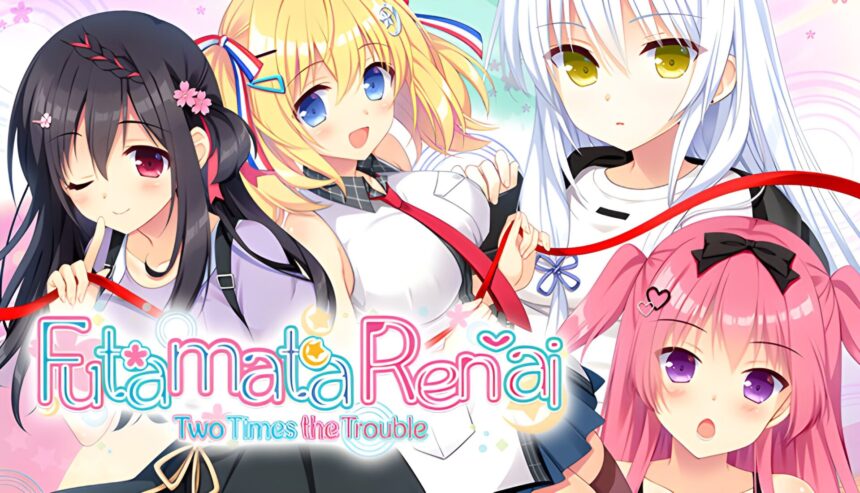
Yua carries herself like she is above the entire situation, confident and guarded in a way that reads closer to a final boss than a typical love interest. She put me off within her first few lines, all cool indifference with nothing underneath it that I could find right away. A playful, teasing side eventually slips through, and once it did I understood why Nao kept confessing for years despite getting nothing back. Kirame, recently arrived in Japan to study abroad and openly fond of takoyaki, presents as calm and courteous until she is overwhelmed. That composed mask starts to crack in a way that caught me off guard the first time it happened. Watching Nao try to keep both of them satisfied without either discovering the other’s existence gives even a simple date real tension. His attention constantly threatens to wander toward whichever girl he is not currently with.
What works best here is how connected the supporting cast is to each other, not just to Nao. Heroines maintain relationships and spend time together independent of him, and several of their motivations tie into one another as much as they tie into the central two-timing plot. The common route does real work establishing why everyone behaves the way they do. It also drops in some unexpectedly heavy material underneath the comedy, more than the premise’s pitch had led me to expect. The humor leans hard into characters who are oddballs at best and openly troubled at worst, Nao included, and that fixation-driven, slightly off-kilter view of relationships colors how he approaches both Yua and Kirame. More than once the banter landed somewhere between funny and mean enough that I wasn’t sure whether to laugh, which is exactly where this style of comedy is aiming.
The opening theme, “Koi no Miraizu,” is sung by Hanatan, written and composed by rian, and arranged by Yamashita Kosei of doubleeleven, who also handled part of the background score. The ending theme, “Zutto Zutto,” goes to Rin’ca. Both tracks lean sweeter than the story earns in its first stretch. That felt like a mismatch at first, and it only started to work once I noticed how much the common route was quietly setting up underneath the jokes.
Character art comes from three credited artists, Fuyuichi Monme, Yuuki Rika, and Yuunagi Seshina, with SD art handled separately by Takahero. Ninety CGs run across the release, eleven of them SD and five falling outside the standard CG format, not counting variations on top of that base count. More than one stopped me mid-scroll rather than just registering as another route milestone. The sprite work backing them carries enough expression variety to keep dialogue-heavy stretches from feeling static, with occasional light motion added without going fully animated. Every character except Nao himself is voiced, and the cast includes actors with prior credits on titles like Nukitashi, Koikari, and Tamayura Mirai. Nao staying silent while everyone around him talks took some adjusting to, but it settled into feeling like the right call the further the two-timing act went on.
Structurally, the common route splits into two paths early before branching further into individual heroine routes and side content for Rui and Miyako. Several save files are worth keeping handy if you want to see everything without backtracking constantly. This is the all-ages release, and a few of the individual heroine routes still lose momentum in their back half regardless, thinning out into repetition right when I wanted more character work instead.
On platforms like Steam Deck and Linux, video playback specifically affecting the opening and ending movies has needed an independently made compatibility fix, using override files, to run properly. That’s worth knowing if you are planning to play outside a standard Windows setup. Clearing a route unlocks a broader extras menu covering replayable scenes, a music gallery, and a sprite viewer, alongside a voice tab for revisiting lines from whichever girl actually won me over by the end.
Verdict
Futamata Ren’ai: Two Times the Trouble gets real mileage out of an interconnected cast and a premise that keeps its central tension alive scene to scene. The humor leans into characters whose quirks will not land for everyone, and I felt that friction myself more than once before deciding I was on board. Ninety CGs of purpose-built art, theme songs from Hanatan and Rin’ca, and a fully voiced cast beyond the silent lead back that up. This is a game that clearly knows what kind of story it set out to tell. A few individual routes lose steam late, but the common route’s heavier undercurrent gives the comedy somewhere real to land, guilt and jokes both intact right to the end.