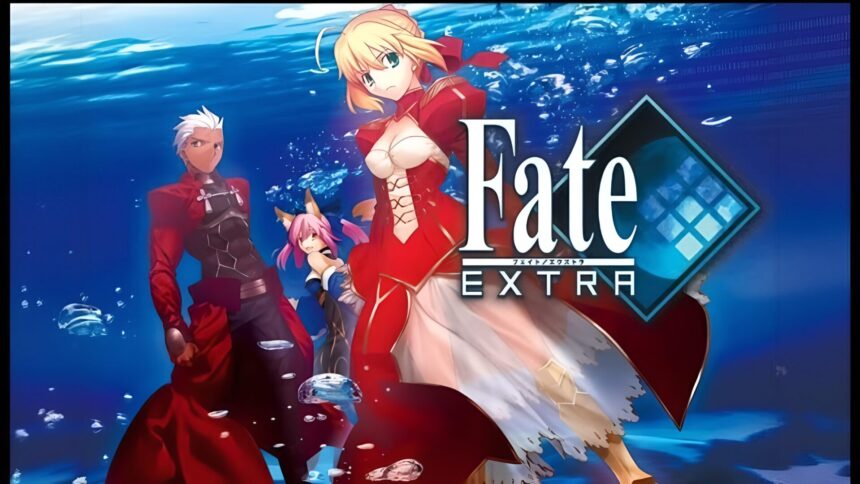
Fate/EXTRA turns the Holy Grail War into a tournament inside SE.RA.PH, a virtual world maintained by the Moon Cell Automaton. The Moon Cell is an ancient non-human artifact discovered within the moon, built to observe and record human existence, while the people capable of entering its deeper systems do so by converting themselves into spiritrons. After surviving the preliminary stage, I could choose Saber, Archer, or Caster as my Servant and enter a seven-round elimination contest against other Masters. The setting initially felt cleaner than the urban conflict of Fate/stay night, but that cleanliness is deceptive. This is not a consequence-free simulation. Defeat in the Moon Holy Grail War is fatal to its participants, which gave every new pairing of Master and Servant an uncomfortable finality.
The week-by-week structure makes me live with each opponent before fighting them. I spend time at Tsukumihara Academy, enter the Arena to gather information and strengthen my Servant, then use what I have learned when the elimination battle arrives. Discovering an enemy Servant’s identity is especially important because their Matrix gradually fills with information about their history, abilities, and Noble Phantasm. I enjoyed the investigative side of that loop much more than simply grinding levels. Fate has always made historical identity part of the appeal of its Servants, and EXTRA turns knowing who I am facing into something mechanically useful rather than leaving it as lore between battles.
Combat is where that idea becomes much harder to love. Each turn is divided into six actions, and the basic system revolves around Attack, Guard, and Break countering one another. Fighting the same enemy type reveals more of its action pattern, so later encounters become increasingly predictable. Against important opponents, that information can make preparation satisfying. During ordinary Arena exploration, the same structure became repetitive for me quickly. Too much success depends on remembering or uncovering sequences rather than adapting freely once the turn begins, and a bad read can punish me before I have much opportunity to recover. Servant skills add another layer, but they never completely solved my frustration with the underlying system.
Choosing a Servant changes far more than the animation attached to those battles. Saber is Nero Claudius, voiced by Sakura Tange, Archer is the Nameless Hero voiced by Junichi Suwabe, and Caster is Tamamo-no-Mae voiced by Chiwa Saito. Their personalities, dialogue, abilities, and progression differ enough that the choice gives another playthrough a real purpose. Nero’s theatrical confidence gave my run a completely different energy from the uncertainty surrounding the protagonist, and learning more about my own Servant mirrored the work of uncovering information about the enemies standing across from us. Archer and Caster offer their own material rather than functioning as alternate combat skins.
Rin Tohsaka and Rani VIII create another meaningful split later in the story. The decision involving them changes opponents and scenes rather than producing completely separate campaigns, adding another reason to revisit the tournament with a different Servant. I would not reduce either woman to a route switch, though. Their involvement changes how parts of the conflict unfold, and I became more interested in what each brought to Hakuno’s journey than in treating the split as a checklist of exclusive fights.
Arco Wada’s character art does a lot to separate this branch of Fate from Fate/stay night. She served as character designer and main artist, with Takashi Takeuchi supervising character design and huke designing weapons. Familiar faces remain recognizable, but Wada’s work gives the new cast and returning names a visual identity that belongs to EXTRA. The 3D side is less consistent. Tsukumihara Academy has a sterile digital atmosphere that suits SE.RA.PH, and the Arena’s geometric spaces reinforce the sense that I am exploring a constructed world. Repeated environments eventually made those spaces feel as mechanical as the weekly routine, though the character artwork kept conversations from inheriting the same visual fatigue.
Shinji Hosoe composed and arranged the score, with Takahiro Eguchi handling sound effects and Koji Tsujitani credited as sound director. The electronic character of the music fits a Fate story transplanted into a computer on the moon, and I responded to the way it keeps the school from ever feeling completely ordinary. The opening theme, “Ranse Eroica,” is performed by ALI PROJECT, with lyrics by Arika Takarano and composition by Mikiya Katakura. Its theatrical energy gives the game a striking entrance before the more controlled digital atmosphere of SE.RA.PH takes over.
The North American release retains the original Japanese voice track rather than replacing it with an English dub. Voice acting is partial rather than continuous, but the cast is extensive. Kana Ueda returns as Rin, Asami Sanada voices Rani, and Hiroshi Kamiya voices Shinji Matou, while the opposing Masters and Servants bring in performers including Kosuke Toriumi, Ai Nonaka, Hisao Egawa, and Ryoka Yuzuki. I noticed the absence whenever a longer exchange went unvoiced, especially after hearing how much personality the cast could bring to important confrontations.
Behind all of this is a deliberate attempt to rebuild Fate as an RPG rather than simply reproduce Fate/stay night in another format. TYPE-MOON and Imageepoch developed Fate/EXTRA with Kazuya Niino as producer, while Kinoko Nasu, Motoki Fujita, and Kunimitsu Tanaka are credited on the scenario. Marvelous Entertainment published the Japanese PSP release on July 22, 2010. Aksys Games brought it to North America on November 1, 2011, retaining the Japanese audio, and the ESRB rated that release T for Teen. Its mixture of lengthy dialogue, investigation, dungeon preparation, and turn-based battles makes the visual novel ancestry impossible to miss even when I am spending hours navigating RPG systems.
By the later rounds, the repetition bothered me more, but the tournament structure also made each remaining opponent harder to dismiss as another boss waiting at the end of a dungeon. The Moon Cell can reduce environments, records, and participants to data, yet learning about the people I would eventually have to face made the competition increasingly uncomfortable. Uncovering a Servant’s identity could transform an unknown opponent into someone whose history I suddenly understood. That emotional contradiction carried me through Arena runs I otherwise would have tired of much sooner.
Fate/EXTRA also became the starting point for a larger branch of the franchise. Fate/EXTRA CCC followed in Japan on March 28, 2013 as a companion game connected to the same setting, while characters introduced here continued into later EXTRA titles. TYPE-MOON studio BB announced a full remake, Fate/EXTRA Record, in 2020. Its planned spring 2026 release was postponed in March 2026 alongside changes to the development structure and publisher. Development is continuing, with a new release date still to be announced. Returning to the PSP original while that remake remains in development makes its strengths easy to recognize, but it also exposes exactly how much room there is to rethink the combat and exploration.
Verdict
Fate/EXTRA gave me a Holy Grail War I wanted to understand even when I did not always enjoy fighting through it. The Moon Cell, the Master and Servant pairings, and the gradual uncovering of enemy identities kept the tournament compelling, while the six-action combat loop and repeated Arena exploration wore down my patience. Arco Wada’s character work and Shinji Hosoe’s electronic score give this branch of Fate an identity of its own. I remember the people I was forced to face far more clearly than the corridors I crossed to reach them, and that imbalance says both what Fate/EXTRA does best and where the PSP original shows its age.