Raid night begins before anyone enters the dungeon. I checked the roster, watched guild chat fill with last-minute problems, decided who deserved a place in the group, and tried to keep personal disagreements from interfering with the job. By the time my party reached the first dragon in Emberfate: Tempest of Elements, the combat mechanics felt almost secondary. The difficult part was getting everyone there together.
Wind Chimes Games builds its romance visual novel around the social work that massively multiplayer games usually leave to real players. I lead a raiding guild in Emberfate, the most popular fictional MMORPG in its modern-day setting, just as the Tempest of Elements expansion introduces the Ruins of Refuge raid and its four dragon encounters. Preparing for those fights means distributing responsibilities, communicating through different channels, managing the roster, and responding when somebody’s life outside the game begins affecting the group inside it.
The interface commits completely to that framing. There is no standard visual-novel text box sitting beneath a procession of character portraits. I moved between realm chat, guild chat, officer discussions, party messages, private conversations, mail, an inventory, a guild roster, voice communications, and video calls. Those systems are functional parts of progression rather than decorative replicas of an MMO screen, and the official feature list specifically identifies the guild, mail, and inventory systems as playable components.
Character creation reinforces the illusion that I am joining an existing online world rather than borrowing a fixed protagonist. I could choose my name, pronouns, background, guild name, and my Emberfate character’s race and class. None of those options transforms the story into a traditional role-playing game with combat builds, but they gave my guild leader enough identity that messages addressed to me felt personal instead of generic.
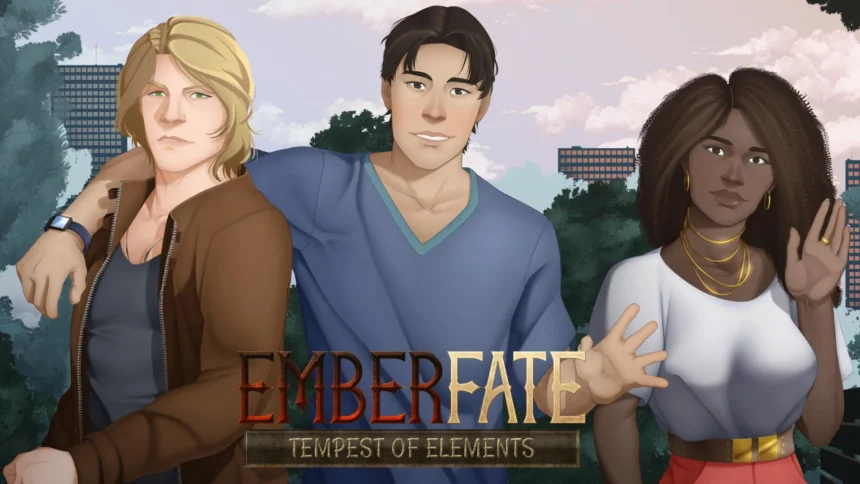
Three romance routes are included in the free base game. Nathan Lin is one of the protagonist’s oldest online friends and a guild officer whose withdrawal from the game is connected to his struggle with depression. Khanyisa Sanford is a new raid recruit dealing with stress and dissatisfaction at work. Chris Gofton leads a rival guild and carries a hostile reputation that becomes increasingly important to their route. The official profiles make those personal conflicts part of each character’s premise rather than presenting the cast only through their in-game roles.
Those routes work because the protagonist already knows these people. Emberfate does not spend half its length constructing three relationships from nothing. Familiarity is present from the start, whether through an old friendship, repeated guild contact, or rivalry between raid groups. The romance changes the meaning of an established connection, which allowed affection to develop without making every conversation function as an introduction.
The wider guild matters just as much. Members discuss relationships, employment, illness, grief, addiction, harassment, and their reasons for continuing to log in. The official content description confirms depictions or references involving cyber-harassment, depression, chronic illness, grief, gambling addiction, and alcoholism. These subjects are spread across a community rather than concentrated entirely within the three romance plots, giving the guild the sense of containing people whose lives continue even when the protagonist is not speaking to them privately.
I believed in that community most during ordinary chat. Conversations drift into jokes, emoji, raid complaints, advice, arguments, and abrupt disappearances that only become worrying after someone notices a pattern. Wind Chimes Games has stated that the project grew from the developer’s nostalgia for guilds and online gaming groups that felt like found families. That origin is visible in how often Emberfate treats checking on somebody as seriously as defeating a boss.
The raid and relationship plots can also reach separate outcomes. Steam’s achievement list distinguishes character endings from raid endings, including separate achievements for a normal raid result and a normal Khanyisa result. That division matters because being supportive in a romance does not automatically make me an effective guild leader, while successfully organizing the raid does not guarantee a healthy personal relationship.
I found the guild decisions more stressful than the romantic ones. Choosing who would participate in the final raid meant considering performance, reliability, group composition, and the consequences of earlier conflicts. The game does not reproduce a full MMO combat system, but it understands that raid leadership often happens before the fight, when interpersonal judgment becomes inseparable from mechanical planning.
All spoken dialogue in raid voice chat is voiced, as are the private voice and video calls with the love interests. Ordinary text channels remain written conversations. That limited placement is well chosen because the transition from typing to hearing another person marks a change in intimacy, while the raid audio reproduces the overlapping excitement and panic of a coordinated online group.
The presentation supports the same divide between online and offline identity. Fantasy avatars, monsters, raid environments, and class icons belong to Emberfate itself, while calls can reveal the people behind those characters. The interface changes according to the activity rather than forcing guild chat, private messages, raids, and video conversations into one visual template. I never forgot that I was playing a visual novel, but I frequently forgot that its MMO was fictional.
Wind Chimes Games originally submitted Emberfate to Amare Jam before continuing development as an episodic project. The eighth and final day became publicly available on itch.io on January 2, 2023, followed by the Steam release on January 26. The complete base game remains free on both platforms and is available for Windows, macOS, and Linux.
A separate $5.99 behind-the-scenes booklet contains more than eighty pages of development material, including postmortem reflections, design and writing notes, inspirations, scrapped concepts, and two bonus short stories. The booklet is the only paid Emberfate add-on currently listed on Steam. The proposed SelfconsciousPotato route was announced as a future $5 DLC, but I found no official release page confirming that the route has launched.
The route structure does produce a genuine replay problem. The central guild and raid storyline remains broadly familiar while the private romance material changes, so later playthroughs repeat more communal content than romantic content. I was still interested in seeing how another relationship developed, but I became less patient with guild conversations whose destination I already knew. That is my assessment from replaying the structure, not a claim made by the developer.
Even with that repetition, removing the guild material would damage the game. Nathan, Khanyisa, and Chris matter partly because they belong to networks larger than their romances, and their decisions affect people who are not competing for the protagonist’s affection. Emberfate treats an online community as a group of relationships requiring maintenance, not as a themed menu through which I select a partner.
Verdict
Emberfate: Tempest of Elements understands that leading a guild is an interpersonal responsibility disguised as a gaming role. Its simulated chats, mail, inventory, roster management, raid communications, and character customization give the fictional MMO enough structure to support that idea, while three established relationships allow the romance to develop inside an existing community rather than apart from it.
The repeated raid storyline makes consecutive routes less flexible than the relationship writing, but the shared material also preserves the guild as the centre of the experience. I was never merely choosing between Nathan, Khanyisa, and Chris. I was deciding what kind of leader I would be when friendship, performance, privacy, and responsibility stopped pointing toward the same answer.