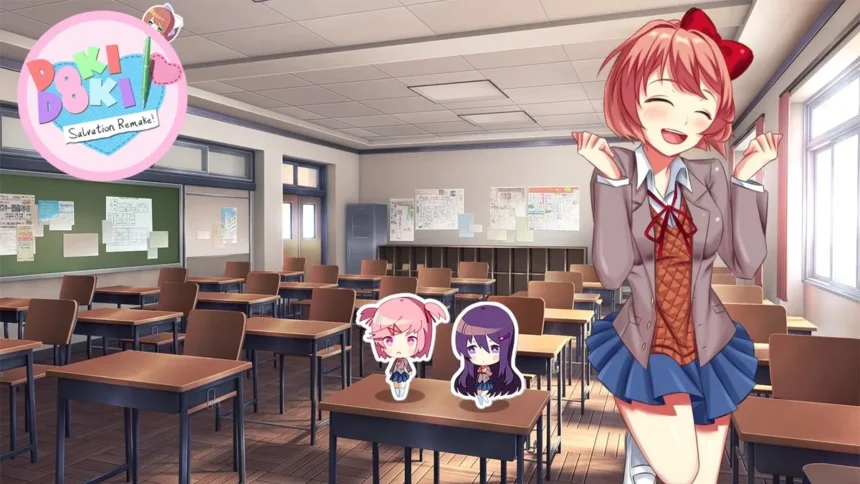
Some what-ifs stay lodged in a story’s aftermath long after the credits roll. DDLC’s ending leaves a specific one behind, the sense that if just one thing had gone differently, someone might have survived. This remake builds its entire premise around chasing that question honestly rather than treating it as a wish to grant and move past. You see, something wakes the protagonist in the deep hours of the night, some instinct with no obvious source pulling him to check on Sayori just in time to find her mid-attempt and stop her before it’s too late. That single divergence reroutes everything that follows, and rather than treating the interrupted moment as a clean resolution, the story spends real time on what actually comes after it.
Sayori goes to the hospital, carries visible reminders of what happened, and the literature club has to learn how to actually support her rather than assuming the crisis ended when the immediate danger did. The protagonist’s own arc runs through this too, and it’s not simply about protecting her. Part of what he has to learn is stepping back enough to let her function without him hovering over every moment of her recovery, a kind of restraint that costs him something too.
That same care extends outward to the rest of the cast instead of stopping at Sayori. Yuri’s self-harm gets addressed as something the others discover and reckon with one at a time rather than all at once, Monika already aware of it well before MC, Natsuki, or Sayori each find out at their own points in the story. Natsuki’s home life, visible bruises included, carries real narrative weight rather than sitting in the background as set dressing, and her arc extends further than that single fact. Part of what she has to work through is recognizing that her old friend group’s mockery of her wasn’t harmless teasing but its own form of emotional abuse, and choosing to cut ties with them once she sees it clearly.
Monika gets the biggest structural promotion of anyone here, moved from antagonist to a full second point-of-view character grappling with her own looming reset on a track that runs parallel to Sayori’s recovery. Her struggle isn’t purely emotional either. Repeated, failed attempts to regain control over the game itself leave her with bruised fingers that other characters notice and comment on, a small physical detail that grounds her powerlessness in something the script never has to spell out. During the stretches told from her point of view, the protagonist himself gets drawn as a fully realized character for the first time rather than staying an unseen presence, a deliberate structural choice that flips whose perspective the story trusts.
Moving away from DDLC’s romantic and horror-driven structure toward something built on friendship, trust, and grounded recovery marks a real departure from both the source material and the creator’s own earlier work. The original Doki Doki Salvation mod released back in October 2018, publicly framed by its creator as a kind of goodbye to the DDLC modding community at the time, and this remake expands considerably on that starting point rather than just polishing it. Five additional side stories unlock once the main story wraps, giving the ensemble cast room to breathe beyond the central Sayori and Monika threads.
Presentation carries over familiar assets from the base game rather than commissioning new art, though all four girls pick up multiple new, non-uniform outfits across the story, giving even quiet scenes a sense of time actually passing rather than looping the same handful of sprites. The soundtrack largely reuses DDLC’s original score, supplemented by a couple of new instrumental pieces, including a soft piano cover of “Can’t Help Falling in Love” used at two key points in the story. That specific choice of song carries an emotional weight the scenes around it never state outright.
12Gizguy6 built this remake as the same creator behind the original 2018 mod, and it’s available free through itch.io, DokiMods, and the Internet Archive rather than sold anywhere. Being unofficial fan content built entirely on someone else’s characters, it assumes real familiarity with DDLC going in, and its subject matter demands real emotional readiness given how directly it engages with suicide and self-harm rather than softening either for comfort.
Verdict
Doki Doki Salvation Remake treats its central what-if with real seriousness, using an interrupted suicide attempt as the start of a difficult recovery rather than a magic fix. That same careful attention extends to Yuri’s self-harm, Natsuki’s abusive friendships and home life, and Monika’s own physical toll throughout. Monika’s expanded role as a full second protagonist, paired with the structural choice to finally draw the protagonist himself during her point-of-view scenes, gives the story real range beyond Sayori’s arc alone. The shift toward friendship and trust over romance and horror marks a meaningful departure from both DDLC and the creator’s earlier mod. This remains free, unofficial content that assumes real familiarity with the source material and demands real emotional readiness for its subject matter, but as a heartfelt, considerably expanded reimagining of a story that began as a goodbye, it earns the time it asks for.