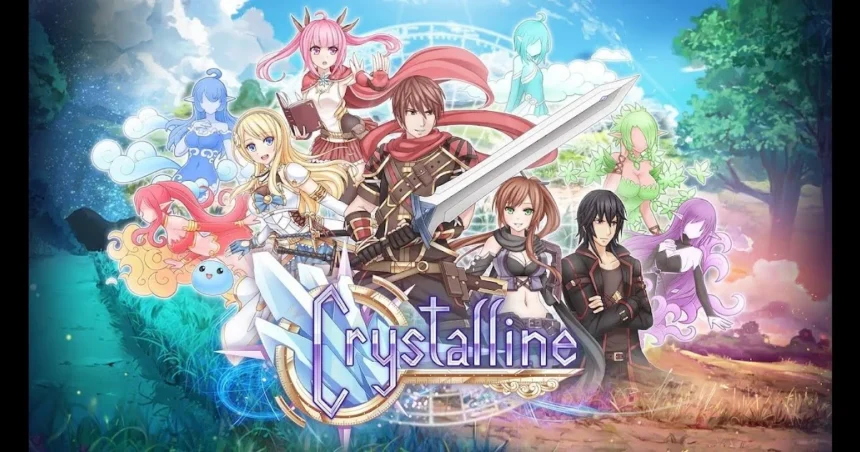
A world can feel completely alien without ever becoming difficult to understand. The challenge is making it worth staying in once the novelty wears off. Crystalline interested me less because it transported its protagonist somewhere magical than because it kept asking whether returning home was actually the answer he wanted. The unnamed protagonist, a college student from Earth, suddenly finds himself in Terra, a world where crystal-powered magic shapes everyday life. His arrival immediately attracts the attention of Leanna, a Mage-Knight investigating an unusually powerful magical surge that turns out to be coming from him. Neither of them understands why he is there, but their search for answers quickly grows into something much larger than simply finding a way back. I liked that the story established its mystery almost immediately instead of spending hours explaining the world’s basic rules before giving me a reason to care.
Terra itself is easy to settle into. Rather than overwhelming me with endless terminology, the setting introduces its crystal-based technology and magical systems gradually through travel, conversations, and everyday life. I appreciated that approach because it let the world feel lived in without constantly stopping the story for lengthy explanations. By the time larger questions surrounding the protagonist’s arrival emerged, I already understood enough about Terra to feel invested in what was happening there.
Relationships sit at the center of almost everything. Hundreds of dialogue choices gradually influence how the cast responds to the protagonist, shaping friendships and romances over the course of the adventure instead of relying on a handful of obvious branching decisions. I liked seeing smaller interactions accumulate over time rather than having every important relationship hinge on one major choice. It made conversations feel more worthwhile because even quieter moments contributed to how people viewed me later.
That structure occasionally creates its own pacing issues. The adventure spends plenty of time traveling, talking, and living alongside its cast, and while those quieter scenes helped me become familiar with Terra, I sometimes found myself waiting for the central mystery to reclaim the spotlight. The slower rhythm suits players who enjoy spending time with characters between major story developments, but I occasionally wanted the larger plot surrounding the protagonist’s unusual connection to Terra to move forward more quickly.
Fortunately, the character interactions remain engaging enough that those slower stretches rarely felt wasted. Leanna makes a strong first impression as someone driven by duty, but she gradually reveals a warmer and more uncertain side as the journey continues. The wider cast also benefits from having enough time together that conversations begin to feel natural rather than existing solely to deliver exposition or move the next romance scene into place. I appreciated that the game gave everyone room to exist outside the central mystery.
Presentation is where Crystalline separates itself most clearly from many independent visual novels. Every major character, along with numerous supporting roles, receives full English voice acting, giving conversations an energy that static text alone would not have achieved. Live2D animation further strengthens those performances by allowing characters to move naturally through subtle expressions, posture changes, and body language instead of remaining fixed portraits. The result consistently made conversations feel more alive than I expected.
The artwork complements that presentation well. Character designs are colorful without becoming overly elaborate, while the fantasy environments establish Terra as a welcoming place to explore rather than an intimidating one. Combined with the animation, even routine conversations have a level of visual polish that helped sustain my attention during the story’s quieter moments. Music also plays an important supporting role throughout the adventure. The soundtrack shifts comfortably between peaceful exploration, emotional conversations, and larger dramatic moments without overwhelming the dialogue. Because so much of Crystalline depends on spending extended periods with its cast, I appreciated that the audio consistently reinforced the atmosphere instead of trying to dominate it.
PixelFade also deserves credit for how the game is sold. Crystalline is a complete experience purchased once, with no episodic structure, premium choices, energy systems, or other mechanics interrupting the story. That straightforward approach let me focus entirely on the adventure without ever feeling pushed toward additional purchases or artificial waiting periods.
I deliberately avoided discussing the deeper explanation behind the protagonist’s connection to Terra because uncovering that truth drives much of the narrative. What stayed with me instead was how naturally the story shifted my attention away from escaping this unfamiliar world and toward the people living within it. By the time the larger answers began appearing, I found myself caring less about the destination than about how those relationships had changed along the journey.
Verdict
Crystalline combines a familiar transported-to-another-world premise with polished production values and a relationship system that rewards consistent interaction rather than isolated choices. Its slower pacing occasionally delays the larger mystery longer than I would have preferred, but the strength of the character interactions, full English voice acting, expressive Live2D animation, and attractive fantasy world kept me invested throughout. Players looking for constant plot twists may find the journey deliberately relaxed, but those willing to spend time with its cast will find a polished adventure that understands the value of letting its relationships grow gradually.