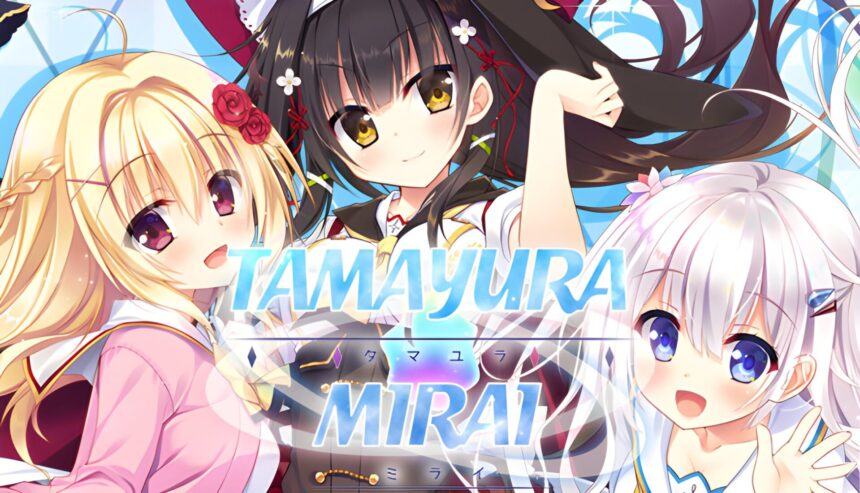
Tamayura is an old Japanese word for something that barely lasts, a flicker of time so brief it’s gone before you’ve had a chance to register it happened. Tamayura Mirai borrows that word for its title, and the choice ends up saying more about the story’s mood than any back of the box description could.
Developer Azurite, working on their second visual novel after Mysteries of the Heart: The Psychic Detective Case Files, built this one around a town called Fukano, where humans and youkai are said to have lived side by side long before the present day. Director Kotake Yoshihiko, whose prior credits include Shugaten! -sugarfull tempering- and Zwei Trigger, oversaw a script split between two writers. Nissy previously handled Toa’s route in Wagamama High Spec and Akane’s route in Kinkoi: Golden Loveriche, while Touta is credited on Sabbat of the Witch and Floral Flowlove. The game first released in Japan in 2019, picking up the Moege Award for User Favorite that year and finishing as runner up for the ceremony’s overall Game of the Year. Publisher Shiravune brought an English localization to Steam and Johren on May 11, 2023. That prior track record across writers and artists alike gives Tamayura Mirai a pedigree most standalone releases in this genre don’t carry into their debut.
Mutsuki Yohane narrates most of the story as the descendant of sorcerers who settled in Fukano generations ago, though his actual day to day work looks less like spellcasting and more like mediation. Anyone who can see and hear the town’s lingering spirits ends up drafted into keeping the peace between them and the human residents, and Yohane spends most of his time doing exactly that rather than chasing grand adventure. That mediator role gives the whole premise a lower key, more procedural feel than a typical fantasy adventure, closer to a small town fixer working through one local dispute at a time.
Yukina Kamikake arrives back in Fukano with a friend early in the story, searching for something she calls Otsuki that she lost long ago, and crosses paths with Yohane almost immediately. She carries more raw magical power than he does and was born with the ability to see the spirit world outright, which sets the rest of the cast in motion around her return. That gap between her power and Yohane’s own more modest abilities gives their dynamic a built in imbalance the writing has to actually navigate rather than smooth over. Cinnamon Yatsuhashi voices her, and has said she expected an icy, standoffish character going in before finding real warmth underneath that first impression once she actually read the lines.
Midari Suishouseki is a high class girl who happens to be a succubus exiled from her own household. Hanako Nekotengu is an unreadable maid once bound to a higher water spirit before losing the master she served. Shiro Kohaku is an older sister figure who reads as younger than her years following an accident the story treats with real weight. The three of them round out the main heroine lineup, with Yukina held back as an unlockable fourth route. Each of the four carries some version of loneliness underneath her introduction, whether that’s exile, loss, or a past the story takes its time explaining properly, which gives the whole main cast a consistent emotional throughline even before any individual route picks a specific direction.
The cast that actually won me over here wasn’t any of the four leads directly, though. It was the supporting characters who drift through the shared opening chapters. One small aside involving two arguing iron pots trying to talk themselves into a compromise stuck with me longer than most of the romantic scenes that came later, a sign of how much life this game packs into its margins even when the main plot takes a back seat. That kind of margin writing extends to plenty of other small moments scattered through the common route too, side characters and passing incidents that never get a name attached but still add real texture to Fukano as a place.
Structurally, the game splits into three main character routes plus that secret fourth one, adding up to more than twenty hours across a full playthrough. Not every route pulls its weight evenly. Two of the four carry real forward momentum for the overarching mystery of Fukano’s spirit world, while the other two lean harder on spending time with a specific character without pushing the wider plot much further, which makes the back half of a full playthrough feel lopsided depending on which order you tackle things in. Clearing every route in a single sitting also means revisiting some of that shared opening material more than once, since the common route has to be replayed in full before each individual path actually branches off.
The common route is the strongest stretch of writing here, carried by that supporting cast chemistry more than by anything happening to the four heroines specifically. Once individual routes kick in, the prose leans on a handful of stock descriptions of Fukano’s atmosphere that get repeated almost word for word multiple times across the story, enough that I started noticing the pattern well before the halfway point. That repetition problem shows up most in how the game describes Fukano’s air and light specifically, phrases that read as evocative the first time and increasingly rote by the third or fourth repeat. Some of the late-game plot reveals also arrive compressed into a couple of dense conversations rather than given room to land gradually, which made at least one major explanation harder to track than it needed to be.
Character art comes from three separate artists, Ameto Yuki, who also worked on Fureraba, along with Izumi Nanase and Matsumiya Kiseri, both previously credited on Floral Flowlove, working alongside Yuzuki Gao, also from Floral Flowlove, on the game’s SD chibi art, a wider team than most visual novels put on lead art duty. That much outside credit spread across a single cast gives Tamayura Mirai a slightly more varied visual identity than a project built around one dedicated artist usually manages, even if it also means individual character designs occasionally read as stylistically inconsistent up close. Backgrounds go a step further with full animation handled by the CG studio Atelier Kuukikan, giving Fukano’s forests and shrine grounds a sense of movement that static background art in this genre usually lacks.
On the technical side, the Steam release ships with mosaic censorship applied by default, and a significant portion of the game’s original adult content gets cut entirely rather than just blurred, restored only through a free eighteen plus patch available through Johren. That distinction matters for anyone deciding which version to actually install, since the difference here isn’t cosmetic censorship layered over intact scenes but content genuinely missing from the base Steam build. Text options at launch cover English, Japanese, Simplified Chinese, and Traditional Chinese, alongside the full Japanese voice track underneath all of them.
The opening theme, Koko ni Iru Kara, is performed by Itou Kanako, a vocalist with a long résumé across the Science Adventure catalog and several Nitroplus and Nitro+Chiral projects, and it sets a warmer, more wistful tone than the game’s comedic first impression might suggest. That same wistful register carries through several of the game’s quieter background tracks too, giving even ordinary dialogue scenes a gentle undercurrent that keeps the comedy from ever tipping into pure slapstick.
Voice acting covers the full Japanese script. Kusuhara Yui voices Midari and has said she likes how the character’s own succubus instincts embarrass her despite her supposed expertise. Anzu Hana voices Hanako and specifically called out how her character felt fresh despite drawing on well worn Japanese ghost story tropes. Anzu Mitsu voices Shiro. All four performances, Cinnamon Yatsuhashi’s included, lean into their characters’ established archetypes rather than subverting them, which works fine for the tone Tamayura Mirai is going for without doing anything especially unexpected. None of the four ever fully breaks from type, but the specificity each actress brings to her own character’s particular flavor of familiar archetype keeps the cast from blurring together across a runtime this long.
Extras include a CG gallery, a music room, and a stills collection tied to each individual route, along with replayable scene options once you’ve cleared enough of the story to unlock them. The stills collection specifically breaks down by route rather than pooling everything into one undifferentiated gallery, a small organizational choice that makes hunting down missed scenes considerably less tedious. None of it reinvents what a visual novel’s extras menu usually offers, but it’s a complete package rather than a stripped down one.
Verdict
Tamayura Mirai is a competent, good-looking entry in its genre that never quite breaks past being exactly what it advertises. The shared opening chapters and the wider cast around Fukano carry real charm, but uneven route pacing and some noticeably repeated prose keep it from reaching the higher tier its presentation budget suggests it was aiming for. For readers specifically drawn to Japanese folklore dressed up in a slice of life frame, there’s real value here even with its rougher edges.