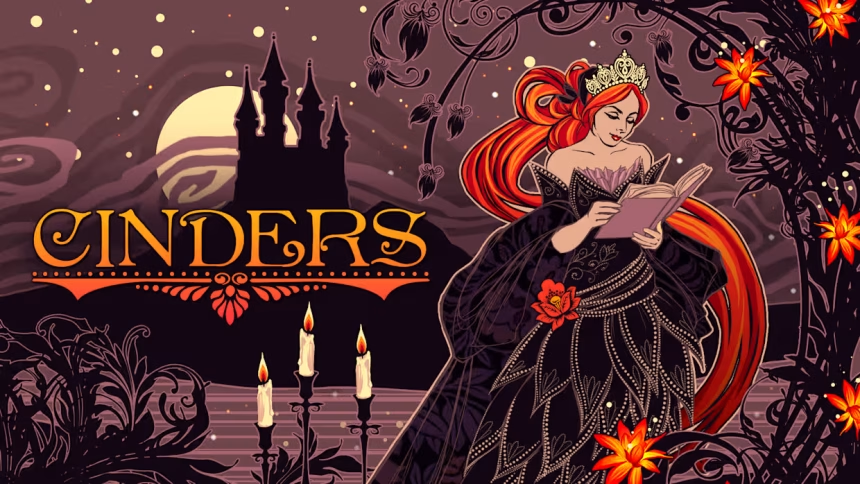
When MoaCube began work on Cinders, the studio had already settled on one design principle before choosing its setting: player choices needed to have meaningful consequences. The developers later explained that they felt many independent visual novels offered too little player agency and wanted to create a game where decisions shaped both the story and the protagonist herself. A fairy tale adaptation became the framework for exploring that idea, eventually leading them to reinterpret Cinderella.
The result begins with familiar foundations. After her father’s death, Cinders is left under the care of her stepmother and two stepsisters, who reduce her to the role of a servant inside her own home. Rather than following the traditional story beat for beat, the game presents numerous opportunities for Cinders to influence both her relationships and her future, allowing the player to decide how she responds to the circumstances surrounding her.
Choice is the game’s defining mechanic. According to MoaCube, Cinders contains 120 decision points and more than 300 dialogue and story choices, all intended to affect the protagonist’s personality, relationships, and eventual outcome. The developers identified this as the aspect of the game they were happiest with during development, describing meaningful player agency as one of the project’s primary goals.
Those decisions gradually shape Cinders into one of several distinct personality archetypes. Depending on how the player responds throughout the story, she can become more obedient, more selfish, or follow a balanced approach that values pragmatism over either extreme. Rather than asking players to choose a personality at the beginning, the game evaluates decisions over time before reflecting that characterization in later scenes, a system MoaCube also discussed in its postmortem.
The story also expands beyond the familiar prince-and-ball narrative by spending considerable time with the women surrounding Cinders. The official description describes the game as “a story of four women and what made them who they are,” focusing on themes of freedom, dreams, sisterhood, and finding a version of happiness that does not necessarily resemble the moral conclusions of the original fairy tale. Madame Ghede and the Fairy from the lake each influence Cinders in different ways, providing contrasting perspectives throughout the story rather than simply functioning as traditional magical benefactors.
Artist Gracjana Zielińska’s illustrations define much of the game’s visual identity. Character portraits and detailed painted backgrounds give the setting a style that differs noticeably from the anime-inspired presentation common among many visual novels released during the same period. Composer Rob Westwood provided the original soundtrack, which MoaCube later identified alongside the artwork as one of the presentation elements most consistently praised by players and reviewers following release.
Development also gave the team an opportunity to reflect on areas they wanted to improve. In its postmortem, MoaCube noted that the game contains numerous subplots and romance routes, observing that reducing their number could have allowed individual storylines more room to develop. The studio also expressed interest in creating future projects with slightly more directed narratives while preserving meaningful player choice. These reflections were presented by the developers as lessons they intended to carry into later games rather than criticisms raised after release.
More than a decade after its original release in 2012, Cinders remains one of MoaCube’s best-known works. It was later released for Nintendo Switch in 2019, followed by PlayStation 4 and Xbox One in 2020. Across all versions, its central premise has remained unchanged: retelling a familiar fairy tale by placing meaningful narrative control in the player’s hands.
Verdict
Cinders approaches Cinderella through player agency rather than strict adaptation, giving players extensive influence over both the protagonist’s personality and the direction of the story. Its 120 decision points, multiple endings, distinctive artwork by Gracjana Zielińska, and emphasis on choice reflect the design philosophy MoaCube outlined during development. The result is a visual novel that reinterprets a well-known fairy tale while remaining focused on letting the player determine how Cinders’ story unfolds.