Butterfly//Circuit made me distrust quiet rooms before it gave me any reason to. A blank stretch of routine, a half-remembered place, and the sense that something has already gone wrong are enough to make Amelia Morrison’s ordinary life feel unstable. The story does not need to announce its unease. It lets memory do the work.
Amelia has left Rzekiva for Centropol, hoping distance will make the aftermath of her home town easier to survive. Instead, the city’s monotony gives those memories more space to return. What begins as an attempt to function inside a numbing routine gradually becomes an investigation into whether Amelia remembers Rzekiva correctly at all, and I liked how the writing lets that uncertainty spread before revealing how large the problem has become.
Centropol is not a neutral refuge. It sits within the New European Federated Economic Territory, where surveillance, resource extraction, and control over people’s bodies have become ordinary parts of life. That background could have remained decorative cyberpunk language, but it changes how I read every conversation. In a city already built around observation and control, Amelia’s inability to decide who deserves her trust feels less like paranoia and more like basic self-preservation.
WireWARE describes Butterfly//Circuit as a cybergothic kinetic visual novel shaped by Serial Experiments Lain, Higurashi no Naku Koro Ni, and David Lynch, and those influences are easiest to feel in the story’s relationship with certainty. Scenes rarely stay confined to one clean interpretation. Familiar faces, hidden spaces, fractured recollections, and technoccult ideas keep rubbing against one another until the line between an external conspiracy and Amelia’s damaged sense of reality becomes difficult to separate. I was pulled forward by that instability, though the density of its terminology occasionally made me work harder than the emotional scene underneath it deserved.
Because this is a kinetic novel, I never chose Amelia’s path or decided which person she should trust. That absence of branching works in the story’s favour. It traps me inside the same forward motion that controls her, with no route menu or alternate decision waiting to restore a sense of authority. The tension comes from watching her make judgments I cannot revise, especially as people from different parts of her life begin to occupy the same narrowing circle.
The writing is strongest when Amelia’s emotional distance and the wider mystery press against each other. Her numbness is not treated as an empty personality trait. It shapes what she notices, what she avoids, and how long she can maintain an ordinary rhythm while Rzekiva keeps intruding. I felt the story lose some force whenever explanation overtook that close psychological focus, but it recovered whenever Amelia had to confront the personal cost of knowing more.
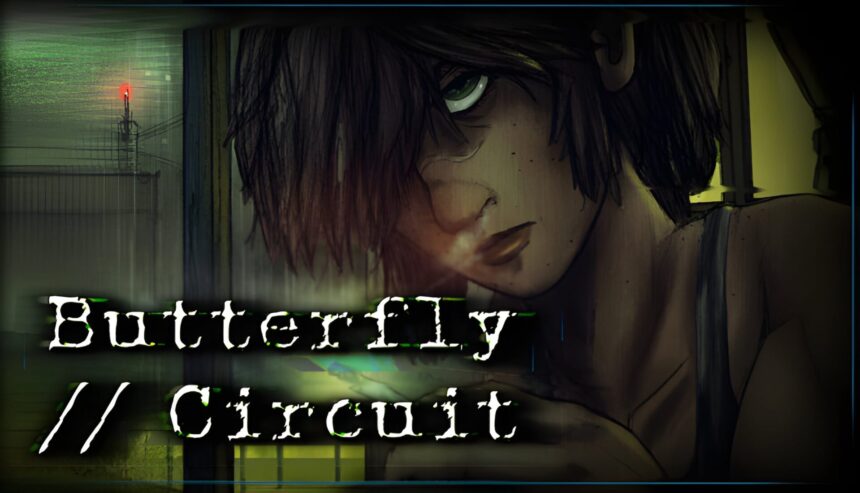
Original art gives Centropol a rough, deliberately unstable identity rather than the polished cleanliness I often associate with futuristic settings. WireWARE built the game in Ren’Py and created its visual material with Clip Studio Paint, while the interface repeatedly uses distortion, hard digital shapes, and corrupted colour effects to make the screen itself feel unreliable. The approach suited the story because it did not merely illustrate a damaged world. It made reading that world slightly uncomfortable.
That discomfort carries into the sound. The original soundtrack contains twenty-five tracks credited to Paper Flesh, moving through techno, trip-hop, post-rock, and atmospheric drone. The more rhythmic pieces give Centropol a physical pulse, while the slower material leaves enough empty space for dread to settle around the dialogue. I did not come away humming a central theme, but I remembered how often the music changed the pressure of a scene before the writing explained why I should be nervous.
Butterfly//Circuit does not include full voice acting, so its dialogue, sound design, and music carry the entire performance. I never felt that silence made the cast unreadable, although a few emotionally crowded exchanges might have gained clarity from vocal delivery. The lack of voices also keeps Amelia’s interiority dominant, which suits a story so concerned with the distance between what happened, what she remembers, and what she can bring herself to admit.
The game addresses depression, substance use, violence, and other mature subjects, but its strongest emotional effect comes from accumulation rather than shock. Each returning memory weakens the possibility that Amelia can simply begin again somewhere else. By the later stretches, I was no longer waiting only for the mystery to be solved. I wanted to know whether understanding Rzekiva would give her any control over it, or merely take away the numbness that had allowed her to keep moving.
That question stayed with me because the story never turns recovery into a clean reward for uncovering information. Knowledge and emotional relief are not treated as the same thing. Butterfly//Circuit understands that a hidden truth can explain a wound without closing it, and its final movement left me unsettled less by the scale of the conspiracy than by how much Amelia has to surrender just to see her own past clearly.
Verdict
Butterfly//Circuit is at its best when its cyberpunk conspiracy remains inseparable from Amelia’s damaged relationship with memory. Centropol’s surveillance and technoccult underworld give the mystery reach, but the personal strain underneath them gives it weight. Some exposition interrupts the psychological pressure, yet the linear structure, abrasive visual identity, and varied electronic score keep pulling the story back into focus. I finished it feeling less as though I had escaped a maze than as though I finally understood why Amelia could not leave it behind.