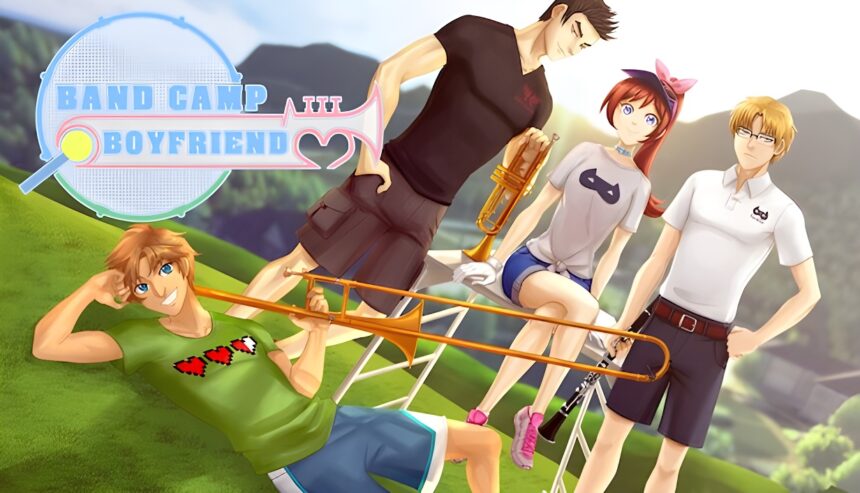
Stories about niche hobby communities live or die on one thing. Do they understand the culture from the inside, or just borrow its aesthetic for background color? Band Camp Boyfriend reads like it was written by somebody who actually lived through the sunburns, the sectionals, and the pre-competition nerves.
The Blue Mountain Bandits High School Marching Band has spent years under inconsistent leadership, watching morale and scores slide while the school treats its music program as an afterthought. Cadence steps into her junior year as the band’s new drum major, working alongside brand new director Victor Wiley, himself a Blue Mountain alum determined to turn things around. To focus entirely on their competition field show, the whole band packs up for two weeks at Camp Bearpaw, a sports compound tucked into rural Pennsylvania, far from any outside distractions. What’s waiting for them out there isn’t just rehearsal fatigue. Every choice carries weight, and something at that camp isn’t behaving the way a normal summer retreat should.
Lovebird Games, a sister duo working under Taylor and Alexandra Burton, built this as their first release, putting it out on itch.io and Steam on May 11, 2023, for Windows, macOS, and Linux. The finished game runs on seven separate story routes leading to more than thirty five different endings, backed by an unlockable sidequest and something in the neighborhood of thirty hours of total content if you’re chasing everything. It carries a T-13 rating, and the content warnings are worth taking seriously rather than skimming past. Suggestive humor and occasional strong language sit alongside dark psychological material, kidnapping, character backstories that include child abuse and emotional abuse, references to sexual assault, blood, violence up to and including gun violence, and death. That’s a real tonal range for an otome game to hold together, comedy and camp culture warmth on one side, a legitimately unsettling thriller undercurrent on the other. I won’t get into how that darker thread actually resolves, since walking into it fresh is exactly how the back half of this game is meant to land.
Each of the seven love interests gets built around the personality stereotype tied to their instrument, a device the game leans into with clear affection rather than laziness. Peter plays trumpet and carries the ego to match it. Clark, on clarinet, runs a website dedicated entirely to his own section and offers to take over duties above his own rank, not out of ambition but out of sheer dedication to seeing the band succeed. That drive gets sharper edges from his quiet resentment that Cadence beat him for drum major despite what he considers his superior conducting skill. Samuel stays cool and quiet, wrapped up in his love of jazz above almost everything else. Poptart, new to band entirely this year, comes off reserved at first before revealing a bubbly, cheerful streak underneath, one that shows up most obviously in how seriously he takes his own devotion to Pop-Tarts as a snack. Doug, hauling the bass drum around as a carefree former football player, gets described by the game itself as the heart of the band despite, or maybe because of, not being the sharpest tool in the shed. Garth leads the color guard section with a politeness and gentlemanly manner his peers clearly respect. Tom rounds out the full seven, his own route carrying weight that becomes clearer only once you’ve seen how differently the camp’s darker events play out across the other six paths.
Garth’s route deserves specific mention for a structural choice that stands apart from the other six. Regardless of how much affinity you’ve built with him, his single available ending resolves not with romance but with him coming out to Cadence as gay, and the two of them settling into a real, dedicated friendship instead of a couple. It’s a deliberate design decision rather than a failure state dressed up as one, and treating a beloved character’s arc as worth writing even when it cannot end in the genre’s usual romantic payoff says something real about how carefully this cast was put together. Alongside the main game, a side story called Band Camp Girlfriend follows Alex’s own repeated, comedic failure to land a date no matter what choices you make, giving the game’s lighter instincts somewhere to live outside the main seven routes.
Presentation includes more than twenty five unique character sprites and forty nine CG illustrations across the full game. I could not attribute a specific character artist beyond the two sisters’ own writing, programming, and composing roles.
Alex’s original score backs the whole experience. Music sits directly at the center of both the plot and the setting here, so having a co-creator personally responsible for the soundtrack rather than an outside contractor makes sense as a creative choice. It ties the score’s identity directly to the same creative voice shaping everything else.
Voice acting covers a portion of the script rather than the whole thing. Alexandra Burton voices Peter Dang herself, and Taylor Burton voices a side character named Sabrina. The wider cast draws from outside talent, Jonathan David Bullock as Doug Hickey, Mark Coutu as Victor Wiley, Joe Goffeney as Tom Rizzotto, Devon Kay as Samuel Robinson, Jared Raman as Poptart, and Joseph Ryan as Garth Dubois among them. Hearing one half of the two-person team voice her own character directly gives Peter’s scenes a specific, personal quality the other routes don’t quite share.
One detail that runs through the wider cast deserves a specific mention. Character names frequently echo the start of their instrument’s name, Susie on sousaphone, Barry on baritone, alongside the school’s own bandit mascot lending the group its Marching Bandits nickname. Mr. Wiley’s own quirks add texture too, dyeing the hair of any student who fails to memorize their part an embarrassingly bright color, a punishment the game plays for real comedy without ever losing its underlying warmth for the character dishing it out. It’s the kind of detail that only shows up when a project actually understands the culture it’s representing rather than performing familiarity with it from a distance.
The studio has kept building on the game long after its initial launch, running character route livestreams during otome game festivals and continuing to share progress on a second otome project currently in development. Band Camp Boyfriend itself keeps receiving deep discounts during seasonal sales events in the meantime.
Verdict
Band Camp Boyfriend succeeds as a real love letter to marching band culture, building seven distinct romance routes around a cast whose instrument-based quirks feel observed rather than assumed. Balancing that camp comedy against real thriller darkness is an ambitious swing that won’t land the same way for everyone. The care put into characters like Garth and Tom shows a studio willing to write honest arcs even when they defy the genre’s usual expectations. That commitment carries through into a soundtrack and voice cast that clearly came from people who understand what a marching band season actually feels like from the inside.