I went into ANONYMOUS;CODE braced to tolerate its central gimmick rather than enjoy it. It is the kind of high concept mechanic that sounds clever on a store page and turns into a chore once the novelty wears off. Instead, the exact prompt I expected to resent, an in-game save-and-load screen built directly into the story rather than tucked into a menu, became the part of the mystery I looked forward to most. By the time the credits rolled, that reload button had produced more tension for me than I expected from a menu screen turned plot device.
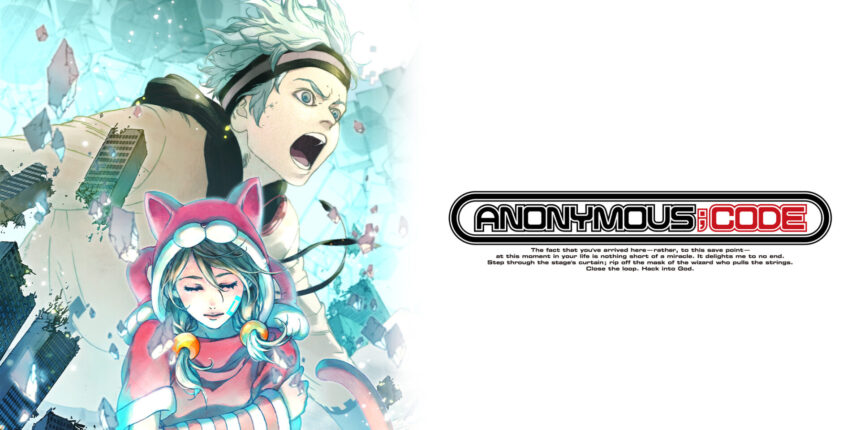
Pollon Takaoka is a teenage hacker-for-hire working out of Tokyo with his closest friend and fellow Nakano Symphonies member, Cross Yumikawa. Most of their jobs are for cash, taken to help people who have nowhere else to turn. He has a soft spot for people in trouble and not much interest in his own hacking skill, which makes him easy to root for before the plot escalates around him. Where I ran into trouble was depth. Pollon carries the story well as a decent, warm lead, but he never develops the rougher edges or contradictions that would make him linger in memory the way sharper protagonists elsewhere in the franchise do. Cross stays a steady presence at his side throughout, though their dynamic doesn’t shift much even as the stakes around them get heavier.
Visually, the game earns its best moments through contrast. Big action beats switch into comic-book style paneling, splitting the screen into dramatic panels and vignettes instead of a single static CG. Those sequences carry a charge that the everyday scenes rarely reach. The everyday scenes rely on semi-animated 3D character models instead, and the trade-off shows. Mouth movements in particular read as stiff and slightly unsettling rather than expressive, a rougher edge next to the polish of the action panels. The soundtrack does not have that problem. Takeshi Abo composed the score, and the full release runs to fifty-two tracks across two discs, ranging from tense hacking cues to a version of Franz Liszt’s Liebesträume folded into the arrangement. The action-driven stretches are where it hits hardest, tracks built to escalate alongside the comic-panel sequences rather than sit quietly under them. More than once I caught myself replaying a chase scene just to hear a cue land again.
The world around Pollon is 2037 Tokyo, rebuilt in the shadow of a disaster called the Sad Morning, a hacking incident on February 6, 2036 that cost innumerable lives. The city that grew out of it leans even harder into augmented reality, world simulators, and AI companion technology than the earlier Science Adventure games ever showed. Mages, the studio behind Steins;Gate and the recent Famicom Detective Club remakes, built ANONYMOUS;CODE as the sixth mainline entry in that loosely connected series. The fingerprints show in how comfortably it handles hard science fiction concepts without losing the human stakes underneath them. That backdrop pays off narratively too. Every mention of the Sad Morning throughout the story carries real weight, since the cast are survivors of it living with the aftermath.
That backdrop is where Momo Aizaki enters the story, a girl on the run who Pollon crosses paths with during an ordinary job and who drags him straight into a government pursuit. Trying to get her clear of a military unit sent to bring her in, Pollon discovers an app quietly installed on his AR interface. It lets him save and load the real world exactly like a game file. The Hacking Trigger, as the game calls it, is not automatic. Bad endings and near-misses prompt a manual button press to activate the reload, and the window for that press is tight enough that I missed it outright more than once early on. Failing gives you a bad ending, though those endings include hints toward what you needed to do differently. That softened my frustration more than I expected walking in. A couple of puzzles late in the story ask for solutions that break from everything the mechanic had taught me up to that point. Even with the hint system in place, those moments slowed me down more than any other section of the game.
The mystery widens fast from there. An anonymous hacker operating under the name Cicada 3301 sits at the center of the plot, and the Vatican has its own reasons for wanting Momo found. Both threads layer on top of Pollon’s more personal fight to keep her safe. Running in parallel is GAIA, an Earth simulator built by a fourteen-year-old prodigy that predicts real-world events with startling accuracy. The story mines real tension out of what happens when Pollon’s ability to reload and change outcomes runs directly against a system built to predict exactly what happens next. That collision, more than any twist I could describe without spoiling it, is where the Hacking Trigger stops feeling like a gimmick. It starts feeling like the actual argument the story makes about free will versus prediction.
Measured against its own franchise, ANONYMOUS;CODE runs shorter and tighter, clocking in around twenty to twenty-five hours against the length of the series’ bigger entries. It also drops the branching routes and multiple endings that earlier games built around almost entirely. I did not miss the extra length the way I thought I would going in. The tighter pacing kept the Sad Morning backstory and the GAIA conflict moving without the padding a longer route structure usually invites. What I did miss was the side cast getting real room to breathe. Characters around Pollon get a backstory scene or two and then get folded back into the main plot before I felt attached to any of them the way earlier Science Adventure casts have managed. The writing’s handling of LGBTQ+ representation is where my patience ran out. It reads as shallow next to how carefully the rest of the plot comes together. That is the one place in the game where the story felt like it was working against its own better instincts, not just falling short of them.
ANONYMOUS;CODE also carries the distinction of being the first Science Adventure game with a full English dub, produced by Bang Zoom! Entertainment under director Alex von David. Max Mittelman voices Pollon, Anairis Quiñones voices Momo, and Yung-I Chang voices Cross. Hearing an entire Science Adventure cast in English for the first time changed how I experienced scenes I would normally have read at a faster clip. Mittelman in particular carries long stretches of internal narration without losing energy, which matters in a game this dialogue-heavy.
Verdict
ANONYMOUS;CODE bets almost everything on a save-and-load mechanic that works as both plot device and player tool. That bet paid off for me far more than the shorter runtime and thinner side cast cost it. Pollon and Cross’s friendship gives the story a steady emotional core even without deep individual arcs. The comic-panel action sequences and Takeshi Abo’s score make the big moments hit harder than the everyday 3D scenes manage on their own. The first English dub in franchise history gave me a way into this world I did not expect to want as much as I did. The Hacking Trigger’s tight timing window and a late-game puzzle or two ask more patience than they probably should, and the writing’s handling of LGBTQ+ material is a real problem worth naming directly. Even with those flaws sitting there unresolved, this is the entry I would hand to someone curious about the franchise but unwilling to commit twenty extra hours to a longer route structure. It earned its place in the series on its own terms, not by imitating what came before.