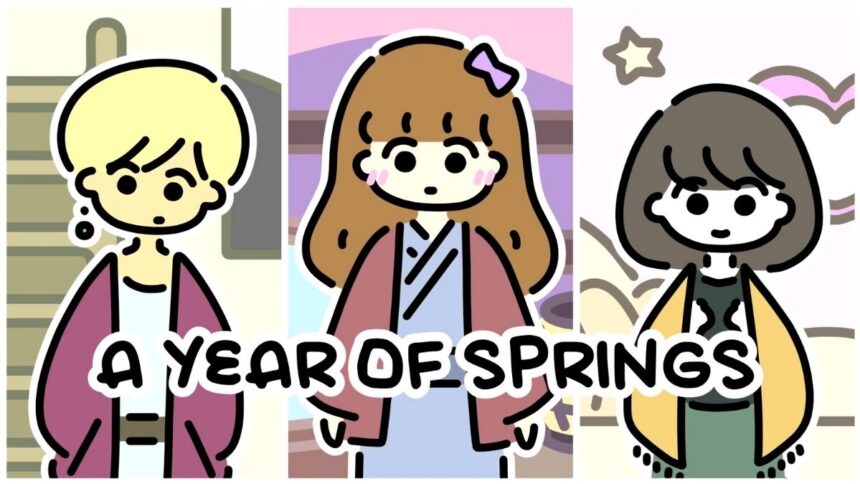
A birthday trip to the hot springs sounds like the easiest favor a friend could ask for, and this trilogy spends its whole opening story proving how untrue that is for the one friend actually being asked. A YEAR OF SPRINGS treats that distance between what looks simple and what it actually costs someone as its entire reason for existing.
Saying yes to that trip means Haru has to weigh things her friends never have to think about for themselves, practical obstacles that Manami and their mutual friend Erika don’t even notice until Haru is the one running into them. Haru is a transgender woman in Japan, where changing legal gender still requires sex reassignment surgery and sterilization, and the story never states that fact as trivia. It sits underneath every small negotiation Haru makes about which bath to use and how much of herself to explain to people who mean well but don’t always know how to help.
That opening story hands off to two more, each centering a different member of the same tight friend group. Erika, a former delinquent still figuring out what she actually wants from her own life, takes over trying to plan Haru’s next birthday and runs straight into obstacles more systemic than she expected. Manami, sweet and a little oblivious by comparison, gets her own turn once she notices Haru and Erika acting strangely around each other and starts asking why. Each woman carries her own story while staying tied to the other two closely enough that revisiting an earlier character through a later one’s eyes changes how I read her.
What keeps this from reading as a simple issues checklist is how much restraint the writing shows around subject matter this heavy. Gender identity, the specific vulnerability of transitioning in a society slow to accommodate it, sexuality, and love all get handled with real tact rather than delivered as lecture. In an interview about the games, the developer said she didn’t want any one character to feel like she was speaking for an entire minority just by existing. That instinct shows in how much room each woman gets to just be a specific, flawed, particular person.
Each story handles the choices you don’t take differently, which turned out to be one of the more thoughtful design decisions I noticed here. The first two games hide unavailable choices behind a point system or route them into distinct endings depending on what came before. The third game does something sharper. It shows you the option Manami almost chose, struck through, sitting right next to the one she actually picks. Seeing the road not taken instead of just the one she settled on made her hesitation feel real in a way narration alone couldn’t have managed.
One night, hot springs alone holds seven different endings across roughly thirty minutes of story, and the other two games branch on a similar scale. I replayed that first evening several times over, curious how differently it could land depending on a handful of small choices. I never felt like I was grinding toward a single correct answer so much as exploring how many ways one conversation could go wrong or right.
Presentation stays simple on purpose, thick line art and soft pastel colors that read as understated rather than underdeveloped once the writing earns its keep. The remastered compilation bumped the original art from 720p to 1080p and reworked the soundtrack with new tracks alongside the old ones, and the resulting music sits gently under scenes without ever demanding attention it hasn’t earned yet.
Beyond the three core stories, the compilation adds a new epilogue exclusive to this release, a CG gallery, a music player, and a new outfit for Haru, all for five dollars across Windows, Mac, Linux, Android, PlayStation, Xbox, and Switch. That’s a real amount of added value over three games that started life as pay-what-you-want releases on itch.io.
Verdict
A YEAR OF SPRINGS treats real, difficult subject matter, transgender identity, sexuality, and the work of supporting friends through vulnerability, with tact and warmth instead of clinical distance, and builds a believable, tightly bonded friend group worth caring about along the way. Its third story’s struck-through dialogue option does more to convey hesitation than any of the trilogy’s other techniques manage, even if the first two games rely on more familiar hidden-choice systems instead. Each story runs short, but seven endings in the first game alone gave me plenty of reason to go back, and the remastered compilation’s extras make this a properly complete package for a compact, thoughtfully written piece of LGBTQ+ storytelling.