The most revealing screen in SympathyKiss isn’t one of its romantic CGs. It’s a decision where the game effectively asks whether Akari Amasawa wants to prioritize her relationship or her job.
Pick one kind of response and the Love side moves forward. Choose another and you’re investing in Work instead. SympathyKiss keeps returning to that divide until it becomes the clearest expression of what the game is actually interested in: not simply whether Akari finds someone, but what happens when career decisions and personal relationships become impossible to separate.
Akari has worked for the mobile-app company Estario for about a year as a designer when her first annual performance review changes an otherwise unremarkable career. She isn’t miserable at Estario, but she isn’t particularly passionate about the work either. Then she’s offered a place on the team responsible for Estarci, the company’s once-successful news app. Estarci has fallen behind its competitors badly enough that management is considering shutting it down, giving the new team six months to prove the app still deserves to exist.
That’s a surprisingly mundane crisis for an Otomate game, and I mean that as a compliment.
There are no kingdoms to save or supernatural rules to memorize before the romance can begin. Akari goes to work. She attends meetings. People message her. Projects run into problems. Coworkers disagree about what should happen next. Someone has to figure out how to make an aging product relevant again while knowing that failure could have consequences for the people assigned to it.
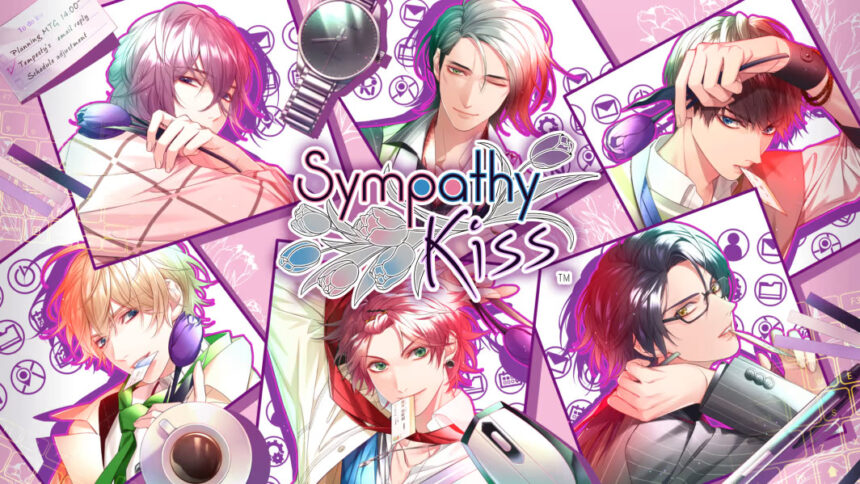
The setup also gives Akari a reason to spend time with the men around her before romance needs to justify it. Kohei Minato, Mitsuki Saotome, Yoji Kobase, Rokuro Yoshioka, Nori Tainaka, and Shuya Usui make up the six love interests advertised for the western release, with additional romance possibilities hidden behind progression. They aren’t all simply interchangeable members of one office team, either. Their positions and circumstances differ, and Nori in particular enters Akari’s life outside the conventional coworker structure.
Mitsuki Saotome quickly became one of the more distinctive personalities for me. He’s a young planning-and-development employee already known inside the company as a hit-maker because of his successful products. He’s intelligent, casual, and capable of rubbing people the wrong way despite generally being well liked. That combination works especially well in an office story because competence doesn’t automatically make someone pleasant to collaborate with.
Kohei Minato occupies a different space in the workplace hierarchy, while Yoji Kobase brings the perspective of someone carrying managerial responsibility. Rokuro Yoshioka complicates the straightforward coworker setup further: he’s connected to Tempesty, one of Estario’s major business partners, and is presented as handsome, intelligent, wealthy, and intensely focused on his career rather than romance.
Then there’s Nori.
Akari doesn’t meet him through a desk assignment. She finds him collapsed outside, and the resulting relationship begins on completely different terms from the Estarci project. He’s deliberately difficult to read, outwardly sweet and helpful while carrying circumstances Akari doesn’t immediately understand. His inclusion breaks up what could otherwise have become six variations on office dating.
Shuya Usui pushes the age range of the cast in another direction again. Between the younger men still establishing themselves professionally and older characters with substantially different life experience, SympathyKiss avoids making adulthood look like a single narrow stage of life.
That variety matters because the game is unusually committed to adult relationships. SympathyKiss carries a CERO D rating in Japan, meaning it was classified for ages seventeen and older there, and its relationships are written around working adults rather than school-age romance. The western release received a Teen rating. The tone can consequently move beyond tentative flirting into more mature relationship territory without pretending these characters don’t have adult lives outside dating.
Mechanically, the Love/Work system is the most important expression of that idea.
Choices can award Love Points or Work Points, pushing a route toward different outcomes depending on what Akari prioritizes. Routes can lead to Love and Work endings in addition to their primary conclusion. I liked that distinction because it prevents career ambition from functioning merely as the obstacle Akari must overcome before getting the man. Work is allowed to matter on its own.
The Emotion Select system approaches choice differently. At certain moments, instead of selecting a complete line of dialogue, I choose how Akari feels from five emotional responses: happiness, anger, trouble, sadness, or indifference. Those selections influence the other character’s response rather than simply functioning as another disguised affection meter.
It’s a small mechanic, but it fits one of SympathyKiss’s most unusual design decisions.
Akari barely speaks in the conventional visual-novel sense.
Rather than giving her a constant stream of written dialogue, the script frequently describes what she says or does while letting the voiced characters respond directly. Her face is also deliberately obscured in CG artwork. The intention is clearly to make her easier for the player to inhabit, and the Emotion Select system effectively lets me supply some of the personality that a more explicitly written heroine would normally express herself.
I wasn’t completely sold on the trade.
Removing so much of Akari’s visible and spoken identity makes self-insertion easier, but it can also make conversations feel oddly one-sided. A love interest might deliver a fully voiced response to something Akari has apparently just said, while I’m left reconstructing the actual exchange from narration and context. In scenes that depend heavily on chemistry or banter, I sometimes wanted Akari to stop being an interface for my reactions and become a stronger conversational participant.
The RiNG system handles communication more naturally. Characters contact Akari through text messages and fully voiced phone calls, extending their relationships beyond whatever conversation happens to be taking place in the office. Texting coworkers after hours is such an ordinary part of contemporary life that the feature barely sounds notable on paper, yet it contributes enormously to the game’s modern workplace atmosphere.
It also means a relationship doesn’t disappear the moment Akari leaves Estario for the day.
Fuji Rito’s character work is one of the production’s strongest elements. Portraits are detailed enough to sell the cast’s individual personalities, while changes in clothing prevent everyone from appearing permanently trapped in office wear. The CG compositions are equally polished, although Akari’s deliberately hidden face can occasionally make an otherwise intimate illustration look strangely staged because the artwork has to find another way of keeping her identity visually neutral.
That tension runs through much of SympathyKiss. The men are highly specific. Akari is deliberately not.
Even her name can be changed, although leaving the default Akari Amasawa allows the voiced cast to say her given name. It’s a sensible compromise between an authored protagonist and the self-insert approach the game otherwise favors.
The voice cast is substantial. Yuichiro Umehara voices Kohei, Gakuto Kajiwara plays Mitsuki, Kazuyuki Okitsu voices Yoji, Seiichiro Yamashita plays Rokuro, KENN voices Nori, and Yuya Uchida handles Shuya. Additional major characters include YOFY, voiced by Soma Saito, and Tsukihiko Higa, voiced by Kosuke Toriumi.
Those performances become particularly important because Akari herself isn’t voiced. Every phone call, workplace disagreement, flirtation, and emotionally loaded exchange therefore depends heavily on the man opposite her to establish the scene’s rhythm. The imbalance could have made conversations lifeless, but the performances generally keep them moving.
SympathyKiss originally launched for Nintendo Switch in Japan on November 17, 2022. Idea Factory International released the English localization physically and digitally in North America and Europe on February 27, 2024.
The western physical release received more elaborate collector options than the basic game needed. Idea Factory International’s Limited Edition included a hardcover art book styled after an Estario employee handbook, the soundtrack and audio-drama CDs, an Estario-themed stationery set and travel tumbler, a reversible cover sleeve, collector’s box, and trading card. Other retailer and regional packages varied, so I wouldn’t treat every edition name or bonus configuration as universally available.
None of those extras change what made the game interesting to me, though.
It’s the ordinariness.
Visual novels regularly ask me to believe that romance will develop while somebody solves a murder, survives a supernatural conspiracy, crosses dimensions, or prevents a kingdom from collapsing. SympathyKiss asks whether two adults who already have deadlines, performance reviews, difficult colleagues, career ambitions, and phones that keep buzzing can find enough room inside that routine for somebody else.
Even Estarci works better as a narrative device because saving it isn’t an abstract heroic mission. It’s a failing product inside a company. Management can kill it. Employees have professional reputations attached to what happens next. Akari has to decide whether this reassignment is merely another job she’s been handed or the thing that finally makes her care about where her career is going.
That gives the romance something useful to push against.
The routes aren’t simply asking, “Does Akari love this person?” They’re repeatedly asking what she is prepared to prioritize when love and work stop pointing toward the same answer.
I found that much more interesting than Estarci itself.
Verdict
SympathyKiss is at its best when the office stops functioning as scenery and starts interfering with the romance. Its Love/Work system makes that conflict literal, separating decisions that advance Akari’s personal relationships from those that prioritize her career, while RiNG messages and fully voiced calls make the relationships feel connected to the rhythms of contemporary working life. Fuji Rito’s polished character art and a strong Japanese voice cast give the love interests considerably more definition than the deliberately faceless, largely dialogue-less heroine opposite them.