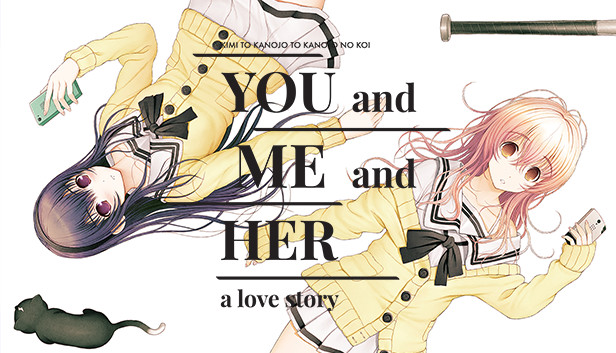
YOU and ME and HER: A Love Story builds its entire structure around forcing that question, starting with Susuki Shinichi finding a strange phone call from God on his school’s rooftop. His classmate Mukou Aoi insists she’s a character trapped inside her own romantic visual novel. Shinichi’s childhood friend Sone Miyuki, the most popular girl in school, gets pulled into helping him look after Aoi, and what starts as three people looking out for one another slowly turns into a love triangle none of them asked for.
Nitroplus built this under its Nitro Origin label around Shimokura Vio’s script and Tsuji Santa’s character art, originally releasing it in Japan in late June 2013 before an English localization finally arrived through JAST USA in May 2020, with a Director’s Cut DLC following just weeks later that same month, sold separately through JAST for $3.99 rather than Steam directly, restoring content trimmed from the base storefront release to meet platform content policies. Academics Mark Kretzschmar and Sara Raffel have since classified the game as both an eroge and an utsuge, a Japanese term for stories built specifically to devastate the reader emotionally, in their book on the history of interactive visual novels, a label that fits how deliberately this story avoids the comfort a lighter romance would offer. Choices steer Shinichi toward one of the two main girls, and the game treats picking a route with far more weight than the genre usually asks players to hold, without ever tipping its hand about why that weight is there until you’re already deep into the consequences of a specific choice.
Shinichi reads as deliberately unremarkable, keeping to himself and thinking through situations rather than reacting on instinct, which made him a steady enough anchor for two very different girls pulling him in opposite directions. That deliberate blankness carries all the way into his art design too, since Shinichi never gets an actual character sprite anywhere in the game and appears in CGs only as a generic, featureless figure with his eyes hidden from view, a choice specific enough to this game that it clearly wasn’t a budget shortcut so much as a pointed statement about the kind of self-insert protagonist he’s built to represent. Miyuki plays the role every visual novel fan recognizes on the surface, the popular childhood friend everyone assumes will win by default, excelling in the drama club and unusually skilled with a baseball bat that she practices with for an upcoming softball-themed performance. Aoi’s rooftop conversations with an imaginary God, and her conviction that she’s living inside her own story, gave her a strangeness that never once felt like a gimmick.
Akebono Yuutarou, self-proclaimed captain of what he calls the Boys and Dreams Club and voiced by Nobuyuki Hiyama, rounds out the friend group with comic relief scenes that gave the story room to breathe between its heavier stretches, though his material stayed thin compared to how much depth the three leads got individually. It was Akebono, not Shinichi, who first passed Miyuki the note that brought her up to the rooftop in the first place, a small detail that put him at the actual center of how these three ended up tangled together at all despite spending most of the story on its margins. Reaching a route’s end left me second guessing decisions I’d made hours earlier without thinking twice about them at the time, and the specifics of how the story actually turns familiar visual novel choices against the person making them stay out of scope here.
Tsuji Santa, also known for character designs on Super Sonico, gives Miyuki and Aoi clearly distinct visual identities well beyond the usual popular-girl and mysterious-outcast archetypes they’re built from, and that specificity showed in how differently each of them expressed the same emotions across the story. The full game carries roughly eighty distinct CGs before counting smaller variations, and set against Shinichi’s own deliberately blank design, the two girls’ fully realized artwork does even more work establishing whose perspective actually matters here.
Hirata Hironobu composed the original score, with theme songs contributed by Keigo Iwase, the band Swinging Popsicle, Tada Aoi, and Kanako Itou, giving the soundtrack a wider range of vocal identities than a single credited theme artist usually provides. Full Japanese voice acting from the original cast covers every named character, and hearing Aoi’s rooftop declarations performed with total sincerity sold her conviction in a way that text alone would have made harder to take seriously.
Watching a story built on familiar visual novel shorthand turn that shorthand against the player made me approach every choice in a second playthrough far more carefully than I had the first time through. Shimokura Vio’s other writing credits, including Sumaga and the Suzuha route from Steins;Gate, share that same instinct for undercutting a reader’s assumptions from underneath rather than announcing a twist outright, and knowing that background going in made me trust the setup here a little more than I might have otherwise. YOU and ME and HER spent years as a niche Japanese-only release before its 2020 English localization finally found it a wider audience. Knowing how long it sat waiting for that audience makes the amount of craft behind it land even harder.
Verdict
YOU and ME and HER: A Love Story takes a love triangle that looks familiar on the surface, popular childhood friend against mysterious outcast, and uses Shimokura Vio’s script to make every choice about picking between them carry real, uncomfortable weight. Tsuji Santa’s art and a fully committed Japanese voice cast keep Miyuki and Aoi feeling specific rather than interchangeable, even when Akebono Yuutarou’s comic relief can’t quite keep pace with the depth the three leads get.