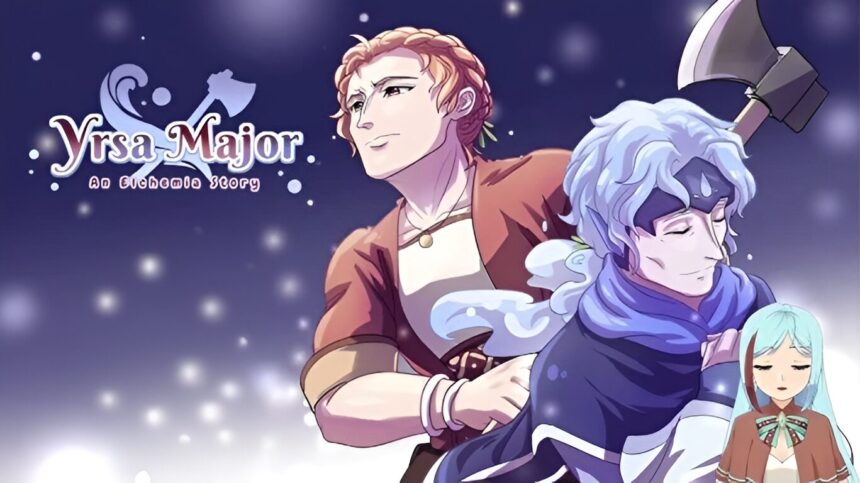
A shovel should not look more reassuring than a line of armed guards, yet that is exactly how I felt when Yrsa stepped between her village and a daimon. Her strength was obvious from the start. The surprise was how much of the story would depend on letting that strength coexist with fear, loneliness, and the wish to be cared for.
Yrsa Major follows a thirty-year-old woodcutter in a village too poor to hire the alchemists and ishim who normally protect people from monsters. After a mysterious alchemist leaves her bonded to Uribel, she expects a fierce partner and instead receives a gentle water elemental who avoids violence and devotes himself to healing. I liked how quickly their mismatch became more than a joke. Yrsa sees power as the ability to stand in front of danger, while Uribel keeps showing her that protection can also mean preserving life, tending wounds, and refusing to become cruel.
That difference gives the writing its shape. Rather than forcing attraction through instant chemistry, shibalist lets the relationship grow through repeated acts of care and the friction between two people who define usefulness in opposite ways. Yrsa’s bluntness could have made her emotionally flat, but her resistance to Uribel reveals how tightly she has connected her worth to what she can endure for others. Watching that certainty weaken affected me more than the larger threats surrounding the village because every small concession costs her something.
Uribel works because his gentleness never turns him into a passive accessory. His pacifism creates practical conflict when danger arrives, yet the story keeps finding ways for his knowledge and healing abilities to matter without remaking him into the fighter Yrsa originally wanted. I was won over by that refusal to treat kindness as an incomplete form of strength. Their romance becomes convincing through contrast, but it lasts because each of them has something the other cannot simply replace.
Made as shibalist’s first completed visual novel for Otome Jam 2021, Yrsa Major keeps its scope disciplined. The script runs about 30,000 words, offers three endings, and usually takes around two hours to finish. That brevity helps the central relationship, though a few stretches of worldbuilding made me wish the game had more room to explore its alchemists, ishim, and daimons. Even so, the story gives enough context for the village’s vulnerability and Yrsa’s responsibilities to feel concrete rather than decorative.
The presentation does more than underline the size difference between the leads. Yrsa’s broad frame, practical clothing, and forceful expressions sit against Uribel’s softer face, robes, and water-based design, making their opposing temperaments readable before either explains them. Shibalist created the character art, sprites, and CGs, while using royalty-free backgrounds, interface assets, and music. I noticed the limited background variety more than the reused music, but the expressive sprites and occasional animation gave the confrontations more movement than I expected from such a compact jam release.
Across its ten CGs, the art is strongest when it turns physical contrast into emotional information. Yrsa often occupies space like a shield, while Uribel’s posture and flowing design soften the frame around her. The romantic images never made her smaller or more conventionally delicate to prove that she was lovable, which mattered to me far more than visual polish alone. Even a simple difference in height becomes part of how the game lets Yrsa remain fully herself inside a tender relationship.
The soundtrack supports the fantasy setting and quieter conversations without demanding attention, although no individual piece stayed with me afterward. Sound is used more effectively as pacing support during danger and recovery, where the shift in atmosphere helps separate Yrsa’s public role as protector from the private uncertainty Uribel keeps drawing out of her. I did not miss a grander score because the emotional pressure comes mainly from the dialogue and character art.
By the time the choices began separating the three endings, I cared less about finding a perfect result than about whether Yrsa could stop treating care as something she was only allowed to give. The routes resolve that question with different emotional shades, and none required the story to betray her toughness to make vulnerability possible. That balance is why the final stretch stayed with me. Yrsa does not become worthy of love by changing into someone softer. She learns that softness was never the price.
Verdict
Yrsa Major is a focused fantasy romance that understands reversal alone is not enough. Its physically powerful heroine and pacifist love interest stand out, but the stronger achievement is how their differences reshape what each considers useful, protective, and lovable. Some parts of Elchemia remain lightly sketched, and the royalty-free presentation occasionally shows the limits of a jam production, yet the central relationship has enough care and specificity to carry the short runtime. I finished it feeling that Yrsa had been seen without being reduced, and that made the romance land.