The first choice in this game killed me. Seriously. There was no extended branch to explore, no gradual accumulation of mistakes, and no alternate investigation waiting behind the decision. I selected the wrong response, reached an abrupt ending, and returned to try the other option. That early exchange told me exactly what kind of interactivity I should expect from the rest of the experience, even though the surrounding mystery initially suggested something broader.
Dr. Elijah Shaw wakes in 2060 with no clear understanding of his circumstances and a mysterious orb in his hand. An agent working for the Bureau, the totalitarian faction controlling his society, takes him for interrogation before a group of rebels intervenes. Elijah joins them as they investigate the Bureau’s power and search for answers about his missing past. Time travel, psychological themes, conspiracy, and the pursuit of a true ending are all identified by Spire Games as central parts of the story.
That orb gives the opening a clean mystery to build around. It is tangible, unexplained, and connected to a protagonist who cannot supply the context himself. I wanted each new revelation to narrow the possibilities around it. Instead, the early chapters frequently widened the world faster than they deepened the immediate question, introducing political structures, historical information, scientific concepts, and character relationships before I had developed much attachment to Elijah himself.
The frontloaded exposition was my largest obstacle during the first half. Important information often arrived through direct explanation rather than discovery, and I sometimes felt as though the script was preparing me for a story I had not yet been allowed to enter. This is my assessment of the pacing and delivery, not a factual claim made by the developer. Spire Games presents the title as a dense science-fiction mystery intended to challenge attentive readers, so the quantity of information is clearly part of the intended experience even when its presentation did not work for me.
Once Elijah and the rebels began applying that information rather than merely discussing it, the story became easier to follow. The Bureau’s control gave the group a specific opponent, while Elijah’s missing history kept the conflict personal. I became more invested when a revelation affected how he understood himself or another member of the group, rather than simply adding another term to the setting.
The official description calls the structure “mostly linear.” Bad endings occur when a key decision leads to failure, while later single choices can produce normal endings or the one true ending. Spire Games clarified on itch.io that the game does not contain multiple full routes. The player generally tests whether an individual decision is correct, survives the resulting scene, and continues along the central narrative.
That description accurately matches my experience. The choices can have immediate consequences, but they rarely give me control over the direction of the overall investigation. Most function as checks placed along a predetermined road. A few added tension because the surrounding circumstances made the correct response uncertain. Others felt like brief interruptions whose main purpose was to send me to a bad ending before I selected the surviving option.
One apparent fork was particularly disappointing because both selections returned me to effectively the same outcome. That is an observation from my playthrough, not a claim that every choice behaves identically. The game does contain several endings, but anyone expecting a network of substantially different routes should pay attention to the developer’s own “mostly linear” description rather than the broader “choices matter” terminology attached to the store page.
The Enigma Files are better suited to the kind of mystery Spire Games created. This in-game encyclopedia records information intended to help readers organize clues and understand the expanding setting. It does not solve the mystery automatically, but it provides somewhere to revisit material after the script has moved forward. With a story this dependent on terminology and connections across time, I used it more than I expected.
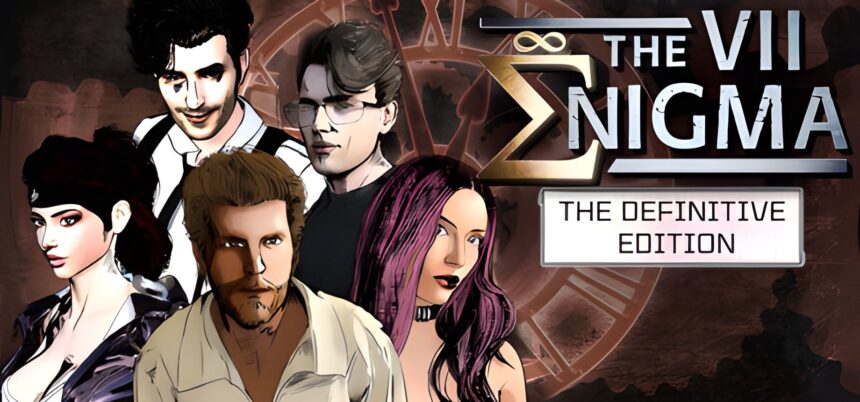
Visually, The VII Enigma rejects the familiar arrangement of one anime-styled portrait placed over a reusable background. Spire Games describes the presentation as an anime and graphic-novel crossover, using third-person limited narration and side imaging to create the impression of a larger world. The official feature list reports more than 250 background images covering numerous scenes and locations, along with character designs credited to the project’s head artist.
The result often resembles three-dimensional renders processed into illustrated panels. Characters, lighting, and environments have a deliberately constructed quality that separates the game from both traditional sprite-based visual novels and fully rendered 3D adventures. I did not find every image equally polished, particularly when poses or facial details appeared rigid, but the style gave the project an identity I could recognize immediately.
It is most successful during scenes that require movement. The developers advertised action and battle sequences as part of the presentation, and the large number of scene images allows confrontations to progress through changing compositions rather than a single portrait shaking against the screen. The direction cannot create continuous animation from still artwork, but it can suggest speed, impact, and changes in position more effectively than a conventional static layout.
The full release also represented a substantial revision over the withdrawn demo. Spire Games states that the finished version added image and interface updates, writing and scenario improvements, and animated sprites. That makes the surviving demo material an unreliable basis for judging the final presentation or script, and I did not use it to assess the completed release.
Caleb Coles wrote and recorded more than thirty original songs for the soundtrack. The music covers quiet conversations, dystopian tension, action, and the story’s later science-fiction developments without relying on licensed tracks. Steam lists no full audio support, and I found no confirmed voice cast, so the dialogue should be treated as unvoiced.
The absence of voice acting places more responsibility on the music and visual direction. Coles’s score frequently provided the momentum that the exposition-heavy passages lacked, particularly when a change in instrumentation signalled that a discussion was moving toward danger or revelation. Several themes remained recognizable when they returned, helping connect scenes that were separated by large amounts of plot information.
Spire Games estimates eight to twelve hours for a fast reader, twelve to twenty hours for a normal reading pace, and more than twenty hours for a methodical completion of every ending. Its itch.io profile gives a simpler estimate of approximately twenty hours. Those are official estimates rather than guarantees, since reading speed and how often someone revisits the Enigma Files will produce substantial variation.
The story contains more worthwhile material than its choice system initially suggests. As the investigation moved farther into time-travel territory, earlier assumptions became less secure, and the idea that answers could belong to a timeline that no longer exists gave Elijah’s search a specific kind of frustration. Evidence is difficult enough to trust when history remains stable. It becomes more troubling when the events supporting an answer can be changed, erased, or displaced.
I will not explain how the timelines operate or what Elijah eventually discovers. The mystery depends on information being introduced in a controlled order, and several of its strongest later scenes would lose their force if separated from that progression. My response improved considerably during the second half because the story began using concepts that the opening had spent so long establishing. That payoff did not make the earlier exposition disappear, but it gave much of it a clearer function.
The game was developed in Ren’Py and released by Spire Games for Windows, macOS, and Linux on January 25, 2022. It was the studio’s first completed project. The current Steam page lists twelve qualifying purchaser reviews, all positive, while the complete review filter contains a slightly larger number that includes non-purchaser copies. Those figures show a small positive user sample, not broad critical consensus.
Verdict
The VII Enigma is built around a contradiction. Its story asks the reader to examine an elaborate time-travel mystery, but its choices usually test immediate survival rather than allow meaningful control over that investigation. Bad endings and alternate conclusions exist, yet the central path remains deliberately linear. That limitation matters because the interface occasionally creates the expectation of a broader interactive mystery than the game intends to provide. Judged as a largely linear science-fiction novel, however, it has clearer strengths. The large collection of illustrated environments gives the dystopian world unusual scale, Caleb Coles’s soundtrack supports both its action and quieter character material, and the Enigma Files help manage a plot that expects close attention.