Body horror often begins with something violently alien invading the human body. Parasite Days takes a more uncomfortable direction by asking what happens if the invader is capable of holding a conversation.
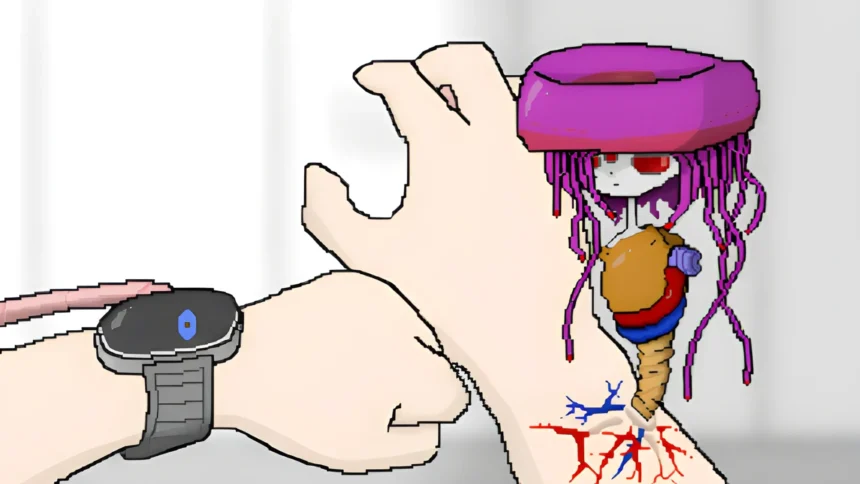
Developed and published by Zxima LLC, Parasite Days is described by its creators as a “parasite-purging adventure game.” The player controls Test Subject 4134, an individual held inside a research facility after discovering that an unidentified parasite has attached itself to their body. Rather than presenting the parasite solely as a threat to eliminate, the game allows the player to interact with it throughout the story while deciding how to respond to the infection. The game was released for Android and iOS on August 30, 2020.
The research facility provides the setting for nearly the entire game. Daily life revolves around balancing physical survival with the parasite’s continued growth while interacting with the Foundation overseeing the experiments. Alongside the parasite itself, the player regularly communicates with Watchio, an artificial intelligence built into a smartwatch worn on Test Subject 4134’s other arm, tasked with monitoring the subject’s condition and activities on the Foundation’s behalf.
Much of the gameplay revolves around resource management. The player purchases food, medicine, injections, and other supplies using money earned through part-time work inside the facility. Every decision affects one or more of the game’s central systems, particularly Vitality and Parasitic Growth. Allowing Vitality to reach zero results in death, while the Parasitic Growth level influences which endings remain available later in the story. Rather than treating purchases as simple inventory management, the game ties them directly to long-term progression and narrative outcomes.
The relationship between the protagonist and the parasite gradually becomes one of the game’s defining features. The parasite displays curiosity about the outside world and frequently initiates conversations, creating an unusual contrast with Watchio’s more restrained and procedural communication. Because much of the story unfolds through these exchanges, the game spends as much time developing its central relationship as it does its survival systems.
Although nearly the entire experience remains confined to the Foundation’s facility, the dialogue repeatedly hints at conditions beyond its walls. Characters refer to the outside world, the Foundation’s activities, and the broader setting without allowing the player to explore those locations directly. I found that decision effective because it allowed the game’s world to remain deliberately incomplete, encouraging speculation without interrupting the claustrophobic atmosphere created by the laboratory setting.
The game contains ten endings determined by the player’s choices throughout the experiment. Several story branches depend not only on conversations but also on how Vitality and Parasitic Growth have been managed across multiple days. Certain encounters with other test subjects, including Subject 2914, can also influence later developments depending on the player’s decisions.
Visually, Parasite Days adopts a clean anime-inspired presentation that contrasts with its unsettling premise. Character illustrations and interface design remain relatively bright despite the story’s darker subject matter, while the limited environments reinforce the feeling that Test Subject 4134 has little control over their surroundings.
The pacing is intentionally repetitive in places, reflecting the routine imposed by the Foundation. Working, shopping, monitoring statistics, and speaking with the same characters gradually become familiar habits. I found that repetition strengthened the narrative because it made subtle changes in the parasite’s behavior and the facility’s routines more noticeable over time rather than overwhelming the player with constant new mechanics.
Verdict
Parasite Days combines resource management, branching narrative, and psychological horror into a story built around an unusual central relationship. Its Vitality and Parasitic Growth systems ensure that everyday decisions remain mechanically important, while conversations with the parasite and Watchio gradually reshape how the player understands the situation. The confined setting and repetitive daily structure will not appeal to everyone, but I found they reinforced the game’s themes of isolation and dependence, making its multiple endings feel like the natural result of the choices made throughout the experiment.