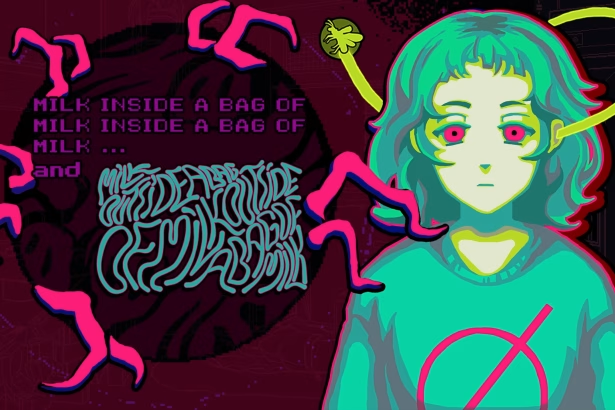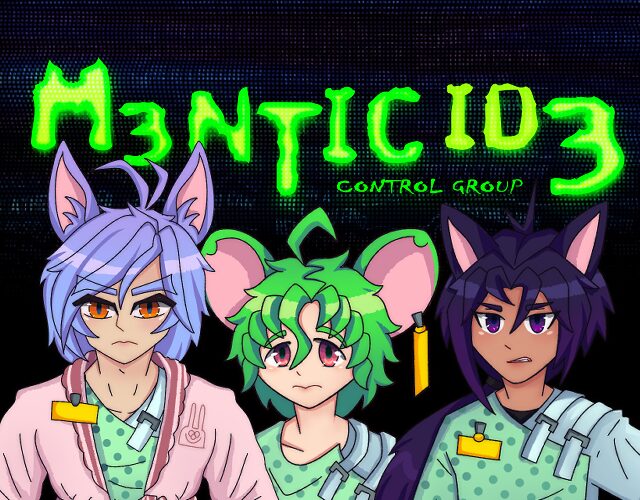
Escaping somewhere that’s already taken your memories raises an uncomfortable question of who exactly is left to do the escaping. INRI carries that question through every scene, a patient at a mysterious research facility who’s been robbed of her memories and her autonomy, forced alongside other patients through a series of strange psychological tests involving an experimental drug called Ichor. Her plan to escape gets thrown into chaos once she’s suddenly moved into a new room alongside three other patients, KZKR, FEFO, and OORR, and the four of them have to try to uncover the facility’s secrets and escape with their lives, risking losing themselves entirely in the process. M3NTICID3: Control Group builds its entire premise around that risk.
GR33N-SCHEMA made this for NaNoRenO 2024, submitted just over a day before that jam’s deadline. NaNoRenO itself, hosted by sakevisual, dates back to 2005 as one of the earliest recurring visual novel jams still running, challenging developers each March to write, build, and release a complete game within that single month, with no restrictions placed on genre or content beyond that timeframe. Built in Ren’Py and released free, M3NTICID3: Control Group wasn’t a one-off effort either. GR33N-SCHEMA returned to the same annual jam the following year with a second project, Fianna, an Irish mythology otome. The team’s own postmortem for that later game noted it was originally planned to run shorter than M3NTICID3 before its scope grew well past that initial estimate, a small but telling sign of a studio that keeps setting more ambitious goals for itself with each entry rather than repeating the same safe formula twice.
Running eighteen thousand words and taking roughly one and a half to two hours to complete, the game closes on one of two endings, backed by four CGs and more than thirteen unique sprites created specifically for each individual patient character. That density of individual sprite work stands out in particular for a project built inside a single month, giving KZKR, FEFO, and OORR each a distinct visual identity despite how little total time any one of them gets on the page. Downloads are offered separately for Windows and Mac specifically, a small but practical touch for a free jam release that a lot of similarly small projects skip entirely in favor of a single platform build.
The developers have been entirely upfront that this isn’t suitable for anyone under 17, depicting uncensored graphic violence, heavy gore, drug use, and real psychological trauma throughout rather than softening any of it for a wider audience. That directness extends to how the story treats its own central premise too. Ichor isn’t treated as a simple plot device to justify strange test sequences, it actively threatens each patient’s sense of self the longer their captivity continues, and the game never lets you forget that surviving the facility and staying yourself intact are two separate, sometimes competing goals. The tags the developers chose for the release itself, gore, horror, psychological, alongside the otome label, signal plainly upfront exactly what kind of experience this is rather than letting the romantic framing soften expectations going in.
An experimental original soundtrack underscores the facility’s unsettling atmosphere throughout, giving even quiet moments between patients a real sense of unease that never fully lets up, right down to scenes where nothing overtly threatening is actually happening on screen.
What actually got under my skin was the quiet horror of realizing survival here might cost each patient more of themselves than the memories the facility already stole from them. How either of the two endings actually plays out stays off the table here, but the dread of losing more than they’d already lost carried real weight scene to scene. KZKR, FEFO, and OORR each get just enough individual characterization within that tight runtime to read as people worth worrying about rather than interchangeable companions serving the plot, even knowing a jam-length script this size was never going to have room to develop all four patients equally.
GR33N-SCHEMA has stated plainly, in response to direct feedback about wanting more time with these characters, that a full expanded version of M3NTICID3 is in active development alongside the studio’s other projects, one built around individual character routes for each patient rather than the single shared path this jam version follows. That fuller version remains a ways off, by the developers’ own admission, but the fact that this short, free proof of concept generated enough of its own momentum to justify a full commercial-scale follow-up says something real about how effectively it establishes its world and cast in such a compressed space.
Verdict
M3NTICID3: Control Group packs real psychological dread into a tight jam-length runtime, letting INRI’s fight to survive carry real weight even with limited time to develop the full patient roster. Distinct sprite work for each character and an unsettling experimental score give the facility real atmosphere despite its short scope. It’s a confident, properly unsettling horror otome that clearly earns the anticipation for the fuller game still to come.