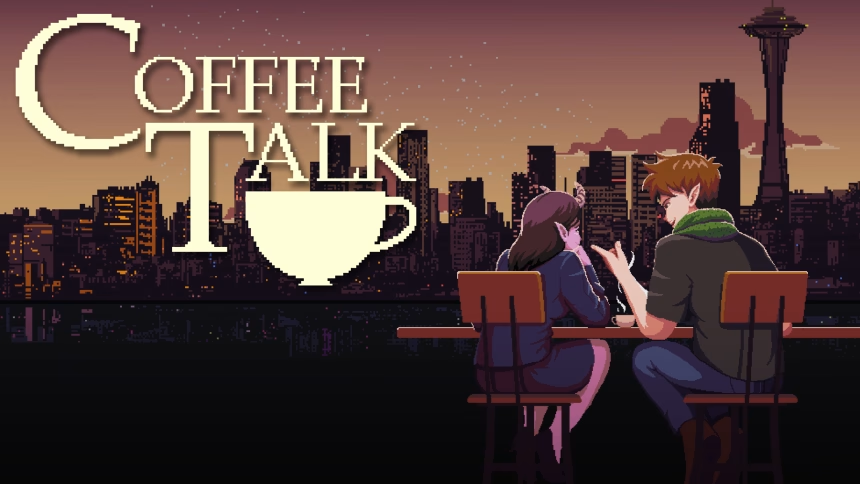
Late-night conversations have a way of pulling out truths people would never say in daylight, especially once a warm drink and a quiet room take the pressure off. That’s the whole world Coffee Talk builds itself around, putting you behind the counter of a late-night coffee shop in an alternate version of Seattle, one where fairies, orcs, mermaids, vampires, and other fantasy peoples live openly alongside humans in a setting that otherwise feels entirely familiar. Regulars drift through at all hours. Freya, a fairy working as a journalist for the fictional Evening Whispers newspaper, dreams of writing her own novel someday and draws inspiration from every conversation she overhears at the counter, treating the shop’s regulars less like sources to exploit and more like the material of a book she actually wants to earn the right to tell. Jorji, a human police officer, stops by regularly enough to become one of Freya’s steadiest sources of local gossip. Rachel, a young cat-person and former girl-band member trying to build a solo music career, gets shadowed everywhere by her overprotective widowed father Hendry, himself a cat-person and former music industry figure struggling to let his daughter grow up without him. Their relationship carries a specific, believable tension neither side is entirely wrong about, Hendry’s own history in the industry giving his worry real grounding even as it visibly frustrates Rachel’s own attempts to carve out an identity separate from his. Hyde, a vampire working as a freelance model, and Gala, a werewolf and military veteran who used to serve as Hyde’s bodyguard, round out a friendship that gives the shop some of its warmest recurring banter. Gala in particular carries the weight of what he went through in service without ever letting that history swallow the gentler, more considerate person he’s actually become. Neil, an alien visitor still working out what it actually means to live among humans, gives the cast its strangest, quietest perspective.
Toge Productions, an Indonesian indie studio, built the whole thing around that late-night atmosphere, with Chorus Worldwide co-publishing alongside them. Designed and written by Mohammad Fahmi and Kris Antoni Hadiputra, programmed by Fredrik Lauwrensius and Jovan Anggara, with art by Dio Mahesa and Hendry Roesly and a score composed by Andrew Jeremy Sitompul, the game released January 29, 2020 for Windows, macOS, Nintendo Switch, PlayStation 4, and Xbox One, later reaching PlayStation 5 on October 24, 2023, and mobile platforms on March 20, 2026. The whole project actually started life as an internal game jam entry at Toge Productions called Project Green Tea Latte, sparked by a Facebook post about playing games while sipping something warm on a cold day, a small, personal origin for a game that ended up carrying so much of its studio’s identity. Fahmi has cited both the Japanese television drama Midnight Diner and the manga Bartender as direct inspirations, both stories built around intimate late-night establishments where patrons open up to whoever’s working the counter that night. Toge Productions has said the wider ambition behind the project was putting Indonesian indie development on a real global stage, using Fahmi’s own writing and small cultural touches to invite players who’d never otherwise encounter Southeast Asian storytelling traditions.
None of the branching here comes from typical dialogue menus either. Story progression ties directly into how you actually treat and serve each customer, brewing their drinks correctly or not, which gave every shift real quiet stakes beyond just clicking through conversation. Specific Indonesian recipes make their way into that brewing mechanic too, STMJ, a ginger, milk, honey, and egg blend, and jahe tubruk, black coffee brewed with ginger, small cultural specifics folded naturally into the mechanics rather than explained with a spotlight. Serving the right drink to the right customer at the right moment in a conversation carries real narrative weight too, occasionally shifting how a whole scene plays out depending on whether you actually paid attention to what someone asked for.
A smartphone stays accessible throughout, letting you check characters’ social media profiles, look up known drink recipes, read short fiction published in the shop’s own fictional newspaper, or swap the song currently playing, small touches that made the shop feel like a real, lived-in place between customers rather than a static backdrop for conversation alone. Myrtle, an orc working as a game developer on a fictional title called Full Metal Conflict, and Aqua, a mermaid and indie developer who happens to be one of Myrtle’s biggest fans, give the phone’s social feed some of its most specific, ongoing background chatter, a small running plot thread you can follow entirely at your own pace if you bother checking in on it. That level of world-building through a background social feed, rather than through direct scenes at the counter, gives the setting a sense of scale well beyond the handful of regulars you actually get to serve each night.
The game leans into 90s anime influences visually, alongside classic pixel art adventure game sensibilities, paired with imagery clearly tied to lo-fi chillhop music. Some character portraits read slightly out of proportion relative to each other here and there, and a handful of music transitions land a bit rougher than the rest of the otherwise polished presentation.
The obvious comparison here lands on VA-11 HALL-A’s cyberpunk bartending format, and Coffee Talk carries that lineage forward with real confidence of its own rather than reading as a simple copy. It’s worth knowing plainly that Mohammad Fahmi, the game’s primary creator, passed away in March 2022 at just 32 years old. A sequel, Coffee Talk Episode 2: Hibiscus & Butterfly, had already been announced the previous August and was partway through its own development at the time, having shipped a public demo just weeks before his death. Toge Productions had originally planned that follow-up as a smaller piece of downloadable content, expected to take somewhere between two and six months to finish, but ended up spending closer to a full year expanding both its story and gameplay. The studio ultimately decided a standalone sequel made more financial sense than DLC given how much the scope had grown, releasing the finished game on April 20, 2023. The studio has continued building on the world since, announcing a further spin-off called Coffee Talk Tokyo in 2024, set two years after Episode 2’s own story and moving the setting to Japan for the first time.
What actually stuck with me was the quiet intimacy of watching strangers open up about things they’d probably never say anywhere else, given just a warm drink and a late enough hour to lower their guard. I won’t say how any specific customer’s story actually resolves, only that being trusted with those quiet confessions carried real weight by closing time.
Verdict
Coffee Talk turns the simple act of making someone’s drink correctly into a real, intimate storytelling device, letting a fantastical cast open up in ways a typical dialogue-choice visual novel rarely manages. Freya’s own writerly curiosity anchors a cast that ranges from Rachel and Hendry’s strained father-daughter dynamic to Neil’s quieter search for understanding, giving the regular customers real range across a small, tightly focused setting. The lo-fi chillhop atmosphere makes every late shift feel calming rather than repetitive, and knowing the real story behind its creator’s own life only deepens how much care clearly went into building this particular counter and the people who keep coming back to it.