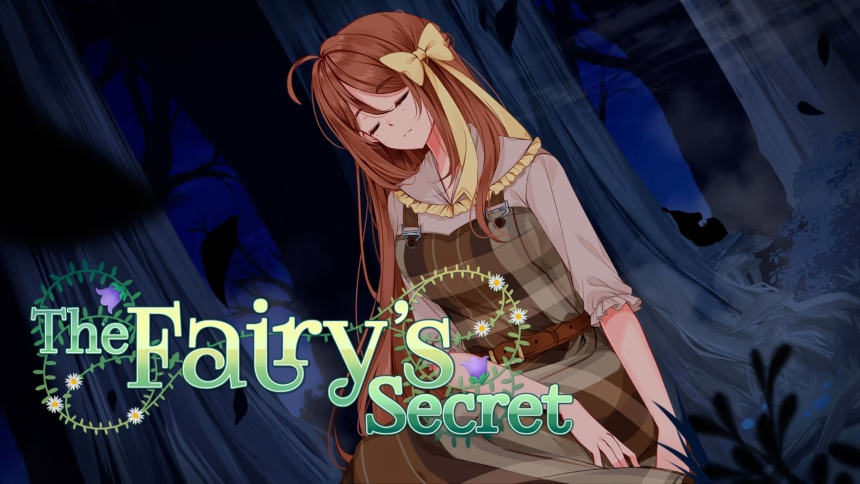
There’s a specific kind of dread that comes from visiting family somewhere the phone signal doesn’t quite reach, where every strange local rumor suddenly feels a little more possible. Fenchapel is exactly that kind of place, a village so small it barely clears five hundred people, without a single shop or cinema to its name. Two years after the events of The Fairy’s Song, Marnie returns there with her girlfriend Lisbeth to check on her grandmother Iris, whose health has been slipping enough to worry her. The rest of Marnie’s life has never looked brighter by contrast, freshly accepted into an art university in London and settled comfortably into a relationship that’s clearly grown steadier since the first game. Marnie’s own first visit to Fenchapel, back in that original story, wasn’t nearly so willing. She’d been palmed off on her grandmother for a week while her parents vacationed in Bordeaux, dreading a stretch of boredom in a village with nothing to do, before Iris’s own warnings about fairies in the woods turned that dull errand into something considerably stranger. Meeting Lisbeth during that first visit, and everything that grew out of it, is exactly the history this sequel now takes for granted rather than re-explains from scratch. The Fairy’s Secret picks up that established relationship directly, and reading the earlier game first actually helps make sense of who everyone already is to each other by the time this one starts.
That visit doesn’t stay simple for long. Marnie and Lisbeth run into a familiar, unwelcome face waiting in Iris’s own garden, Edmund, the vengeful knight who once pursued them through the forest during the first game, returned seemingly from beyond the grave and carrying a warning about how the woods have changed since his own awakening. He tells them plainly to stay clear of the forest if they possibly can, admitting that something’s felt wrong there ever since he woke, and that trouble tends to find people whether or not they go looking for it. Watching that warning slowly reshape what should have been a quiet family trip gave the story’s early chapters a real sense of unease creeping in around the edges of an otherwise ordinary visit.
Writer and programmer ebi-hime built the whole thing personally, working alongside a small, consistent team of collaborators. AuCrowne handled the core sprite and CG art, with additional contributions from Renmiou, RemyArt, and Sysen, BackgroundTK painted the environments, and ds-sans built the interface, the same core team that also worked on The Fairy’s Song before it, keeping the sequel’s visual identity consistent with the original rather than reinventing the cast’s look partway through the story. Composer Hope wrote the entirely original score, which folds in four newly composed tracks on top of the material carried over from the first game, a modest but deliberate expansion rather than a wholesale replacement of the sound the earlier story had already established. Localization ran through a small dedicated team too, Yuri Atelier handling the Chinese translation, Saryana covering German, and Mikhail “KornyPony” Burov-Kosolapin responsible for Russian. That gives the finished release real multilingual reach for a project this size, especially given how much of ebi-hime’s output otherwise stays a purely one-person operation from script to release. Steam approved the game slightly ahead of ebi-hime’s own expected schedule, and rather than sit on a finished build, ebi-hime pushed the release out early on February 6, 2023, once the last outstanding assets came in sooner than planned. The developer marked the occasion with a discount on the first game too, encouraging anyone who hadn’t already read The Fairy’s Song to pick both up together before diving into the sequel. Ratalaika Games later brought console versions to PS4, PS5, and Switch, the same publisher that would go on to handle the console release of In Fair Spirits as well, while the PC release stayed self-published across Steam, itch.io, and GOG.
Marnie’s fondness for anything dark, dreary, and eerie hasn’t dimmed a bit since the first game, dressing more like she’s headed to a funeral than a family visit even as her actual life has never looked better. That goth sensibility plays well against Lisbeth’s steadier, more grounded presence, a former knight who’s clearly settled into civilian life without losing the protective instincts that defined her before. Their established relationship gives the eerie plot developing around them somewhere warm to keep returning to, even as the mystery in the woods gets stranger, a dynamic that would feel considerably colder if this were either woman’s first appearance rather than a couple already two years into knowing each other. Edmund himself gets more room to breathe here than his original appearance allowed. Where he functioned as a fairly flat, one-dimensional antagonist in The Fairy’s Song, ebi-hime has described deliberately fleshing him out into a real supporting presence for this entry, giving him his own unresolved history rather than leaving him a pure obstacle for Marnie and Lisbeth to overcome. That expanded characterization laid groundwork ebi-hime would go on to build an entire separate spin-off around once this game wrapped.
This is a kinetic novel through and through, no branching choices, a single path from beginning to end, running past eighty five thousand words along the way, somewhere around four to six hours of reading depending on pace, roughly the same total length as the first game before it. The console releases add a full trophy list with a Platinum available on both the PS4 and PS5 versions of the cross-buy release, a nice bonus for anyone hunting completion beyond just finishing the story. The game supports English, German, Russian, and Simplified Chinese text, and every line of dialogue stays purely text throughout, no voice acting anywhere in the experience, a deliberate match for a small, self-published project built around reading rather than performance.
Watching Marnie try to hold two things at once, her real worry over Iris and the mounting strangeness pulling her attention toward the forest, gave the story real emotional stakes beyond just solving a supernatural mystery. Neither thread ever gets set aside for the other’s sake, and Marnie’s grandmother stays a present, grounding concern throughout even as Edmund’s warning pulls more and more of the plot’s actual attention toward the woods. Exactly how either thread wraps up stays off the table here, but the two never once felt like they were competing for space in the same story.
The Fairy’s Secret sits inside a real, enormous catalog of visual novels from ebi-hime, a body of work stretching well past this particular trilogy into titles like Strawberry Vinegar, Blackberry Honey, Cafe of Roses, and Asphyxia, among many others released under the same prolific, largely solo output. A single Steam bundle collecting nineteen separate ebi-hime titles together gives some sense of the actual scale involved, with entries like My Dear Prince, Salome’s Kiss, Dreamy Planet, and The Demon Queen’s Dire Dilemma sitting alongside this one, all released across genres and settings the studio’s cycled through with real consistency year after year. The Fenchapel story itself continues past this entry too. A third installment, In Fair Spirits, shifts the franchise into boys’ love territory entirely, centering Edmund himself as the lead a full year after the events covered here. His story deals with adjusting to life in the twenty first century after centuries spent elsewhere, working through his complicated feelings about leaving his old life and his younger sister Leofe behind, and meeting a new love interest along the way, a gothic boy living right there in Fenchapel. Marnie and Lisbeth do show up in that third game, but only as brief cameos rather than as the focus, a clear sign of how deliberately ebi-hime built out Edmund’s arc once The Fairy’s Secret gave him room to actually matter. Anyone hoping the trilogy would keep circling back to the original couple indefinitely should know going in that In Fair Spirits really does belong to Edmund now, not to them.
Verdict
The Fairy’s Secret carries Marnie and Lisbeth’s relationship forward with real warmth while folding in a real, unsettling mystery that never undercuts the quieter family concerns driving the visit. Edmund’s warning about the woods gives the story just enough dread to keep pages turning, even without a single branching choice to steer where things go, and his own expanded role here quietly sets up an entire spin-off built around him. It’s a modest, linear read that trusts its established couple enough to let them carry the weight, while still finding room to grow the world around them.