A birthday party already comes with enough ways for a day to go wrong. Add old grudges, friends who are behaving strangely, and far more uninvited guests than anyone could reasonably handle, and keeping everybody happy starts sounding harder than simply surviving until the cake arrives. I like comedy that understands how absurd that contrast is without forgetting that the people caught inside it still care about one another.
Purrfect Apawcalypse: Purrgatory Furever throws Olive into exactly that problem. One thousand students killed in the Hachiko High School massacre have returned as zombies and crashed their birthday party, leaving Olive and their friends trapped inside the Grimalkin Estate. The immediate questions are bad enough, especially how the students came back at all, but two details bothered me more. Sparky is acting strangely, and Angel’s old body is loose somewhere in the estate. I entered expecting the zombie outbreak to dominate everything, then quickly became more interested in what was happening inside Olive’s own group.
That shift suits the way choices work. Purrgatory Furever is dark comedy interactive fiction built in Ren’Py, with decisions capable of leading Olive toward survival or disaster. Instead of making the apocalypse the only thing worth worrying about, the script keeps returning to the idea that Olive should still care whether their friends are happy. I enjoyed that conflict because it made apparently small social decisions feel important beside much larger dangers. Sometimes I knew exactly what I wanted Olive to do. At other points, I hesitated because keeping one relationship healthy did not necessarily feel like the safest way forward.
Olive’s personality helps those decisions feel like more than route switches. Their concern for the people around them gives the birthday premise a purpose beyond setting up another joke, while Patches and Sparky pull that concern in different directions. Patches brings his familiar bookish personality into the group, whereas Sparky’s unusual behavior creates an uncertainty that I kept watching closely. Brownie, Coco, Angel, and the others give Olive more relationships to manage, but the cast works best when several personalities collide rather than when someone simply arrives to deliver information. I started reading ordinary exchanges more carefully because a friend behaving slightly differently could suddenly matter.
Sparky gave me the strongest version of that feeling. The game openly establishes that something about him is wrong without immediately handing over the explanation, so his presence creates tension before I know what to do with it. That restraint worked better on me than simply adding another threat to the estate. A zombie is easy to understand. A friend who no longer feels completely familiar is harder to dismiss, especially when Olive is already trying to hold everyone together. I became suspicious without wanting to become suspicious, which made the relationship side of the story carry more weight than I expected.
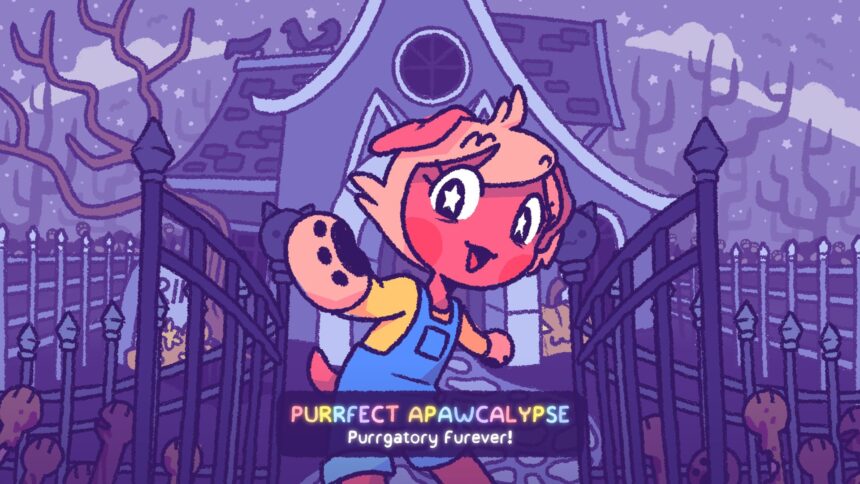
Meanwhile, the artwork refuses to abandon the series’ bright cartoon identity just because the situation has become grim. Cute anthropomorphic characters, expressive faces, and deliberately simple shapes sit beside horror imagery and frequent cartoon violence. I enjoyed that visual contradiction because neither side completely cancels the other. The cast can still look charming during an absurd exchange, then the same style can turn uncomfortable when the situation changes. It gives Purrgatory Furever a recognizable personality without asking realistic imagery to create its horror for it.
The content itself can get violent, and the official warning also calls out strong language and mature themes, with a recommended age of 15 or older. I never felt that the violence was the only joke available to the script, though. Friendship, awkward conversations, bad decisions, and Olive’s determination to keep people happy continue alongside the horror. That mattered because shock alone would have worn thin quickly. The warmer character moments gave me something to protect, so danger meant more than waiting to see what outrageous thing happened next.
Audio takes a more character-specific approach than I expected. Denny composed the music for this entry, and individual tracks are associated with members of the cast and different situations. Ginger’s track also functions as a spooky exploration theme, while Coco’s accompanies more stressful exploration. Angel has a dedicated piece as well. I liked how that arrangement lets familiar musical identities shift into practical scene-setting instead of treating the soundtrack as one interchangeable background loop. The music supports the changing mood without fighting the dialogue for attention.
There is no full performed voice track, so those personalities still depend on text, portraits, timing, and music rather than actors delivering the lines. That never bothered me here. The exchanges move quickly enough that I formed my own rhythm for each character, and the expressive presentation already gives conversations plenty of energy. With a cast this stylized, I preferred reading at my own pace to having every choice interrupted by waiting for spoken dialogue to finish.
Choices also have more purpose once I stop treating survival as the only measure of success. Steam currently tracks 19 achievements, which encouraged me to poke at decisions I would otherwise have avoided. I liked having a reason to revisit situations from a less sensible angle because a game about disastrous choices should let curiosity get me into trouble. The short-form structure makes experimentation easier too. I could return to earlier decisions without feeling as though I had committed myself to replaying a huge route just to test one idea.
That willingness to reward curiosity fits the wider trilogy. Purrgatory Furever is explicitly the second entry, sitting between Love at Furst Bite and Patches’ Infurno, and I think its position matters. The first game’s relationships give returning characters history before this outbreak begins, while this chapter can push those connections into less comfortable territory. I would not choose this as my introduction to Olive and the others. Knowing that these friendships already survived an earlier apocalypse made every new reason to doubt them hit harder.
90% Studios credits the game to Denny, with programming help from Andy, and the current version remains available for Windows, macOS, Linux, and Android. The Steam edition arrived on April 1, 2021, adding Steam achievements, animated transitions, bug fixes, typo corrections, and small art consistency fixes. I appreciated those additions more than I expected, particularly the transitions, because polish matters in a story where so much of the experience comes from moving rapidly between dialogue, decisions, and sudden changes in circumstance.
The game has continued receiving support long after that Steam release. Its current itch.io build is version 3.51, and the available languages now extend beyond English to Brazilian Portuguese, Russian, Japanese, Simplified Chinese, Polish, and Ukrainian. The Ukrainian localization arrived in May 2026, while earlier updates added Japanese and Polish support. That continuing maintenance gives the second entry a surprisingly long tail for something that began years ago, especially since the trilogy itself is already complete.
Outside the main release, 90% Studios also maintains an official soundtrack presence and has produced Purrfect Apawcalypse merchandise and behind-the-scenes material. Those extras fit a series whose appeal depends so heavily on its characters and visual identity, but I never needed them to make the game feel complete. The strongest material remains inside the estate, where Olive is trying to solve an impossible situation without forgetting that the frightened, difficult people around them are still their friends.
By then, the birthday setup had become almost secondary for me. I cared less about the absurdity of a celebration surviving an apocalypse and more about whether Olive could keep trusting the relationships that made celebrating worthwhile in the first place. Sparky’s altered behavior sharpened that anxiety without requiring the script to reveal its hand immediately. I won’t explain where that thread goes or what any particular decision produces. The uncertainty itself was the part that worked on me, because every familiar face became slightly harder to read without making friendship feel pointless.
That balance is also where the writing occasionally risks becoming crowded. Purrgatory Furever has the returning cast, the resurrected students, the mystery surrounding the outbreak, Angel’s body, Sparky’s behavior, relationship choices, comedy, and the constant possibility of things going badly. I sometimes wanted a little more breathing room between those concerns. Still, the pace rarely left me bored. When the story was at its best, one problem would complicate another rather than merely waiting its turn, and my choices felt tangled up in both survival and affection.
Verdict
Purrfect Apawcalypse: Purrgatory Furever gave me a much stranger birthday party than Olive deserved and a stronger relationship story than its zombie setup initially suggested. I enjoyed the clash between cheerful cartoon presentation and dark comedy, but Sparky’s unfamiliar behavior provided the tension that kept me watching the cast most closely. The branching decisions, achievement support, character-linked music, and returning friendships give this middle chapter enough of its own identity to avoid feeling like connective tissue between two larger stories. Its busiest stretches can pile on more ideas than I wanted at once, yet the central question stayed simple enough to matter. When everything around Olive becomes unreliable, deciding how much faith to place in a friend can be more frightening than knowing exactly where the monsters are.