Day five was the point when La Gueule de Saturne stopped feeling like a workplace I could master. I knew where customers would sit, how quickly they would lose patience, and which route between the kitchen hatch and dining room wasted the least time. None of that knowledge helped once the restaurant itself began giving me reasons to distrust it.
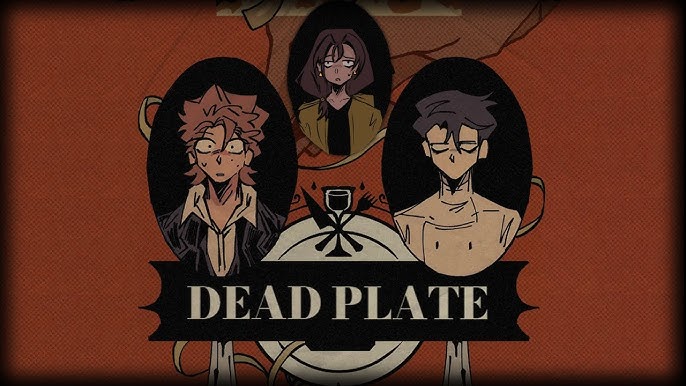
Dead Plate is a free, name-your-own-price RPG Maker horror game developed through Studio Investigrave by RachelDrawsThis and Ekrix, with music and sound design by Bell Kalengar. Released on November 6, 2023 for Windows and macOS, it combines restaurant-tycoon routines with visual-novel dialogue and point-and-click exploration inside a French bistro during the 1960s. The official page describes it as a one-week story about the lively waiter Rody trying to earn as much money as possible while working for the successful chef Vince.
The week gave me a clear practical goal before the horror asserted itself. Rody Lamoree takes the job because he wants money, and my shifts revolved around seating guests, collecting orders, carrying dishes, clearing tables, and keeping customers from leaving. Those tasks continue even after the restaurant begins to feel unsafe. I liked that refusal to separate “gameplay mode” from “story mode.” The same dining room I learned as an efficient route during service became somewhere I searched more cautiously once the restaurant closed.
Studio Investigrave identifies itself as an independent studio focused on narrative-driven horror made with RPG Maker. RachelDrawsThis and Ekrix are credited for Dead Plate’s development, story, and graphics, while Bell Kalengar is credited as composer and sound designer. The finished game contains more than 8,000 words of dialogue, over 70 CGs, eight maps, and four endings with different dialogue and hidden details. One ending takes an estimated 80 to 90 minutes, while the official page estimates up to three hours for full completion.
Those numbers do not make Dead Plate feel expansive in the usual sense. The restaurant is compact, the cast is small, and the calendar is fixed. Its density comes from revisiting the same spaces under different circumstances. During a shift, a room is part of a route-management problem. Afterward, it can become a place to inspect, remember, or avoid. That reuse made small environmental changes more noticeable than they would have been across a larger map.
Rody’s personality keeps the first half buoyant. He talks easily, makes poor decisions with confidence, and brings an informality that clashes with Vince’s controlled manner. Vince Charbonneau rarely needs an exaggerated reaction to dominate a scene. His short responses and stillness made ordinary exchanges feel uneven, as though Rody was always supplying more of himself than his employer returned. I found their conversations strongest when nothing overtly threatening happened, because the imbalance was already visible before the plot explained why it mattered.
Manon Vacher occupies a different kind of space in Rody’s week. The game presents her through his memories, calls, photographs, and decisions rather than placing her beside him during restaurant service. That distance turns her into both a person and a motive. Rody’s desire to reconnect with her explains why he keeps chasing money, but it also exposes how much of his plan depends on what he imagines she wants. The emotional weight came less from romantic certainty than from watching him build his week around a relationship that is no longer secure.
The restaurant mechanics are intentionally simple, but they are not always smooth. Movement uses the standard RPG Maker direction keys, with a run command and a separate interaction button. The official page warns that object interaction can require facing the correct direction and that tables may need to be approached from a particular side. I repeatedly lost time because I was positioned slightly wrong when trying to serve or clear a table. That friction became especially noticeable during later shifts, when customers were less forgiving and the story was already asking me to pay attention to other details.
Even so, the service loop performs an important narrative function. Repetition creates a baseline. Once I knew what a normal shift looked and sounded like, irregularities stood out immediately. A restricted area, an object placed where it did not belong, or a line from Vince that contradicted my expectations carried more force because the routine around it had become familiar.
The art direction does not depend on realism. Thick linework, exaggerated expressions, limited but deliberate colour choices, and highly composed CGs give the game the appearance of an illustrated thriller rather than a conventional restaurant simulator. The official feature list confirms more than 70 CGs across eight maps, and the volume of bespoke artwork is noticeable in how often major interactions receive their own framing. I was particularly drawn to the contrast between the dining room and the spaces beyond it. Public areas can appear warm and orderly while staff-only locations feel harsher and more exposed. That is my visual reading of the environments, not a claim about a stated developer intention. The change in atmosphere made exploration feel like crossing between the restaurant Vince presents to customers and the version of it Rody is gradually uncovering.
Bell Kalengar’s soundtrack supports that division. The official soundtrack release credits Kalengar as its author and includes two bonus pieces, “Table for One (Samba)” and “Rody Plays the Guitar,” that are not on streaming platforms. In the game, I found the service music functional enough to settle into a working rhythm, while quieter or more dissonant cues made familiar rooms feel less stable once the customers were gone.
Dialogue is presented without a credited voice cast, so characterisation depends on text, portraits, timing, and sound design. I did not find the absence of spoken performances damaging because Rody’s internal commentary gives his scenes a clear rhythm, while Vince’s restraint is communicated through how little he chooses to say. The writing does occasionally move faster than the game’s short length can comfortably support, particularly once the hidden conflict begins demanding answers, but it never lost the personalities established during the earlier shifts.
Dead Plate contains four endings, and the official page explicitly notes that they include different dialogue and hidden secrets or details. My first completion did not provide a complete account of the week, and the official guide exists because reaching the remaining conclusions requires specific actions across several days.
That structure is both a strength and a limitation. Replaying makes earlier scenes more revealing because I knew which details deserved scrutiny. It also meant repeating restaurant shifts whose mechanical surprises had already worn off. The ability to retain certain purchases reduced some of that friction in my experience, but the awkward interaction detection remained the largest obstacle between me and the additional story material.
The official content warning lists graphic death, blood, gore, violence, cannibalism, eyestrain, and disturbing imagery and audio. Those warnings accurately signal that the game moves far beyond its initial restaurant-management appearance. I will not describe the late-game material in detail, but readers sensitive to those subjects should treat the warning as substantive rather than decorative.
Verdict
Dead Plate uses a one-week restaurant job as both a management routine and a method of concealment. The repetition of serving customers teaches the layout and rhythm of La Gueule de Saturne, then the horror gains force by making that knowledge unreliable. Rody’s openness, Vince’s reserve, and Manon’s distance give the short script a strong character triangle, while the large number of CGs and Bell Kalengar’s soundtrack give the project a more authored presentation than its compact scale suggests.
The four-ending structure rewards close replay, but it also exposes the weakest part of the game: serving and clearing tables can become unnecessarily difficult when interaction depends on precise positioning. Dead Plate is most effective when I am studying a conversation, a room, or a contradiction. It is least effective when I know exactly what to do and the controls make me repeat the attempt.