Eight dollars is not a lot of money to ask someone to cry over, and I went in doubting a self-published indie visual novel with a Steam price tag that low could actually pull it off. By the time I reached my first ending, I understood why I have to put this game in the same breath as To the Moon.
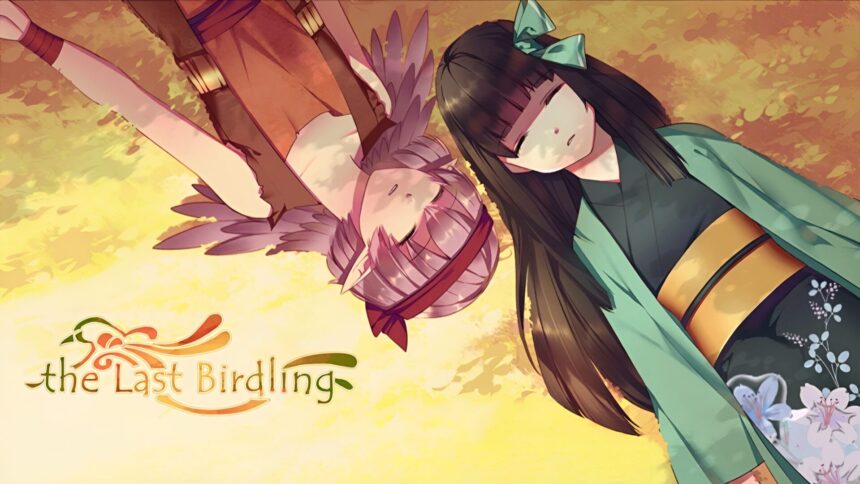
Marcus Lam, working under the pen name InvertMouse, built this as a fifth-anniversary passion project, and it shows in how tightly everything here is focused. Lam’s first game under that name, Unhack, came out back in 2012, and The Last Birdling arrived as his seventh release since, a culmination point after five years of steadily sharpening the same basic craft across earlier titles like Cursed Sight and Without Within. Watching a developer’s skill visibly mature across a run of seven consecutive projects is rare enough in indie visual novel circles that the anniversary framing here feels earned rather than purely promotional. There’s no expansive cast here, no branching political intrigue, just two girls on opposite sides of a war neither of them started. Bimonia is one of the last Birdlings alive, a winged, humanoid people nearly wiped out by humans in what the game’s own lore glossary frames plainly as genocide rather than a fair fight. Her mother, having lost her husband to that same slaughter, raises Bimonia in hiding and drills into her that humans are the enemy, full stop. Tayo is a human girl from the village on the forest’s edge, already an outcast among her own people for being too outspoken and too unwilling to accept the old stories she’s been handed. When the two of them cross paths in the woods, Bimonia is supposed to kill her on sight. She doesn’t, and an unlikely friendship starts growing in a world actively working to tear it apart.
Lam has spoken directly about what drew him to a conflict this simple on paper. He’s described the human-Birdling war as deliberately avoiding an easy us-versus-them framing, noting that any war this large inevitably produces sympathizers on both sides, people with no real stake in the fighting, and others willing to exploit the chaos for their own profit. That same interview also touched on why he keeps making these smaller, personal stories instead of chasing something more commercially safe. He’s admitted there are easier paths to a quick payday that simply don’t interest him the way stories like this one do, since he’d rather look back on the work with pride than regret trading his own real interests for something more marketable.
The story alternates between Bimonia and Tayo’s two perspectives across their childhood into adolescence, and that structural choice does real work. Getting both girls’ interiority rather than just one means neither Bimonia’s fear of the human world nor Tayo’s frustration with her own village’s rigidity ever gets to dominate the story unchallenged. Both come across as sharp, a little cynical for their age, and legitimately funny with each other in a way that makes the tenderness between them feel earned rather than assumed, right down to the small affectionate nicknames they settle on for each other, Yoyo and Bibi, once they’re comfortable enough to bother with them. Those nicknames alone do more to sell how close the two of them actually get than a dozen more direct declarations of friendship could have managed on their own. The writing trusts that anyone reading will pick up on how similar these two are underneath everything keeping them apart without ever having to spell that theme out directly, which is a harder trick to pull off than it sounds.
Where this game separates itself from a typical forbidden-friendship premise is how unflinching it’s willing to be about the cost of that world, refusing to let the girls’ bond exist in some protected narrative bubble immune from everything happening around them. Without getting into which specific outcomes hit hardest, I’ll say plainly that several of the game’s beats involve real loss, and the story doesn’t soften them for the sake of comfort. Parents die. Trust gets broken in ways that reshape a character’s entire sense of who they can rely on. The choices you make along the way, only twenty-one total across the whole game, carry real weight specifically because the game is so sparing with them. Nothing here feels like filler dressed up as a decision, and knowing that any one of those twenty-one moments could be steering you toward a considerably harsher outcome keeps them from ever feeling routine.
The five possible endings range from bittersweet to properly devastating, and the game earns the harder ones by taking its worldbuilding seriously rather than treating the human-Birdling conflict as pure background dressing. There’s real texture to why this war happened and why it hasn’t ended just because two children decided to be friends, and the story lets that larger context bear down on Bimonia and Tayo’s relationship instead of keeping the political stakes conveniently offscreen. An in-game glossary lets you dig deeper into that history at your own pace, filling in details the main script only gestures toward without ever forcing that reading on anyone uninterested in the extra lore. There’s a real Watership Down quality to how comfortably this story sits with bleakness once its second half fully commits to tragedy, never pulling its punches just because the leads are children.
The art carries its emotional register well, character art from Tooaya and backgrounds from Juliastorybored working in close lockstep with each other throughout. Character portraits and backgrounds start with a warmth and playfulness that matches two children discovering the world together, then gradually mute and darken as the story’s stakes escalate, without ever needing a scene to announce that shift out loud. It’s a disciplined use of color as mood-setting, and it holds up across the whole runtime rather than being a trick the game leans on once and forgets. Kevin Turner’s trailer work rounds out the credited team, giving the release a proper promotional presence beyond just the game itself.
Nothing here gets spoken aloud, and honestly, it doesn’t need to be. Composer Efe Tozan’s score does the heavy lifting the voice cast would otherwise carry, a haunting, melodic backbone that stays with you well past the point you’ve closed the game. The choice to let music and prose carry the emotional weight instead of vocal performance ends up suiting the story’s quieter, more introspective tone better than a full dub probably would have. Both the score and the game’s artwork are also sold separately as a digital soundtrack and artbook, bundled together with the base game on Steam for anyone who finishes and wants to hold onto more of it, a small but thoughtful bit of aftercare for a story that clearly earns the attachment.
If there’s a real knock against the experience, it’s a small one. The interface doesn’t make it obvious how to rewind text you’ve already read, and figuring out the right key took some trial and error rather than being intuitive from the start, Page Up on a keyboard specifically, or the shoulder buttons if you’re playing with a gamepad instead. It’s a minor friction point in an otherwise clean, easy-to-navigate presentation that supports mouse, keyboard, and gamepad input without much fuss beyond that one specific quirk.
Verdict
The Last Birdling takes a small cast, a tight structure, and a real, unflinching willingness to let its characters suffer real consequences, and turns all of it into one of the more quietly devastating visual novels I’ve read in a while. Bimonia and Tayo’s friendship carries real weight because the world around them never stops threatening it, and the muted, mood-driven art and Efe Tozan’s score both do exactly what they need to without overreaching. For eight dollars and a runtime that comfortably fills an evening, this punches well above its budget, and it stands as a real high point in a catalog that’s been building toward exactly this for five full years.