I’ll admit I went in skeptical that Nintendo, of all companies, was going to pull off a story built around teen suicide, urban legend serial killings, and a villain who mutilates his own face on screen. That skepticism didn’t survive the game’s final chapter, which landed with enough weight that I sat with the credits for a while before doing anything else.
Emio marks the first new entry in the Famicom Detective Club series in 27 years, the fourth installment overall, following the 2021 remakes of the original two Famicom Disk System games. Nintendo EPD co-developed this one with Mages, and by Nintendo’s own account, it was Mages who pushed to revive the dormant franchise after working on those 2021 remakes, a passion Nintendo recognized enough to greenlight an entirely new entry rather than another remake. Director and writer Yoshio Sakamoto, a veteran of the series’ earlier games, handled the plot, script, and cutscenes personally alongside co-writer and co-director Kaori Miyachi, with Yukihiro Matsuo credited as artist. The whole project quietly built toward its July 10, 2024 announcement, a short, deliberately cryptic teaser that generated real online buzz specifically for how dark and unusual it read for a Nintendo project.
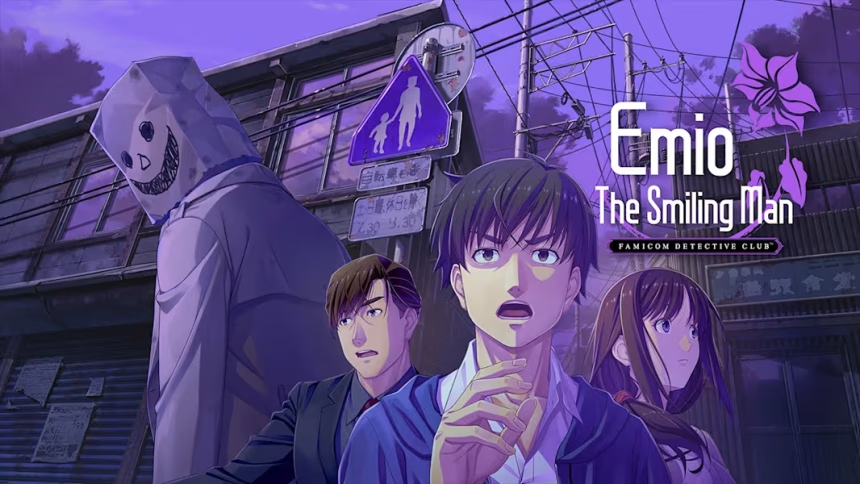
This is a clear step up from the already handsome 2021 remakes visually. Backgrounds stay evocative and moody without tipping into outright horror-game territory, and the Live2D character animation gives the cast a level of expressiveness, small shifts in posture, flickers of discomfort or forced cheer, that a static VN portrait system couldn’t match. Full Japanese voice acting runs through the entire script, featuring a cast that includes Megumi Ogata, Yûko Minaguchi, Riki Kagami, and Hôchû Ôtsuka, and while there’s no English dub, the performances carry real range, especially in scenes where a character’s composed exterior starts to crack. Takeshi Abo’s score knows when to sit back and let dialogue breathe and when to lean into real dread, and it never overplays its hand during the story’s quieter, sadder scenes. Nintendo released a two-disc physical soundtrack the same day as the game itself, a level of dedicated musical support not every Switch release gets.
Emio picks up the same unnamed protagonist and his colleague Ayumi Tachibana as junior investigators at the Utsugi Detective Agency. The case that pulls them in starts simple enough on paper. A fifteen-year-old junior high student named Eisuke Sasaki turns up dead near a remote pump station, strangled, with a paper bag drawn with a crude smiley face placed over his head. The detail immediately drags up an eighteen-year-old cold case involving a killer the local urban legend calls Emio, the Smiling Man, said to appear before crying girls and offer them a smile that lasts forever before ending their lives.
What makes the setup unsettling from the jump is how badly it doesn’t fit. Emio’s legend is built entirely around targeting girls, and Eisuke is neither a girl nor someone who resembles the killer’s supposed pattern, nor was he strangled the same way the old victims were. Every person the protagonist interviews about Eisuke in the early hours describes a well-liked kid with his life together, which makes the paper bag feel less like a signature and more like a message somebody wanted read a very specific way. The mystery earns its slow burn by making you distrust the connection to the old case almost as much as you’re drawn to it.
Investigation plays out the way the series always has, moving between locations, working through a menu of context-sensitive commands like Ask, Examine, Take, and Show to pull information out of witnesses and scenes. New to this entry are sections where you take direct control of Ayumi rather than just hearing about her half of the investigation secondhand, and those chapters do real work fleshing her out as her own detective rather than a supporting fixture. The mechanical loop itself is the game’s weakest link. More than once I found myself cycling back through the same menu options on a location or witness just to trigger the specific line of dialogue the story needed before it would let me move forward. That turns a handful of stretches into trial and error rather than real deduction. The full production credits over 499 people across localization, voice recording, and testing partners spread across multiple countries, a scale that shows in the polish everywhere except that one recurring mechanical friction point.
Where the writing takes real risks is in how far it’s willing to follow its darker threads. Without spoiling specifics, the story eventually digs into family dysfunction, isolation, and a character’s history with suicidal depression in ways far more direct than this franchise has ever attempted before. It’s a legitimately bold swing, and the game deserves credit for not flinching away from material this heavy. Whether it fully earns that weight is a fair point of disagreement. I came away feeling the story treated its darkest beats with real care rather than shock value, though I can see the argument that the game leans on the presence of heavy themes as a substitute for saying something meaningful about them. It’s the kind of story that will land very differently depending on what you bring into it.
Character work across the main cast is a clear strength. Utsugi carries a lived-in, world-weary authority as the agency’s director. Ayumi comes across as sharp and independently capable in her own right rather than a foil for the protagonist. The supporting cast of police and witnesses, particularly a detective investigating her own brother’s disappearance from around the same time as the original killings, gives the story more emotional throughlines than the central murder alone could carry. The characters most connected to the eighteen-year-old cold case get the most careful, patient writing in the whole game, and it shows.
Everything the earlier hours set up actually pays off in the game’s back half, especially its post-credits bonus chapter. Red herrings that felt like padding earlier resolve into a well-constructed final act, and the epilogue that follows the credits recontextualizes enough of what came before that I went back and reconsidered scenes I’d mentally filed away as minor. It’s a rare case of a game’s ending meaningfully improving my opinion of everything that led up to it.
I’ll flag, given how directly the story engages with suicide and self-harm as central plot material, that this is a heavier read than the series’ earlier entries, and if any of that touches close to home for you, it’s worth going in with that awareness. If you’re personally struggling with anything similar, it’s always worth reaching out to someone you trust or a support line rather than working through it alone, and I’m glad to help point toward resources if that would help.
Verdict
Emio – The Smiling Man takes real risks with how far it’s willing to follow its darkest themes, and that gamble doesn’t land with total consistency. The strength of its central cast, its confident visual presentation, and a final chapter that recontextualizes the entire mystery still make it a worthwhile, if occasionally frustrating, return for a franchise that had been dormant for nearly three decades. The trial-and-error stretches in its investigation systems hold it back from greatness, but the emotional payoff by the end is real.