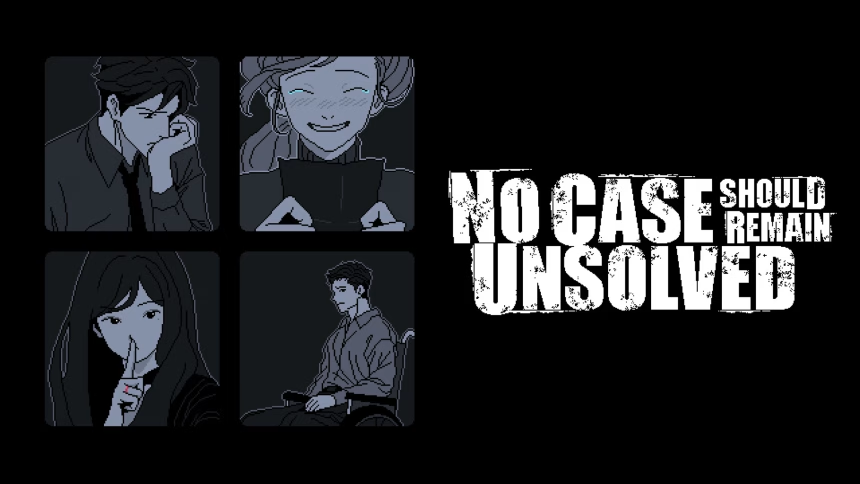
Detective fiction has a long history of struggling to balance the puzzle of a case against the person solving it, sometimes leaning so hard into clever mechanics that the detective disappears, sometimes leaning so hard into character that the mystery stops feeling like one. No Case Should Remain Unsolved finds that balance in an oddly literal way, refusing to let you piece together Seowon’s disappearance without also piecing together how unreliable the mind doing the piecing actually is. It follows the stoty of Senior Inspector Jeon Gyeong, Twelve years after retiring, who gets a visitor she cannot quite place, maybe a young officer, maybe Seowon’s ghost, maybe something closer to a judgment arriving to collect on an old debt. Whatever it is, it pushes her back into the 2012 disappearance of a little girl from a playground, a case that went cold and never really let her rest since. Her own memory keeps slipping while she works through it, which turns the investigation into as much a reckoning with her own unraveling recollection as with the actual facts of the case.
That reckoning plays out through fifty-four scattered conversations with no clear speaker or timeline attached, and I had to read tone and context just to figure out who was even talking before I could start untangling what they meant. Selecting specific words inside testimony I’d already uncovered stimulates new memories and unlocks fresh conversations, passcodes, and keys, which made the mystery feel like it was actively assembling itself under my hands rather than getting recounted to me after the fact. I made the same wrong assumptions Jeon herself must have made the first time around, and walking that path myself rather than watching her walk it gave the eventual reveal real weight.
Getting there took me through a real stretch of confusion in the middle before the pieces started locking into place, and I would have taken a keyword search function similar to Her Story over scrolling through that much testimony by hand. That friction is real, but it never undid how satisfying the last handful of connections felt once they landed.
Without spoiling the specifics, the truth behind Seowon’s disappearance ties into grief and mental illness within her own family, and the game treats even its most culpable figures with real moral complexity rather than flattening them into villains. Guilt and innocence don’t resolve as cleanly here as a typical mystery’s tidy reveal usually allows, and I sat with that discomfort longer than I expected a two to three hour game to earn.
Sparse pixel art and a deliberately restrained score, composed by Seongyi Yi, keep focus squarely on the text and the puzzle of figuring out who’s speaking and when, the same quiet minimalism Yi brought to Somi’s earlier Legal Dungeon and The Wake. Somi built this one during a stretch of unexpected free time in 2023, following the same authorial habit found across Replica and those other titles of turning an everyday task, reading a diary, scrolling a phone, sorting through interview transcripts, into the entire game itself.
That habit picked up real recognition here beyond just my own reaction to it. No Case Should Remain Unsolved won the Excellence in Game Design award at BitSummit 2024 and the Best Game Design award at Tokyo Game Show’s independent showcase. The BIC Festival gave it both an Excellence in Social Impact award and a Jury award, and it went on to earn an Excellence in Narrative nomination from the Independent Games Festival along with further nominations from indiePlay and gamescom latam’s BIG Festival. Steam carried the original release starting January 2024, with a Switch version following that September and a PlayStation 5 release, through publisher Playism, arriving in August 2026.
Verdict
No Case Should Remain Unsolved uses an inventive testimony-piecing system to make investigation feel like an active, real-time process rather than passive narration, and it rewards patience with a resolution that earns its emotional weight rather than assuming it. Its central tragedy gets handled with real moral complexity instead of easy answers, and its minimalist presentation, backed by Seongyi Yi’s restrained score, keeps focus exactly where a mystery like this needs it. A confusing middle stretch and the lack of a keyword search tool are real friction points, but for a short, award-recognized mystery built around the specific discomfort of not trusting your own memory, this earns its place among the more memorable detective visual novels out there.