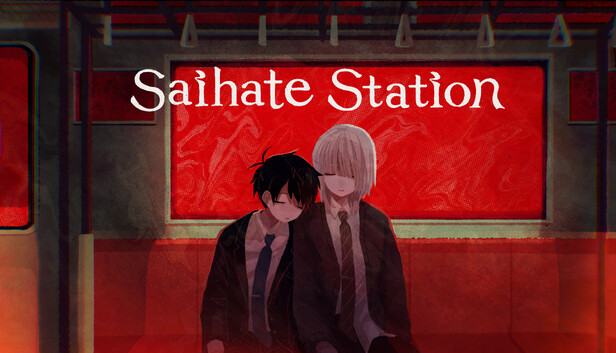
The station’s departure boards still function. Trains still arrive. Announcements still echo through the platforms. Yet Saihate Station has no place on any railway map, and everyone who reaches it quickly discovers that leaving is much harder than arriving. Saihate Station is a free horror adventure created in RPG Maker by viv. It follows Haru Akinashi and Shion Tatsunami, two 26-year-old coworkers who become trapped inside the mysterious Saihate Station while returning home from work. Although employed by the same company, the two have never formed a comfortable relationship. Shion is naturally talented, cheerful, and well-liked, while Haru struggles with self-confidence and has gradually begun distancing himself from his senior colleague out of growing feelings of inferiority. Their unexpected arrival at Saihate Station forces them to cooperate if they hope to find a way home. An earlier Japanese-only version released as freeware in May 2024, funded through crowdfunding, before the full multilingual version — including an official English localization — launched on Steam on March 7, 2025. It is available free of charge for Windows and macOS.
That strained relationship immediately becomes the game’s greatest strength. Horror often relies on isolation, but Saihate Station instead traps two people who already carry unresolved emotions toward one another. Every conversation reveals another layer of their dynamic, with Haru’s insecurity repeatedly colliding with Shion’s seemingly effortless optimism. Rather than treating these exchanges as interruptions between horror sequences, the game allows them to become the horror’s emotional foundation.
The official character profiles establish the imbalance between them before the story even begins. Haru joined the company only two months earlier and constantly compares himself to Shion, whose competence and outgoing personality make difficult situations appear almost effortless. Haru’s envy eventually leads him to avoid Shion altogether, making their shared predicament even more uncomfortable once escape depends on mutual trust.
As the pair explores Saihate Station, they encounter abandoned platforms, strange passengers, and increasingly disturbing mysteries that resist straightforward explanation. The game gradually introduces puzzles, exploration, and occasional chase sequences, but none of those mechanics dominate the experience. Dialogue remains the primary method through which both the characters and the station itself are understood.
The Steam page describes the game as containing simple puzzles and chase scenes while specifically noting the absence of surprise elements. Failure is also handled generously. If Haru is caught during a chase or reaches a game over, the player can immediately continue from nearby without repeating long sections. That approach keeps the focus on the story rather than mechanical punishment.
One mechanic quietly reinforces the relationship at the centre of the narrative. Throughout the story, Haru’s decisions influence an invisible dependency value. According to the official description, that value affects which ending the player ultimately receives. Rather than reducing the story to obvious moral choices, the game ties its conclusions to the evolving relationship between its two protagonists.
Visually, Saihate Station takes an approach that feels distinct from many RPG Maker horror games. Character portraits feature soft colours and expressive illustrations that contrast with the unsettling environments surrounding them. Instead of relying on grotesque imagery throughout, much of the atmosphere comes from empty platforms, dimly lit corridors, and locations that appear ordinary until something subtle begins to feel wrong. I found that contrast more unsettling than constant visual shock because it encouraged me to pay closer attention to small changes in the environment.
The soundtrack follows a similarly restrained approach. Rather than overwhelming scenes with dramatic music, I often found the quieter moments more effective, allowing conversations and ambient sounds to carry much of the tension. The game rarely felt eager to startle me. Instead, it encouraged me to sit with uncertainty, wondering what the station actually was and whether Haru and Shion could continue trusting one another as stranger events unfolded.
The official content warnings are extensive. The Steam page advises players that the story contains depictions of blood, murder, abuse, vomiting, frightening sound effects, and other sensitive themes. Those warnings are worth reading beforehand because the emotional intensity comes as much from the characters’ experiences as from the supernatural setting itself.
The game also offers multiple endings, giving replay value without significantly extending its relatively short running time. Since those endings depend on Haru’s dependency level, revisiting earlier choices can reveal noticeably different outcomes while remaining consistent with the relationship-focused structure established from the beginning.
Verdict
Saihate Station succeeds because it understands that its greatest source of tension is not the station itself but the two people trapped inside it. Haru’s growing resentment and Shion’s unwavering optimism create a relationship that remains compelling even during quieter stretches of exploration, while the dependency system gives their interactions lasting significance beyond individual conversations. I appreciated how confidently the game allowed atmosphere and dialogue to drive its horror rather than overwhelming the player with constant threats. Its puzzles remain accessible, its chase sequences avoid excessive frustration, and the story consistently returns to the emotional conflict between its protagonists. For a free horror adventure, Saihate Station delivers a remarkably focused and memorable experience built as much on character drama as supernatural mystery.