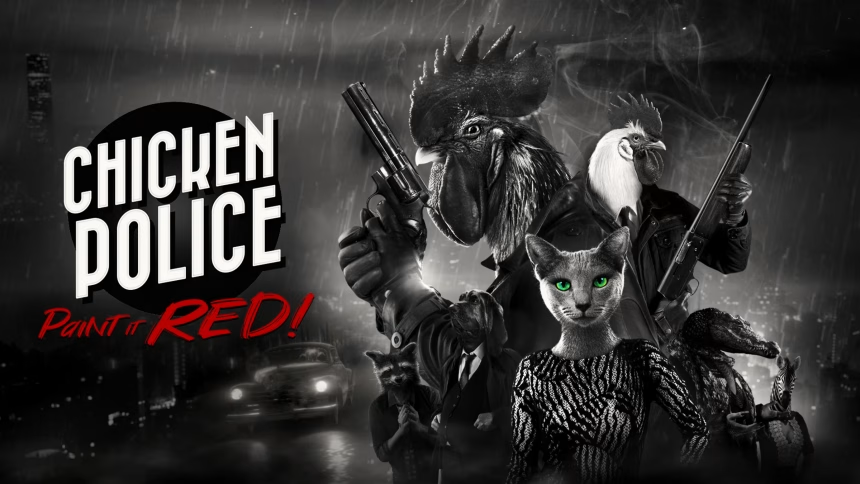
Two washed-up detective partners forced back together for one last dangerous case is about as familiar a noir setup as fiction gets, and Chicken Police – Paint it RED! makes the bold, slightly ridiculous choice to tell that exact story with a cast of human-animal hybrids, every character sporting a regular human body fused with an animal’s head. It sounds like it should undercut the genre’s inherent seriousness. Instead, once the initial visual jolt wears off, it becomes one of the more effective settings I’ve seen a detective story use, letting species stand in for real social hierarchy in ways that feel organic rather than heavy-handed.
Sonny Featherland and his estranged former partner Marty MacChicken, once Clawville’s legendary Chicken Police, get pulled back together for a case that quickly reveals the city’s dark underbelly. Clawville itself was conceived, in-universe, as an Edenic place where predators and prey could live in peace, and watching that founding ideal curdle into something considerably darker gives the whole setting real weight before the actual mystery even gets moving. This isn’t a world where every animal exists on equal footing, and the game takes its predator-and-prey social structure seriously, using it to explore real systemic discrimination and inequality baked directly into Clawville’s history and politics rather than treating the animal gimmick as pure novelty. That commitment gives even throwaway worldbuilding details, entries in Sonny’s investigative notebook about the city’s meat wars and social stratification, real thematic weight I did not expect walking in.
The Wild Gentlemen, a Hungary-based studio founded in 2018 by three friends and now grown to roughly twenty three people, made this their debut release, part of a wider project the team calls World of Wilderness. Director and writer Bálint Bánk Varga led the project alongside producer Tamás Bakó. Varga, Bakó, and Péter Nádas handled design, Nádas and Zsolt Várady programmed the whole thing in Unity, and a four-person art team, Alex Johannes Kuster, Zoltán Ludas, Titanilla Pizvor, and István Lovász, took responsibility for the game’s distinctive look. HandyGames published the finished game across an unusually wide spread of platforms on November 5, 2020, including Windows, Switch, PlayStation 4 and 5, Xbox One and Series X/S, mobile, and even Amazon Luna and Stadia.
That distinctive look comes from a real, unusual production pipeline. The team started by photographing real human models in a studio, then swapped the heads for animal photography, initially sourced from stock images before the developers decided to shoot their own photos at zoos and wildlife parks for a more convincing, grounded result. Dangerous predators were the one exception left to existing photography for obvious safety reasons. Small hand-drawn touches, like the glasses worn by a character named Bubo the owl, got added on top of the photographic base, and the finished images were broken into textures and animated inside Unity. Backgrounds went through their own multi-step process too, concept art first, then a 3D mockup and render, cut apart and rebuilt into a final 2.5D scene layered with lighting and filters.
Investigation itself blends point-and-click scene exploration with an engaging interrogation system, requiring me to read each suspect’s personality and figure out which questioning approach actually gets results, sympathy, pressure, careful probing, rather than treating every conversation as an identical dialogue tree. Sonny and Marty’s own banter carries real chemistry throughout, witty and lived-in in a way that sells years of shared history even during lighter, more comedic exchanges. The supporting cast gets real love too, with Archibald, a gangster sporting an impeccable French accent voiced by Fanos Xenofós, standing out to me specifically among an enormous ensemble. The game is entirely voice acted, more than eight hours of spoken dialogue across the whole cast, down to minor characters like a random possum encountered on the street. That density gives Clawville a real sense of a lived-in, populated city rather than a handful of important characters surrounded by silence.
Kerry Shale voices Sonny alongside a second role as Dr. Quetzal, Shai Matheson voices Marty, and Jules de Jongh voices Natasha Catzenko. William Roberts, Christopher Ragland, Demetri Goritsas, Devora Wilde, Patricia Rodriguez, Eric Meyers, Nicolette McKenzie, Toby Longworth, John Guerrasio, Lachele Carl, and Kelly Burke round out a cast carrying real pedigree from titles like The Witcher, Mass Effect, Horizon Zero Dawn, and Mirror’s Edge. Composer László Vincze scored the whole thing, giving the noir atmosphere a consistent musical identity that sits comfortably alongside the visual style rather than fighting it for attention.
Where the game shows real rough edges is interface and pacing. Some puzzle sequences demand specific clues in a particular order before progressing, occasionally in ways that felt more convoluted than intuitive to me, and the menu system itself never quite feels as polished as the writing and voice work surrounding it. Console-specific control choices, tying interrogation input to an analog stick with a fast dwell-timeout, made those sequences noticeably more frustrating on that platform specifically than they needed to be. The story’s overall beats, while well executed, also hit some predictable noir turns here and there, though the strength of the character writing carried those moments for me regardless.
A sequel, Chicken Police: Into the HIVE!, continues Sonny and Marty’s story on a new case, releasing on Windows in November 2024 through publisher Joystick Ventures, with ports for PlayStation, Xbox, and Switch still to follow. The Wild Gentlemen have also teased further projects under the World of Wilderness umbrella, including one called Moses & Plato – Last Train to Clawville and another called RetroSpace, suggesting Clawville’s world has more room left to explore beyond just Sonny and Marty specifically.
Verdict
Chicken Police – Paint it RED! turns its initially jarring human-animal hybrid aesthetic into a real vehicle for social commentary instead of just a gimmick. It builds a noir detective story with real emotional stakes around Sonny and Marty’s estranged partnership and a richly detailed, unequal world worth investigating. Superb voice acting across a huge cast and consistently sharp, witty dialogue elevate even the story’s more familiar genre beats, and a personality-driven interrogation system gives investigation real texture beyond simple clue-collecting. Some frustrating puzzle sequencing and rough interface choices, particularly on consoles, stop it short of flawless, but as a visually distinctive, thoughtfully written noir mystery, it holds up as a confident debut from a studio that clearly had more of Clawville left to tell.