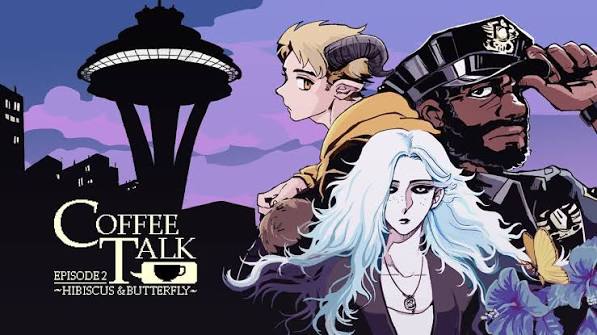
Being the barista rather than the customer changes the whole emotional math of a story, since you’re brewing someone’s comfort instead of just receiving it. That quiet, listening-first premise returns here, set three years after the original in an alternate-world Seattle where elves, orcs, nekomimis, and the occasional alien all wander in off the rainy street looking for a hot drink and someone to talk to.
Toge Productions developed and self-published this sequel, releasing April 20, 2023 for Windows, macOS, Switch, PlayStation 4, PlayStation 5, and both Xbox One and Series X/S on day one, a considerably wider simultaneous platform spread than the original game managed at launch. Director Kris Antoni Hadiputra returned alongside producer Frederick Tirta, designer and programmer Fredrik Lauwrensius, artist Dio Mahesa, writers Junkipatchi and Anna Winterstein, and composer Andrew Jeremy Sitompul, who also scored the first game. The story picks up on the stormy night of September 13, 2023, a few days shy of three years since the original’s own events, and knowing the first game’s true ending specifically pays off in a handful of scenes here that lean on that earlier resolution rather than re-explaining it from scratch.
The core appeal hasn’t changed. You brew custom drinks for a rotating cast of regulars while their conversations slowly reveal what’s actually weighing on them, but the returning cast’s problems have evolved alongside them rather than resetting to a blank slate. Freya, the face of the original game and now an established author in her own right, spends most of this entry away on a research trip, appearing only briefly near the end to hear about everything that happened in her absence. Her advice column runs during that stretch under a ghostwriter, Rahlia Aumat, filling in while Freya’s away rather than leaving the feature dark. Jorji Williams, the human police officer, gets a small comic touch of his own too, lactose intolerant enough that his first order becomes an impromptu tutorial in working around that specific limitation.
Lucas and Riona anchor the story’s newer material, and their origins trace back to an unusually candid bit of development history. Writer Junkipatchi has described both characters as splitting off from a single earlier concept that failed an internal script test for feeling unengaging on its own. That concept reworked afterward into Lucas, a boisterous satyr influencer currently taking a break from content creation, and Riona, a banshee working as a freight driver while chasing a soprano opera career that keeps stalling out under prejudice specifically aimed at banshees in the wider industry. That contrast between old-fashioned artistic persistence and modern online performance runs through several of the game’s newer storylines, and the writing gives even brief one-on-one conversations real emotional specificity throughout.
A mysterious white cat named Amanda, sporting two different colored eyes, occasionally slips into the shop looking for someone specific, adding a small ongoing mystery thread alongside the more grounded, everyday customer conversations filling most of the runtime. Silver, previously known as Neil in the original game, returns having transitioned since the first story, now living in a new body and going by he/him pronouns, one of the clearer and more prominent pieces of queer representation running through this specific entry.
Mechanically, this entry adds real teeth to the barista’s role through a new item system, letting you place a small object on the serving tray alongside a customer’s drink, a business card, a fidget spinner, whatever fits the moment, giving individual conversations another layer of choice beyond simply picking what to brew. The phone menu returns with four accessible apps, Tomodachill for social media, Brewpad for tracking every recipe you’ve made, The Evening Whispers for daily short fiction, and a new addition, Shuffld, letting you swap the shop’s background music directly. New hibiscus and butterfly pea-based recipes expand the actual drink list too, and latte art controls feel more refined than the original’s simpler version.
Returning faces fill out the rest of the cast alongside the new arrivals. Hyde, the gruff vampire with a soft interior, and Gala, his close friend and former bodyguard, keep their easy rapport intact. Jorji still drops by for gossip and drinks. Lua and her succubus partner, Rachel building a solo career after leaving her old band, Aqua working as a game developer alongside Myrtle, and Hendry making a brief appearance as Rachel’s still-protective father, all get at least a scene checking in on where their earlier arcs have landed. Aqua and Myrtle’s specific continuation lands a little less cleanly than the rest of the returning cast, their resolution feeling comparatively thinner than characters like Jorji or Lua who get fuller follow-through.
Where the game shows some real strain is in managing its larger ensemble. With more returning and new faces vying for screen time, a few individually interesting stories inevitably get pushed toward the background, and some conversations lean on filler dialogue that doesn’t always earn its place. The core gameplay loop also doesn’t change dramatically from the original beyond the new item system, which is less a flaw than a deliberate choice not to fix something that was never actually broken.
Watching customers’ individual storylines start to intersect over the course of the game was the biggest improvement for me, their private struggles quietly made lighter through the casual, incidental connections they build with each other over shared cups of coffee, a clear step forward from the first game’s more isolated character vignettes. How any of those individual stories resolves stays off the table here, but the writing trusts small, human moments to carry weight rather than reaching for anything more dramatic than the situation calls for.
Verdict
Coffee Talk Episode 2: Hibiscus & Butterfly succeeds by deepening what made the original such a beloved slice-of-life experience, using a new item mechanic to give the barista’s role real narrative weight while letting its returning and new customers’ stories intertwine in ways the first game never quite managed. Real character development for figures like Silver, alongside dialogue specific enough to make one-on-one conversations feel real, elevates the experience well beyond a simple retread. A larger cast means some individual stories inevitably get shortchanged, and the core gameplay loop stays largely unchanged from its predecessor, but for anyone who loved the original, this remains a warm, worthwhile continuation.