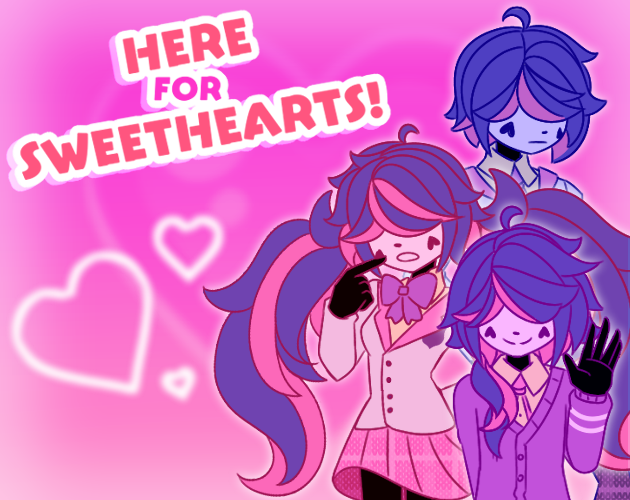
I used to think making friends was just a matter of finding the right thing to say at the right moment, some secret combination that would unlock people if you got it right. It took me a long time to realize the people worth knowing were the ones who liked you even when you got the combination wrong. Aether West Academy accepts exactly one new student partway through the school year, and Nova is it. The stated goal from the opening minutes of Here For Sweethearts is simple enough, win over as many classmates as possible, platonically or romantically, whatever form that affection ends up taking. What keeps nagging at that friendly setup is a detail the game refuses to explain outright, Nova is the only student living alone in a dorm, and nobody around them seems willing to say why.
That detail lands differently once you learn what Nova actually is. They are a pathospire, born to a pathospire father named Jik-Jak and a flamingo noisrevian mother named Bubblegum, a species that has to feed on other people’s heartbreak instead of ordinary food to survive. Chasing everyone’s affection stops reading as simple friendliness once that context sits underneath it, and the game lets that tension exist quietly rather than turning it into the whole point of every scene.
Here For Sweethearts shares its setting with several of the developer’s other visual novels like It’s Not Me, It’s My Basement, Crowscare, Cemetery Mary, and Tricks N Treats among them, and this entry takes real care reworking how certain returning faces come across compared to their appearances elsewhere. Characters treated as antagonists in Cemetery Mary get softened considerably here, Reginald and Mary chief among them, reframed into a couple written with warmth rather than menace. That willingness to let the same cast exist differently depending on which story is being told gives this specific entry its own gentler identity within the wider connected universe, even for anyone who has met these characters before under rougher circumstances. It’s worth noting that It’s Not Me, It’s My Basement centers on a kid living entirely alone too, which makes Nova’s own dorm situation feel less like an isolated writing choice and more like a theme this creator keeps circling back to across her catalog.
The roster stretches well past its two leads. Netina, Theodore, Mitzi, Ollie, Crowven, Vasilis, Twyla, Gunter, and an intermission chapter besides all get their own dedicated stretch of story, and Zapara and Jaxter close things out just before the finale. Theodore stood out to me specifically, carrying an easy warmth that made his chapter one I replayed just to sit with him a little longer, though the roster’s real strength is how distinct everyone stays even in chapters this short. Nova’s own name is customizable too, and typing in Nova manually does nothing special since that’s already the name the game defaults to if you leave the field blank, a small detail that says something about how little the game needs to gate behind secret inputs when the writing is doing the actual work.
The whole thing released in episodic bursts across roughly a year, from its first chapters in July 2021 through two closing chapters and a secret bonus chapter, unlocked only after finishing Jaxter’s route, in July 2022, with the developer openly noting along the way that chapters weren’t coming out on any strict schedule. Each chapter runs about ten to fifteen minutes and generally centers on one or two characters at a time, which keeps the pacing tight even though the full cast takes a long stretch of real time to fully meet. The game itself is playable on Windows, macOS, and Linux, distributed on a pay-what-you-want basis, with the option to read it in English or Spanish once the translation caught up.
Representation here goes beyond the pride-flag details worked into individual character designs. The developer is openly asexual herself, and has said directly that several characters in her games share that identity, including Mary and Reginald specifically as the central romantic pairing reworked in this entry. Treating that identity as simply part of who these two people are, rather than a plot point or an obstacle to overcome, is a rarer choice in this genre than it should be, and it never once felt like the game was making a point of it.
Art here is entirely the developer’s own work, simple in its linework but deliberate in its details, teenage Reginald wears his hair short and teenage Mary wears hers long specifically to visually mark how young these two are in this continuity compared to their appearances in Cemetery Mary. That kind of small, continuity-aware choice shows up throughout the cast, and it rewards paying attention even in a game built around short, self-contained chapters.
There is exactly one ending, and that is where my own hesitation sits. A few threads involving the more adversarial characters gesture toward a bigger confrontation the story never quite lets you have, and closing the game left me wanting a version where Nova got to push back harder against the people working against them, rather than one clean resolution covering every relationship at once.
A volunteer translator named Ivan brought the full game into Spanish in March 2024, nearly two years after the English version wrapped, extending a small free release well past its original audience. That kind of unpaid, after-the-fact support says something about how much this specific cast means to the people who found it, even if the game itself never asks for that kind of devotion. That devotion runs both directions too, since the developer sells a set of Discord emoji packs through her own Ko-fi page featuring characters pulled from across her catalog, this cast included, alongside a running Patreon that keeps the rest of her connected games moving forward.
By the time the last chapter closes, the quiet tragedy hanging over Nova’s dorm situation finally gets acknowledged rather than brushed off with another joke about it not being important. I will not say what that reason actually is, only that it recontextualizes the entire friend-collecting premise once it finally surfaces, and it left the ending feeling more earned than a game this short and this breezy had any obligation to be.
Verdict
Here For Sweethearts succeeds as a warm, unforced friend-sim that uses its shared-universe connections thoughtfully, giving familiar faces gentler arcs than their appearances elsewhere while building real affection for its cast around a mystery that stays quietly present without overwhelming the game’s cozy tone. Its asexual representation, built into its own central couple rather than treated as a talking point, stands out as a rare choice handled with real care, and Theodore alongside the rest of the roster gives the friend-collecting structure real emotional payoff. A single fixed ending leaves a few of its more adversarial threads without the confrontation they seem to be building toward, but as a free, continuity-aware entry in its solo developer’s growing catalog, this earns the small, devoted following it has found.