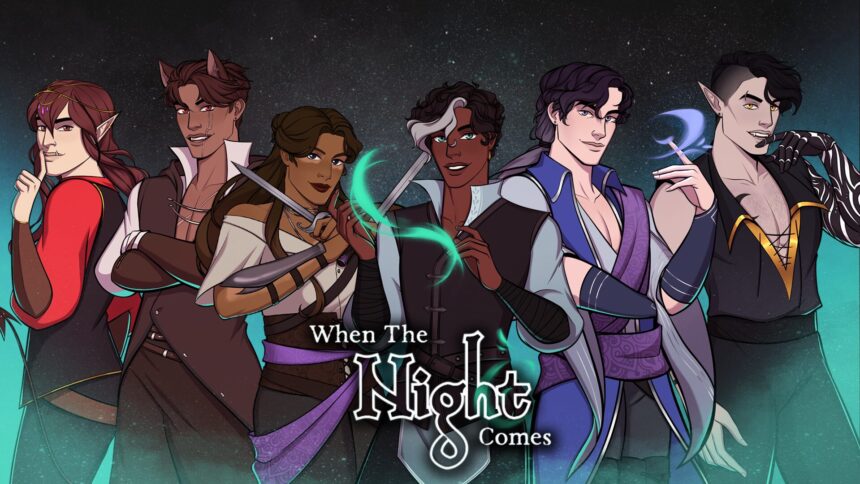
Monster romance is strange in a specific way most stories never fully sit with. The nearest cultural touchstone is probably Twilight, which sold that pairing mostly as a fantasy of safety, danger flattened out until it barely registered as risk at all. That comparison stops working almost immediately here, though, because nothing about this story lets the danger disappear. When The Night Comes hands its protagonist a job that requires killing the exact kind of person they’re being asked to fall for, and it never once flatters you that the tension resolves into something safe.
You take on the role of a renowned Hunter, summoned to the quiet, strange little town of Lunaris to assist the local Enforcers with an investigation into a string of unsettling, unexplained supernatural murders. Over the course of the story, you’re immersed in a world of witches, vampires, demons, and Lycans, working to figure out whether the actual culprit is one of the creatures everyone already fears, or something else entirely hiding underneath the town’s more obvious dangers.
Developer Lunaris Games originally completed the game in October 2019 before releasing a substantially reworked version, called the ReVamp, in August 2021 with partial voice acting, new artwork, a codex, and an improved interface. That ReVamp picked up Gayming Awards nominations for Best LGBTQ Indie Game two years running. The full package spans eleven chapters and more than 490,000 words, with over 80 hours of potential content across every possible route combined, individual romance routes running around six hours each on their own.
The ReVamp’s partial voice acting covers more than 2,000 lines, with a full cast including Jalen Cassell as Alkar, Jonah Scott as August, Ione Butler as Piper, Chris Patton as Omen, Adam Faison as Ezra, Gideon Emery as Finn, and Cyrus Nematti as Harry. Emery in particular brings real genre pedigree from prior roles in Dragon Age 2 and Skyrim.
You choose your own character’s name and pronouns right from the start, and the central investigation runs along a linear structure, meaning the core mystery doesn’t branch dramatically no matter which relationships you pursue along the way. Which romance you focus on still shapes how much time you spend with specific characters, and a dedicated no-romance mode lets you skip intimate content entirely without the game punishing that choice.
Six individual romance options exist alongside two polyamorous pairings, Finn and Ezra together, and Omen and Alkar together. August, your own commanding officer within the Enforcers, is written as non-binary and uses they and them pronouns, and stays a romanceable option despite the demanding professional dynamic sitting underneath that relationship. Piper is the only woman in the main cast, a skilled and powerful Hunter carrying real authority of her own. Harry Addington sits in sharp contrast, composed and agreeable through most of the story, understandable given how recently he lost his husband, only losing that composure near the very end. Omen, a demon, carries an oddly mundane weakness in the form of a chocolate allergy that makes his tongue swell, an absurd detail specifically because any allergy at all is unexpected for a demon to have. Alkar, a half-lycan, becomes a specific target of in-story prejudice once the murders start escalating tension across Lunaris. Being hired to hunt exactly the kind of person you might end up falling for gives every relationship real stakes from the moment it starts. How that tension plays out differently depending on who earns your trust first is the single strongest thread running through the whole script.
What actually makes that tension land is how the story treats Lunaris’s supernatural residents. Most of them are written as sympathetic rather than monstrous by default, people who just want to live peacefully, which flips the expected Hunter-versus-monster dynamic on its head and gives the mystery real moral texture instead of a straightforward good-versus-evil setup. The ending specifically lets you choose whether the Hunters and Enforcers pursue a closer relationship with Lunaris’s supernatural community going forward, tying personal romance choices directly into the story’s wider political resolution rather than keeping them separate.
Where the writing runs thinner is the wider worldbuilding underneath the mystery. The core investigation plot stays fairly linear regardless of dialogue choices. Details about how the Hunters and Enforcers organizations actually came into existence, or how magic itself works in this setting, get noticeably less attention than the mystery and romance content built on top of them. It leaves real curiosity about the wider world that the story doesn’t fully satisfy, even with plenty of room left for a sequel to pick that thread back up.
Accessibility choices throughout show real care. Important choices are clearly labeled ahead of time, and potentially triggering content gets an explicit warning before it appears. A generous number of save slots plus a built-in rewind feature make it easy to revisit and change an earlier decision without losing progress, a real practical benefit for a story built this heavily around branching relationships.
The current release includes more than 60 collectible CGs and codex entries that unlock as the story progresses, plus three post-game mini-stories originally sold as separate DLC now bundled directly into the main package. A further standalone DLC, Living Dead Girl, arrived October 29, 2022, built in just four weeks as a shorter thank-you to supporters. It lets you replay one of six characters, August, Alkar, Omen, Piper, Ezra, or Finn, in a comedic, partially voiced mini-tale running 40 minutes to an hour, priced separately at $2.99. Worth knowing directly, anyone on a Mac running 10.15 Catalina or anything newer won’t be able to launch the current build at all.
Verdict
When The Night Comes takes the Hunter-versus-monster setup and complicates it in real, meaningful ways, giving its supernatural cast real sympathy instead of treating them as obstacles to clear. The linear plot and thinner worldbuilding leave some real curiosity unanswered, but the romance options, the accessibility design, and an ending that ties personal choices into Lunaris’s political future make this one of the more thoughtfully built entries in its genre.