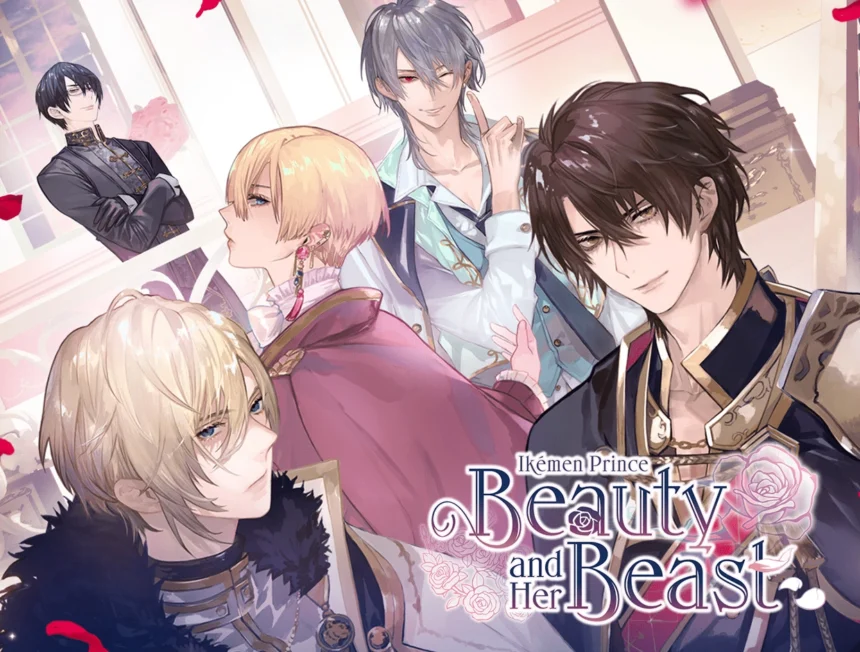
I used to roll my eyes at otome premises that hand the heroine a deadline, since most of them treat the ticking clock as an excuse to rush a romance rather than a real constraint on anyone involved. It took playing something willing to build its entire cast, its politics, and its own central rule around that deadline for me to take the device seriously again. Generations before the story begins, the royal family of Rhodolite tore itself apart in a war over succession, and the kingdom decreed afterward that a commoner with a pure heart would be chosen to select each future king, a role known as Belle. That history is what pulls Emma, an ordinary bookstore worker who has always wanted a bigger life than the one she has, into Ikémen Prince: Beauty and Her Beast, after the sudden death of the current king puts her in front of a royal minister and, soon after, in the palace itself as the new Belle.
She has exactly one month to choose the next king from among the eligible princes, each one feared and nicknamed a beast for how ferociously he fights. Falling for any of them carries a built-in expiration date too, thanks to the Belle covenant’s 99th clause, which forbids any further contact between Belle and her chosen king once the selection is finalized. That rule exists for a reason baked directly into Rhodolite’s own history, since the current princes’ own father once fell for the previous Belle himself, and the chaos that caused in the royal court is exactly why the clause was written in the first place. Knowing that backstory made the rule feel less like an arbitrary plot device and more like a wound this family keeps reopening with every new Belle.
Rhodolite earns its nickname, Kingdom of Roses, honestly, with rose motifs worked directly into its architecture and craftsmanship and roses that bloom year round regardless of season. It sits alongside neighboring nations Obsidian, Benitoite, and Jade, and Obsidian specifically has spent decades as a real, aggressive threat to Rhodolite, a history that breeds textually justified suspicion toward anyone connected to it. That suspicion colors how ordinary townspeople treat Yves Kloss, one of the princes, given his own mixed Rhodolite and Obsidian royal blood, and watching him get treated as a future traitor for something he never chose gave his early scenes a weight the rest of the cast doesn’t have to carry.
The original eight prince roster has grown considerably through added routes since launch, and the wider cast of named princes across the game’s material now includes Leon Dompteur, Chevalier Michel, Yves Kloss, twin brothers Nokto and Licht Klein, Jin Grandet, Luke Randolph, Clavis Lelouch, Sariel Noir, Rio Ortiz, and further additions like Silvio Ricci, Keith Howell, Azel Radwan, Matias Asbrink, and Kagari Amagase. The princes also split into competing court factions, Jin answering to Leon’s faction and Clavis and Luke both aligned with Chevalier’s, and each one trains and commands his own troop of soldiers and works on his own policy positions for the kingdom rather than existing purely as a romantic option waiting around the palace. Emma’s single month with these men forces real decisions well before she has had time to properly get to know any of them, and the 99th clause hanging over every growing connection gives even a simple shared meal more weight than it would carry in a story without that deadline attached.
The game itself runs on the freemium model familiar to this genre, gating story progress behind either five free daily Chapter Tickets, enough for roughly one chapter, or premium currency purchased directly, a system the game itself frames plainly as paying in Gold for the standard path or Diamonds for the premium one. A separate minigame called Salon Time lets you earn Intimacy points with your chosen prince outside the main story, and a collectible card system runs its own gacha alongside it, guaranteeing a five star card and unlimited redraws right after the prologue, with some cards carrying voiced lines and different levels of intimacy depending on rarity. A customizable player avatar can be dressed up with cosmetic items collected along the way, and a companion Glossary and World Map help keep the setting’s terminology and geography straight as the roster keeps expanding.
Character work here stands out relative to the crowded freemium otome space, but the actual amount of story content unlocked per single Chapter Ticket felt disproportionately small to me compared to how other Cybird Ikemen titles pace out their own daily allotment. That gap meant I could build real momentum in a route only to stall out waiting on the next day’s five tickets, which is a frustrating rhythm for a story this invested in its own countdown. Salon Time in particular read as filler rather than something built to hold my attention on its own merits, more a currency chore standing between me and the next scene I actually wanted to read.
Voice work comes from a solidly stacked Japanese cast, Kazuki Katou, Yuuki Ono, Shouichirou Oomi, Hiroki Yasumoto, and Shion Yoshitaka among the names attached to this specific roster, performers whose other credits run through plenty of well known anime. The voicing itself is partial rather than continuous, concentrated in the prologue and in the higher rarity gacha cards rather than running through every line of every daily chapter, which tracks with how this genre typically budgets its audio work across a story built to run this long.
I wasn’t able to confirm specific credited character artist or composer names for this release, so I’ll leave those attributions unclaimed rather than guess, though the anime style character art and the score both do real work setting the tone across the story’s lighter court scenes and its heavier confrontations alike. The emotional high point for me came from a scene tucked into one prince’s route where his own self worth, tied directly to his complicated bloodline, finally breaks down in front of Emma rather than staying hidden behind his usual composure. I won’t say which route it belongs to or how it resolves, only that the buildup toward that moment, watching someone convinced he doesn’t deserve his own crown slowly let his guard down, landed harder than the game’s glossier surface prepared me for.
Ikémen Prince also sits inside a much larger Cybird catalog, following the same studio’s Midnight Cinderella, Ikemen Sengoku, Ikemen Revolution, and Ikemen Vampire, and it wears that lineage openly rather than trying to distinguish itself from its own siblings. Fans of those earlier titles will recognize the daily ticket structure, the gacha, and the avatar customization immediately, even if this specific cast and its succession-crisis backdrop are what set it apart from the rest of the family.
Verdict
Ikémen Prince: Beauty and Her Beast earns real credit for how directly it commits to its own central premise, giving Emma’s one month deadline and the looming 99th clause real narrative teeth rather than treating them as background flavor. Its expanded roster of princes, political factions, and a threat from Obsidian give the world more texture than a typical otome backdrop, and the freemium structure is a real, consistent friction point that slows down even the story’s strongest stretches. Voice work from a well credentialed Japanese cast and writing that outpaces the genre’s crowded field make the wait worth it regardless, and for a franchise entry this committed to its own succession crisis, that’s a real achievement.