When I think back on visual novels built around the making of other visual novels, the ones that actually work share one thing in common. They treat the making-of process as the real subject rather than a cute framing device to hang a romance on. One thing that observation doesn’t quite capture is how much that unglamorous specificity actually costs a story in pacing, since committing to industry texture over dramatic momentum is its own kind of trade-off. And here we are now with a game betting everything on exactly that texture. Jumping into it, I was surprised by how much specific industry detail made it into scenes that could have stayed generic. Yet even with all that specificity, one particular route clearly comes out as the strongest of the bunch, but still not quite escaping the pacing problems that run through the whole structure.
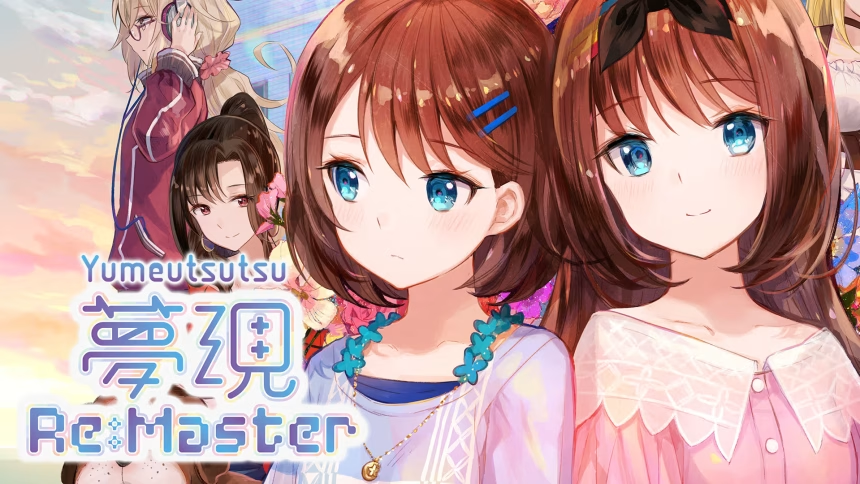
Ai Otori is twenty one, a country girl who moves to the old Tokyo-adjacent neighborhood of Koenji after a mysterious email lands in her inbox from a small indie studio called Eureka Soft. Her real reason for taking the job has nothing to do with career ambition. Her younger sister Kokoro works there and has cut off all contact with her, and Ai is hoping proximity might fix what distance couldn’t. With zero prior industry experience, she gets thrown straight into helping the studio’s tiny team remake an old visual novel called Nie, Majo, and the End of the World, known around the office simply as NieMajo.
One structural detail sets the whole world apart before the plot even gets moving. Men don’t exist in this setting at all. Every character is female, right down to the studio’s own dog and self-declared vice president, Banako. Alongside Kokoro, Ai spends most of her time working with administrative assistant Nana, who moonlights as the studio’s own voice talent, scenario writer Saki, nicknamed the office’s tiny dinosaur, and illustrator Marie. Additional side characters including Honoka round out the office, all under a studio head described by her own team as the big sisterly type holding the whole place together.
Kogado Studio, a Japanese company old enough to have started out in the printing business before ever making games, developed this through an internal team called Shimarisu. It released the game in Japan in 2019. Degica published the English localization the following April, bringing it to Switch and PC simultaneously with PlayStation 4 and PlayStation Vita versions following after. Kogado had already explored this same professional-life yuri territory once before. Kogado’s earlier Nurse Love Addiction and Nurse Love Syndrome duology mined similar territory from inside a hospital rather than a game studio, and the same instinct for grounding romance in a specific, unglamorous workplace carries over directly here. A sequel, Yumeutsutsu Re:After, followed in April 2020 as an after-story centered on all five main heroines, with its own six endings, one per character except Honoka, who gets two.
Four main character routes exist here, each carrying its own separate good and bad outcomes, and an overarching true ending sits behind all of them, only becoming accessible once you’ve cleared every individual character’s story rather than being reachable in one straightforward playthrough. Between the four routes and the true ending, the full structure adds up to nine possible endings in total. A full completionist run covering everything can stretch toward seventy hours.
The meta framing does real work here. Building a visual novel around a small team remaking an older visual novel gives the writing room to pack in specific industry references without ever feeling like it’s just winking at me. Renamed nods to well known franchises and environmental advertising for the studio’s own earlier Nurse Love titles get tucked into the background art, folded in as texture rather than announced with a spotlight.
Pacing across the individual routes is where the structure struggles most. The common route moves slowly and withholds a lot of context early on, which works fine as an intentional slow burn. Once you branch into a specific character’s story, though, plot beats tied to that character’s backstory sometimes get introduced abruptly rather than seeded earlier in the shared route. That makes certain routes feel like they’re interrupting the main story rather than naturally growing out of it. Having four separate writers handle different routes compounds this, since a couple of characters read noticeably differently depending on whose story you’re currently reading. I also found the choice system itself a real source of friction at points. Figuring out the specific combination of answers needed to progress sometimes meant retracing the same stretch of dialogue more than once just to land on the option the game actually wanted.
Every individual route builds toward a dark, bittersweet resolution rather than a conventional happy ending. That consistency across the whole cast means reaching any given ending carries real weight instead of feeling like a foregone conclusion you saw coming from the start. I won’t go further than that, since what actually happens in each one is exactly the kind of specific, personal reveal worth discovering for yourself rather than having spoiled here.
The CGs, backgrounds, and character portraits are rendered with real care, and one specific technical touch stands out directly. Certain backgrounds use animated rain effects layered right into the scene rather than a static overlay, a small but effective detail that added more atmosphere than I expected from something this understated. The text box also uses a color coded border system to indicate whose perspective a given scene is being told from, a useful piece of interface design given how often the narrative shifts point of view between characters.
Music carries its own real specificity too. The main theme, “Place of Promise,” is performed by vocalist Asaka, with two separate ending themes, “Natsukashii Machi” performed by Imai Asami and “Hana” performed by Azuna Riko. The wider soundtrack blends tense and upbeat cues with recurring piano melodies, including a specific work-focused theme that stayed engaging even deep into an exhaustive completionist playthrough. The game’s habit of looping the same short cues repeatedly did wear on me, though, by the time I reached my third or fourth route.
Every main character gets full Japanese voice work across every route, and the performances land consistently. Yoshioka Maya voices Ai, Numakura Manami voices Kokoro, Tokui Aozora voices Saki, Izawa Shiori voices Nana, Ikezawa Haruna voices Marie, Itou Shizuka voices Honoka, and Ohtsubo Yuka even voices the studio dog Banako. Only a handful of minor side characters land a little less convincingly by comparison.
Worth flagging directly, the developers themselves describe this as carrying mature themes including some nudity and sexual content, though it stays framed within the broader story rather than centered on explicit scenes for their own sake. Extras include a full CG and video gallery, a dedicated voice and music jukebox, and support for multiple save slots, standard for the genre but present and working here.
Verdict
Yumeutsutsu Re:Master earns real credit for treating its own meta premise with this much care. It lets a story about remaking a visual novel become a real showcase for industry texture and detail rather than a gimmick. The uneven route pacing, an occasionally frustrating choice system, and inconsistent characterization across four different writers are real problems worth going in aware of. The visual presentation and vocal performances carry the whole thing through its rougher patches, though, and the century-old studio behind it clearly understands the specific workplace drama it’s spent two separate series building.