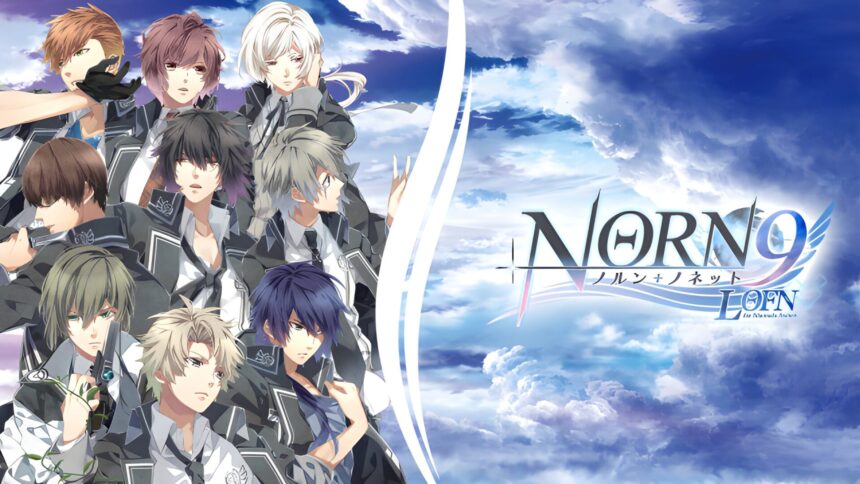
Three girls sit together over tea, trading complaints about whichever of the nine men on their ship did something foolish that week, and not one of them treats the others as competition. I went in braced for the usual rivalry a story with this many love interests tends to invite. NORN9 LOFN spent its first few hours proving me wrong instead and showing my how different it actually is.
Sorata Suzuhara is on an ordinary school trip when a strange, half-remembered song pulls him backward into the Taisho era. The girl who keeps him warm with fire she summons at will is the first sign that whatever happened to him is not going to resolve simply. The two of them get taken aboard a floating, globe-shaped vessel carrying a dozen similarly gifted people, later called Espers, gathered for reasons tied to something called The World that only unravel gradually. I expected the setup to explain itself faster than it does. Sitting with that unresolved tension longer than I wanted to ended up being part of the point.
Koharu earns her nickname for how disconnected she seems from ordinary conversation, unable to remember her own name and prone to writing new information down in a notepad she carries everywhere. She won me over faster than a character this withdrawn usually manages. It came down mostly to how much care the writing puts into small, specific details of her confusion rather than playing it for easy cuteness. Mikoto Kuga grew up wealthy under heavy expectations tied to her own abilities, carrying herself with a sharp, almost regal confidence that reads as critical on the surface. Nanami Shiranui stays quiet and reserved, armed with a kunai and a power strong enough to change the course of someone’s life. I found Nanami the hardest of the three to read early on, and that same reserve is what made her later scenes land harder for me than either of the other two heroines’ did. The three of them getting closer to each other than to any of the men made the individual romances feel almost secondary. Their friendship is the thread I actually stayed invested in.
Koharu’s three love interests are Kakeru, Senri, and Masamune. Nanami’s are Heishi, Akito, and Ron. Mikoto’s are Sakuya, Itsuki, and Natsuhiko, with no crossover between which men belong to which heroine. Masamune, Ron, and Natsuhiko all stay locked at the start, opening up only once you’ve cleared another route for that same heroine. I liked how much that structure quietly assumes you’ll want real time with each heroine’s world before earning her more complicated men. It rewards patience over route-hopping for the sake of variety.
Not every route carries equal weight. Several function mostly as character-focused vignettes that deepen a relationship without moving the ship’s overarching mystery forward much. Others dig directly into what’s actually happening and why everyone was gathered together in the first place. One route leans hard enough into melodrama, built around a love interest whose power lets him glimpse a future he cannot fully control, that it undercuts some of the more grounded, earned beats found elsewhere. That inconsistency actually bothered me, not as a minor quibble but as something that pulled my attention away from the ship’s central mystery more than once. It also makes the route I’d point to as the strongest stand out even further, since it’s the one that finally clarifies what’s been happening aboard the ship all along. Reaching it after already spending time in the others gave its answers real weight instead of dropping them in cold.
Otomate developed NORN9 under publisher Idea Factory, first releasing the original game for PSP in Japan on May 30, 2013. A Vita port titled Var Commons followed in Japan that December, reaching the West through Aksys Games in November 2015. Two fan discs came after: Last Era in April 2015, later localized for Switch in English in August 2023, and Act Tune in 2016, which never made it out of Japan or off the Vita. The Switch bundle sold in Japan under the single title NORN9 LOFN actually ships in the West as two separate releases, Var Commons and Last Era, rather than one combined package. I didn’t realize that until I went looking for where the story picks up after finishing the base game.
Character designs come from Teita, giving the cast a soft, detailed look that fits the story’s period setting. Akiba Minoru handles the background art, establishing both the Taisho era streets and the ship’s more otherworldly interior spaces. The contrast between those two spaces carried real weight for me, quiet as it was. Stepping from a sun-lit street straight into the ship’s stranger architecture kept reminding me how far from home Sorata actually was.
Music carries real pedigree for a game this size. The main theme comes from composer Nobuo Uematsu, well known for decades of work on the Final Fantasy series, with Kevin Penkin handling the arrangement and score around it. Vocalist Nagi Yanagi performs both the opening theme, “melee,” and the ending theme, “many universes.” The whole cast performs in Japanese, with Ayumi Fujimura specifically behind Koharu’s voice. Her performance carries Koharu’s disconnected, half-formed way of speaking better than the text alone managed for me. Hearing the hesitation in her voice sold the character in a way reading her dialogue on the page hadn’t quite done.
NORN9 spun off into a separate 12-episode anime, plus a special episode, animated by Kinema Citrus and Orange with scripts from Natsuko Takahashi. Penkin returned to score it, and it aired in Japan from January through March 2016. Knowing the game first made the anime feel like a strange companion piece rather than an adaptation proper, compressing choices I’d spent hours making into a single fixed path. I only noticed what got lost in that compression because I already knew what could have gone differently.
Verdict
NORN9 LOFN could have coasted on any one of its individual romances. Instead, the three heroines’ closeness with each other stuck with me longer than any one man’s route did, something this genre rarely bothers building with this much care. Route quality swings noticeably between tightly plotted highlights and thinner character vignettes, and the melodrama in at least one route pulled me out more than the stronger writing elsewhere ever did. The route I’d call the strongest finally answers what the ship and its Espers were gathered for, and reaching it after the others gave those answers real weight. Between Teita’s character art, Uematsu and Penkin’s music, and Ayumi Fujimura’s voice work carrying Koharu specifically, this is a cast and crew that clearly knew the story they were building.