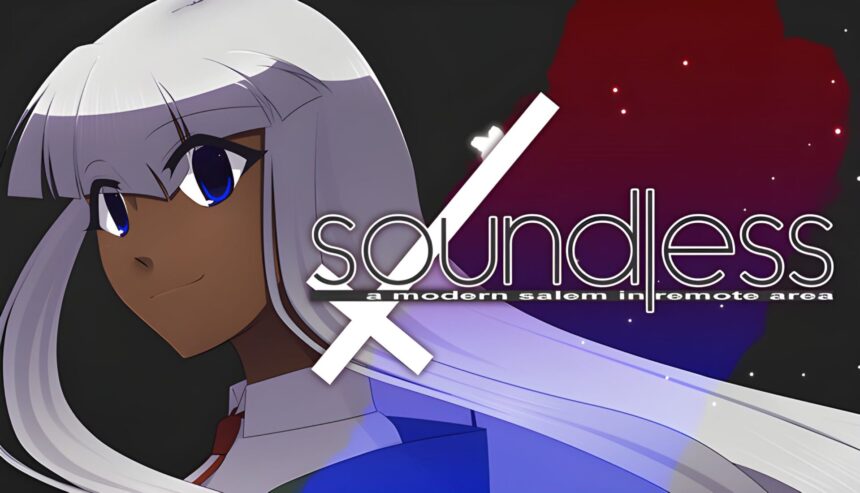
Good horror doesn’t need loud scares to work. The stories that actually stay with me are usually the quiet ones, the ones that let dread build in silence until it’s too late to look away. soundless – A MODERN SALEM IN REMOTE AREA understands that principle better than most horror visual novels manage.
The story settles in Phada, a village of only 145 people cut off from the rest of the world and governed entirely by a small clergy called the Group. They worship a protective god split into two halves, a defensive Barrier energy and an offensive Expulsive one, and nearly every custom in the village traces back to keeping that balance intact. Nearly everyone in Phada has lived under that framework their whole life. That makes any deviation from it, Mercy’s included, read as a threat to the village’s entire cosmology rather than just one girl’s personal problem.
Mercy lost her parents young and was taken in by the Group afterward, only to become an outcast within that same community once her eyesight seemed to turn against her at age ten and started showing her things nobody else could see. The Group’s answer was isolation, framed as treatment, and it left her marked as different well before she turned fifteen. By the time the story properly begins, Mercy is a bullied fifteen year old attending school under the weight of a reputation she never asked for. The sudden death of the village’s twenty-fifth Holy Woman throws Phada into a panic, and rumors spread that Mercy’s condition is somehow responsible. When the Head Priest announces that the village has been granted two new Holy Maidens instead of one, it’s Auma, the Barrier Maiden, who seeks Mercy out afterward with a simple admission: she can see it too. That admission from Auma lands with real weight specifically because Mercy has spent five years being told, implicitly and explicitly, that what she sees isn’t real.
Structurally, this is a kinetic novel with no branching choices anywhere in its runtime, a deliberate decision from developer milk+ for what was their debut project. The presentation style leans hard into the look of early 2000s Japanese visual novels on purpose, a stylistic choice that reads as affectionate homage rather than budget limitation. Mercy’s story was designed to stand on its own while also serving as the first entry in a larger, loosely connected series milk+ has continued building since, though nothing about reading it here requires familiarity with anything beyond what’s on screen. That series ambition shows up mostly in small worldbuilding touches rather than direct crossover content, background details that reward familiarity without ever demanding it from a first time reader.
Mercy carries the story’s emotional center, and her arc works because the game never lets her isolation become abstract. Watching her navigate a school full of people who’ve already decided who she is before she speaks builds a specific, grinding kind of dread that has nothing to do with jump scares. Auma complicates that isolation the moment she extends the smallest gesture of recognition, and the way Mercy responds to being seen for the first time in years carries real weight without the game needing to spell out where that connection eventually leads. Delilah, heir to one of the village’s prestigious clergy families, adds another layer of tension as someone caught between institutional loyalty and whatever she notices happening to Mercy around her. None of the three women in this triangle read as simply good or simply villainous either. That keeps the tension between institutional loyalty and personal conscience feeling properly unresolved rather than building toward an obvious right answer.
The writing carries the atmosphere of entrapment about as well as a story this compact can manage, and the denpa influence shows in how reality itself starts bending around Mercy’s perception rather than staying reliably fixed. That kind of reality bending shows up most in how documents and secondhand accounts start contradicting each other the deeper Mercy’s investigation goes. It forces a reader to hold multiple possible versions of events in mind at once. Where the game stumbles is in its final stretch, where the tone shifts hard enough that it landed for me as more jarring than earned, less a culmination of everything building beforehand than an abrupt swerve away from it. It’s a real complaint, not a small one, though it didn’t undo the impact of everything that came before it.
Visually, the retro presentation gets built from licensed background art credited to several outside contributors, including COCOON, Neo Himeism, Joe Mabel, BEIZ Graphics, Ayaemo Research Institute, and THoE. Character sprites carry the story’s more intimate moments, and the current release lets you toggle between the original 2017 artwork and a redrawn 2023 version, a rare bit of preservation-mindedness for a small freeware project. That dual art option matters more than a simple visual toggle too, since some scenes read noticeably differently in expression and staging between the two versions. Small choices like that shifted how a moment landed for me depending on which art style I had active.
milk+ is effectively one person, a developer working under the name Papaira, who has said the whole project grew out of discovering Team Shanghai Alice’s Touhou games and wanting to build something similarly personal on a small scale. Ever17 and Yume Miru Kusuri get cited as specific influences on the visual novel side of that ambition. Soundless itself first released in late 2017, funded as a free project with a donation drive tied to Hurricane Maria relief efforts running alongside launch. A second donation drive accompanied the Final Verse overhaul roughly five years later, this time split between causes the developer named directly rather than tied to a single disaster response. That personal, small scale approach carries through everything else about the project too, a single developer building an entire visual novel series slowly rather than chasing a faster, more commercial release schedule.
Music works the same way the background art does, assembled from contributions by Cnoc, Ramine, Abstract Hope, Taira Komori, Minpoke, THE MATCH-MAKERS, and Vita-Chi, with the in-game tracks converted from MIDI files through a specific soundfont named in the credits. It’s a patchwork approach by necessity, but the cues land where they need to, tightening the mood during Mercy’s worse moments without overplaying the horror. I’d have liked a slightly larger pool of original compositions given how much of the game’s runtime leans on quiet, ambient stretches, but what’s here does the job it needs to do without ever calling attention to itself.
Text carries every line in Soundless, no performed dialogue anywhere in the release. What the game offers instead is a self-voicing accessibility feature that reads the on-screen text aloud through the operating system’s own text-to-speech settings, paired with a text-to-clipboard option built for screen readers.
That accessibility work extends further than most visual novels bother with, freeware or otherwise, and it’s worth crediting milk+ directly for it. Photosensitive mode, an option to disable screenshake, audio captions that display translated song titles during key scenes, and image descriptions all ship as standard features, alongside an alternative Atkinson Hyperlegible font for players with less severe visual impairments and full gamepad navigation support. Full gamepad navigation in particular is an easy feature to skip for a small kinetic novel built primarily around mouse and keyboard reading. That makes its inclusion here feel like a deliberate choice rather than an afterthought. Few small studios build this much consideration into a first release, let alone one that costs nothing.
Soundless is free on both Steam and itch.io, distributed as a donation-supported project rather than a paid release, and the current build represents a major overhaul the developer calls Final Verse. That version adds a bonus epilogue story titled Adiaphoron, created specifically for the game’s fifth anniversary, alongside the accessibility suite and dual art options already mentioned. Saves from earlier versions of the game don’t carry over into Final Verse, a clean break the developer made deliberately when overhauling the engine version underneath the whole release. The Steam listing also notes incompatibility with macOS 10.15 Catalina and later, worth knowing for anyone on an older Mac setup. Content warnings for extreme bullying, religious and domestic abuse, gore, and disorienting or surreal imagery are posted upfront by the developer, and they’re accurate to what’s actually inside. This is a short read, comfortably finishable across six to eight hours in one or two sittings, and its lack of branching paths means everyone who plays it experiences the exact same story beat for beat.
Verdict
Soundless lives up to the denpa horror lineage it clearly draws from, building real dread out of isolation and false hope rather than cheap scares, anchored by a protagonist whose pain never feels abstract. The final stretch shifts tone hard enough to undercut some of that goodwill, and the fully linear structure means there’s no variation across playthroughs, but neither issue erases what an accomplished, thoughtfully accessible debut this is. Few free horror visual novels put this much care into both their scares and the readers who need extra support actually getting through them.