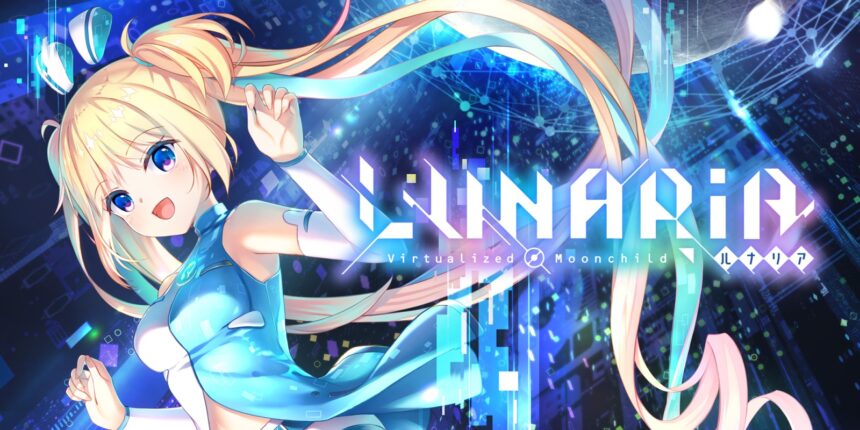
A rabbit-eared girl is waiting on the far side of the Moon, inside a server almost nobody knows exists. She cannot step outside it, cannot look up from Earth and see where she lives, and cannot cross the 384,400 kilometres separating her from the boy who accidentally found her. All she can do is ask him to return.
Before Takeshi Matsuyama wrote that relationship as a visual novel scenario, he wrote it as though he were producing another novel. Matsuyama had published more than twenty light novels but had never written a game script when former project director Daichi Koneko contacted him. Koneko had read Matsuyama’s science-fiction novels Iris on Rainy Days and Kimi Shi ni Tamou Ryūseigun while searching for someone capable of combining science fiction with the emotional storytelling expected from Key. Matsuyama accepted the offer despite his uncertainty about moving into an unfamiliar medium.
That transition shaped the development of LUNARiA -Virtualized Moonchild-. Matsuyama initially wrote freely in prose, after which Koneko advised him on pacing, presentation, and the amount of text that could comfortably appear inside a visual-novel window. Matsuyama also read several Key titles while learning the form, including planetarian, which the developers treated as a quality benchmark for the project.
The project did not begin solely with Lunar-Q. Producer Tōya Okano first requested a kinetic novel built around esports. Koneko produced several proposals involving esports, virtual reality, and artificial intelligence before the team settled on an AI living on the far side of the Moon. Koneko described the Moon as the most distant place people can still readily imagine, making it suitable for a story about an extreme long-distance relationship. The esports and virtual-reality elements were then incorporated around that central image.
T-Bit, whose real name is Tabito Kamishiro, is a high-school student and dominant competitor in the virtual-reality combat-racing game SkyOut Forever. He earns prize money by racing until a network error sends him into Lunar World, an unknown server based on the Moon. There he meets Lunar-Q, an AI avatar who identifies herself as the rejected mascot of a lunar development project and wants to see Earth for herself.
I found the racing material useful less as a competition plot than as an explanation for why T-Bit is comfortable treating virtual space as somewhere meaningful. Lunar-Q does not have to persuade him that a digital environment can support real identity, work, friendship, or attachment. He already makes his living there. Their relationship therefore begins with a shared acceptance of the virtual world, even though only one of them can leave it.
The early chapters lean heavily into Lunar-Q’s energy. She is enthusiastic, affectionate, and quick to turn T-Bit’s visits into events worth celebrating. I sometimes found that cheerfulness exhausting, particularly when several playful exchanges arrived without enough contrast between them. The writing became more persuasive once it showed that her behaviour was not the entirety of her character. Her excitement about Earth carries the weight of someone whose knowledge of it comes through screens, data, and conversations rather than physical experience.
T-Bit is initially easier to understand through action than introspection. SkyOut gives him a public identity, an income, and a place where his skill produces immediate recognition. Lunar World removes the familiar structure of competition. He cannot solve Lunar-Q’s circumstances by simply becoming faster than another racer, and that limitation gradually forces him to invest in something outside his established measure of success.
Their distance is specific rather than abstract. The official description places 384,400 kilometres between the real Earth and the virtual Moon, while the development interview repeatedly returns to the idea of a romance that feels simultaneously close and impossibly remote. T-Bit can communicate with Lunar-Q and enter the environment where she lives, but the relationship remains divided by a physical reality that neither conversation nor virtual presence can erase.
That contradiction became more effective for me than the harder science-fiction vocabulary surrounding it. The technical material gives the setting rules, but the emotional problem remains straightforward. Lunar-Q can know Earth without experiencing it. T-Bit can visit her without truly reaching her. Each successful connection therefore emphasizes the boundary it temporarily overcomes.
LUNARiA is a kinetic novel, so I never selected dialogue options or redirected the story into another route. Key and Prototype explicitly describe it as having no choice-based branches, with the narrative proceeding along one fixed path. That structure suited the material because the later revelations depend on controlled timing and on information established much earlier in the story. A route system would not automatically have improved a narrative designed around delayed context and reinterpretation.
The fixed path also meant the slower opening could not be bypassed. I had to spend time with the lighter conversations before the story widened its concerns. That patience eventually paid off for me because later developments changed how I understood several earlier scenes, but the improvement did not erase my frustration with portions of the opening. The first half is not secretly perfect because the second half adds context. It is simply more purposeful in retrospect than it initially appears.
I will not describe the later plot turns because doing so would damage the structure that makes them effective. What I can say without revealing outcomes is that the story eventually examines who controls technology, what responsibilities institutions have toward the intelligence they create, and how isolation changes a person who has no meaningful way to leave their environment. Those themes emerge through the plot rather than through optional lore entries, and they gave the science-fiction premise more weight than the early romantic comedy suggested it would carry.
Matsuyama’s background was a good fit for that shift. Koneko sought him out because his earlier work combined artificial intelligence, space, and emotional storytelling, not merely because Key wanted technical terminology. The development interview makes clear that the team needed someone who could handle both science fiction and a moving character story. I thought the finished script was strongest whenever those goals became inseparable, with a technical limitation producing an emotional consequence rather than pausing the relationship for an explanation.
The character art is divided between humuyun, also credited as Fumuyun in other English-language material, and Sora Saeki. Official Switch materials credit both artists, while the four principal Japanese performers are Minami Tanaka as Lunar-Q, Takahide Ishii as T-Bit, Yuki Wakai as Con Momosaki, and Anna Yamaki as Myau Myov. The story is fully voiced in Japanese, with English, Japanese, and Simplified Chinese text available in the Switch and Steam releases.
The designs embrace Key’s familiar cute aesthetic, particularly in Lunar-Q’s rabbit-themed avatar. That style occasionally intensified my impatience with the sweeter opening scenes, but it also made the visual difference between the virtual personas and their surrounding environments immediately legible. The CG work held up well at the full-HD resolution supported by the later releases, especially during scenes where scale and distance mattered more than elaborate movement.
Full voice acting contributes substantially to the characterisation. Minami Tanaka gives Lunar-Q enough variation that her enthusiasm does not remain one unbroken note, while Takahide Ishii keeps T-Bit from sounding emotionally vacant during passages where the written character remains guarded. I found their quieter exchanges more effective than the broadest comedic scenes because small changes in pacing and tone carried feelings the narration did not need to restate.
Shinji Orito served as sound producer, with the complete soundtrack drawing on work from several composers associated with Visual Arts and Key. The commercial soundtrack contains twenty-five tracks. The two opening songs, “LUNAR RISE” and “PRISM PRINCESS,” are included in full in the Switch release and become available through its music menu after completing the story.
I considered the soundtrack one of the production’s strongest elements. The racing material uses more immediate energy, while Lunar World receives music that makes the server feel peaceful without making it emotionally neutral. The score becomes especially effective when a familiar cue returns under circumstances that have changed, allowing the music to recall an earlier emotional state without repeating the corresponding scene.
The original Japanese Windows version launched on December 24, 2021. Mobile ports followed in February 2022, the multilingual Nintendo Switch version arrived on February 22, 2024, and the Steam release followed on August 30, 2024. The Steam version supports English, Japanese, and Simplified Chinese text, Japanese audio, full-HD presentation, touchscreen devices, and Steam Deck play through Proton.
I could not verify a universal eight-and-a-half-to-ten-hour runtime through official material, so I have not treated that estimate as a production fact. My own completion time fell within the range commonly associated with a medium-length kinetic novel, but reading speed, voice playback, and automatic text settings can change that substantially. The absence of branches means the full narrative content is encountered in one playthrough rather than divided among routes.
The official English script was understandable throughout my reading. I noticed occasional lines whose grammar or phrasing sounded less natural than the surrounding dialogue, but none prevented me from following the scene. That is my assessment of the localization I read, not a claim that every player or language version contains the same issues.
Steam currently classifies the game’s user reception as Very Positive, with 94 percent of 163 recorded reviews marked positive at the time I checked. That figure establishes a strong user-review ratio on that storefront, but it does not justify broader claims that the title is universally regarded as one of Key’s best works.
Verdict
LUNARiA -Virtualized Moonchild- benefits from the exact tension built into its production. Takeshi Matsuyama approached the project as a novelist entering game writing for the first time, while Key’s staff reshaped that prose around the pacing, art, sound, and performance of a kinetic novel. The result is most convincing when its science-fiction rules create emotional restrictions that T-Bit and Lunar-Q cannot simply talk their way around. The opening’s sustained cuteness tested my patience, and the fixed structure offers no route around those stretches. Once the narrative begins using its earlier details more aggressively, however, the same linearity becomes an advantage. Strong Japanese performances, carefully divided virtual and physical imagery, and a twenty-five-track score support a romance whose central obstacle is not misunderstanding but measurable distance. It does not need alternate endings to complete its argument. It needs the reader to reach the only one it has prepared.