Where God going silent usually sets up a quiet, contemplative story about faith, Tokyo Babel turns it into the trigger for full scale interdimensional collapse instead, and somehow still finds room for slapstick bickering, awkward crushes, and characters cracking jokes in the middle of the end of the world. That mismatch between scale and tone shouldn’t work nearly as well as it does, and it’s the reason the whole thing was still on my mind days after the credits rolled.
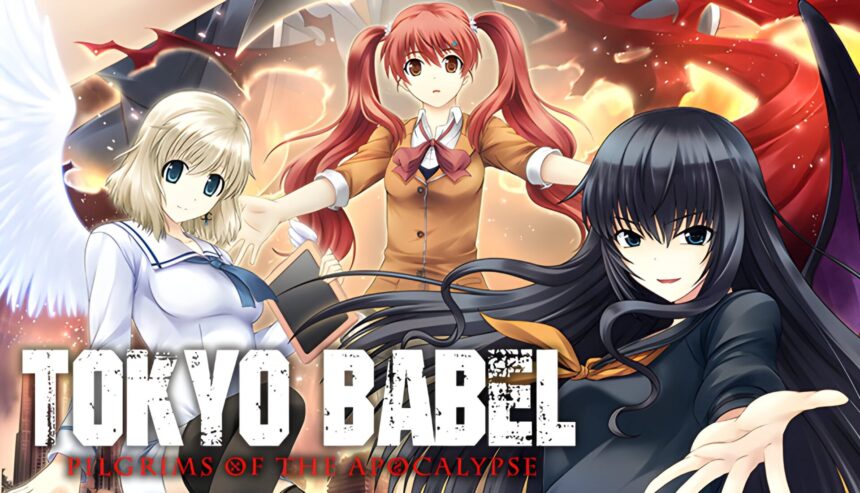
The trigger for all of it, which characters later call the Divine Calamity, is total silence from God. Archangels lose contact with Heaven overnight, Lucifer vanishes from a flooded Hell, and one parallel Earth after another tears itself apart. Out of the wreckage, angels, demons, and human survivors build a floating refuge called Tokyo Babel, staging a pilgrimage up Jacob’s Ladder to reach God directly and demand answers. Kugutsu Sorami gets pulled into this world after discovering her entire high school is a fabricated dream trap, rescued by Tendou Setsuna, a boy who has spent his whole life denied normal human treatment because of the nanomachines running through him. Lilith, a demoness with her own agenda, and Raziel, an angel whose competence rarely matches her clumsiness, round out the group carrying most of the story.
Writer Yuichiro Higashide leans hard into biblical and apocryphal source material, and it pays off. Metatron, Astaroth, and Leviathan all get treated as more than borrowed names, with enough grounding in the actual mythology that looking up the real references adds a second layer of reward. The seven layers of Tokyo Babel that the pilgrims climb toward Heaven give the plot a literal structure to match its thematic one, and the writing rarely lets that framework go slack even when individual character arcs do.
Visually, Tokyo Babel holds up well for a game Propeller first released in Japan back in 2012, with panning, zooming, and animation touches that felt ahead of their time even by the point MangaGamer localized it for English readers in 2016. CG art turns up often enough that big story beats rarely pass without a dedicated illustration to match them. The soundtrack, thirty tracks strong, carries scenes competently throughout, though several cues repeat often enough to lose their impact by the time a full route wraps.
I didn’t expect comedy to be one of the strongest cards here, but it is, oddly enough, for a story built around the end of multiple worlds. Slice of life scenes between the main cast land funnier than the premise has any right to allow, largely because the voice cast sells every exaggerated reaction and awkward pause. That voice acting exists at all is notable, since Tokyo Babel’s all ages rating gave the production room to secure a fuller cast than many adult labeled visual novels manage.
Fights carry more weight than pure spectacle would suggest, since each character’s raison d’être, their core reason for living, fuels both their power and the emotional stakes of the scene. A missile launching cyborg or a demon lord twice a character’s size isn’t just an obstacle to clear, it’s an argument about what that fight is actually for. That structure keeps even the most over the top confrontations tethered to character rather than letting them become empty power scaling exercises.
Fifty hours across three main routes is a long ask, and the back half struggles to justify all of it. Setsuna narrates most of that runtime, and his emotional flatness makes long stretches hard to stay invested in. Sorami fares much better, particularly once her own route gets going, where a handful of quieter, character focused scenes carry a weight the rest of the cast rarely reaches, the kind of scene that changes how an earlier moment between her and Setsuna reads in hindsight without spelling out exactly where that thread ends up.
The wider cast of angels and demons mostly stays inside comfortable anime archetypes, competently played but rarely breaking from type given how large the roster gets. Character motivations occasionally read as inconsistent as a result, especially among side players who get less screen time to justify sudden shifts. Samael breaks from that pattern immediately, an unhinged, Alice in Wonderland inspired figure whose scenes are memorable mostly for how strange they get rather than for any real narrative weight.
Verdict
Tokyo Babel commits fully to an apocalyptic premise built on real biblical depth, then undercuts the doom with comedy that has no business working as well as it does. The raison d’être combat and Sorami’s route give the back half real high points, even as Setsuna’s flat narration and an overlong three route structure test patience along the way. What’s left is a flawed, distinctive visual novel that earns its length more often than it wastes it, provided a reader is willing to stick with the slower stretches to get there.