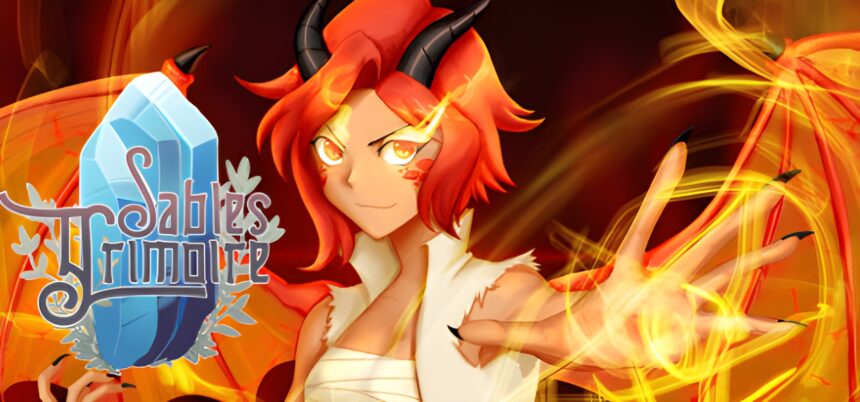
The essence of Sable’s Grimoire as a magic school dating sim is that romance keeps taking a back seat to Sable’s own stubborn focus on his studies, again and again, right up until it doesn’t anymore. That’s not a complaint exactly. But when it comes to actually building romantic momentum, the game’s thoughtful worldbuilding sometimes takes a backseat to a reluctance toward romance that doesn’t always respect how long a reader’s patience can stretch. That’s the whole tension of the game in miniature, a story more interested in earning its romance the slow way than handing it out early.
It took a script running past 25 hours for a single full route to unbury all the layers of Amadronia Magic Academy’s demihuman society, and getting a real sense of the wider cast means running through multiple routes on top of that. You and your fellow students navigate a magic school where humans rank near the bottom of the social order, forced to prove basic competence in a building full of species who outclass you by default. As far as capturing the vibes of a Harry Potter style magic school while still building something specific to itself, developer Zetsubou has done a properly thoughtful job. Zetsubou has said in interviews that the games are written entirely in American English despite being an Australian citizen, a small detail that speaks to how deliberately the whole project gets built despite operating well outside any studio structure.
Sable enrolls at Amadronia Magic Academy as one of only two humans in his entire grade, and the game leans hard into the particular anxiety of being an outsider in a school where even a bottom tier magical species outclasses him by default. That inferiority runs through the whole common route, giving Sable real stakes tied to his own competence rather than just romantic pursuit. Even small classroom interactions carry that weight, since Sable has to actively work to be taken seriously by classmates who assume his magic can’t possibly measure up to theirs. It’s a smart foundation for a story that turns out to be considerably more interested in worldbuilding and personal growth than its dating sim framing initially suggests.
One of the more refreshing choices here is how little urgency the game puts on romance itself. Sable stays consistently too busy, too focused on his studies, and often outright uninterested in pursuing any of the women around him, and watching that resolve wear down organically over dozens of hours feels considerably less leery than genre convention usually delivers. That patience extends to how the game treats Sable’s own ambitions too, since his stated goal of becoming a magic researcher never gets sidelined just to clear space for a faster romance plot. His roommate Tix, a pixie who never gets a dedicated route of her own in the base game, still gets enough presence that her absence from the romance options feels like a deliberate choice rather than an oversight.
The main heroines mostly avoid being defined purely by their species gimmick. Rei’s constant hunger and stretchy rokurokubi neck could have stayed a one note joke. Her joint route with the mandragora Eth finds real emotional ground beyond the physical comedy the two of them lean into early on. Eth himself, sharing that joint route with Rei, gets treated as a full character in his own right rather than a comedic sidekick tacked onto her story. The two of them build a dynamic that works because neither one carries the route alone. Jorou’s half spider design and literal hunger for books gives her arc a distinct flavor among the cast. Lisha carries herself with valedictorian composure that slowly cracks to reveal someone far less certain of herself than her reputation suggests. Drakan, a pyromaniac half dragon who never seems to sit still, gives the cast its most immediately chaotic presence, and her energy makes the quieter routes elsewhere in the game land with more contrast by comparison.
Eris, the teacher openly bored by having to educate what she calls the school’s shitty brats, eventually gets a route of her own added after the base game’s initial release, expanding a character who starts out as pure comic relief into something with real depth underneath the sarcasm. Raphael rounds out the faculty as a much longer tenured teacher, someone who’s been at Amadronia long enough that Rei’s own mother once sat in her classroom. That balance between comic relief and real depth extends to how the game treats its faculty generally. Teachers who could have stayed pure background texture instead get enough personality to feel like they exist outside the classroom too.
Where the writing runs into real trouble is consistency. I hit more than one moment where Sable states or thinks something that directly contradicts information established just paragraphs earlier in the same conversation, the kind of continuity slip that suggests routes got written somewhat in isolation from each other without enough of a unifying editorial pass. The contradictions tend to cluster around small factual details rather than major plot points, a character referencing an event slightly differently than how it was actually described, which suggests rushed proofreading more than any deeper structural problem with the writing itself. It’s not damaging enough to derail any individual route, but it’s noticeable enough to pull focus during otherwise strong scenes.
It’s a large cast for a game this size, sixteen endings spread across the main story paths, and while some routes clearly received more polish and attention than others, the overall hit rate for distinct, well realized characters is higher than a game this size usually manages. That structure rewards real investment in more than just a single favorite character. Seeing the full picture of what Amadronia and its wider demihuman society actually look like takes stitching together details from routes a reader might not have picked as their first choice. Player choice matters meaningfully throughout too, with distinct good and bad endings requiring real attention to which routes remain open or closed off depending on earlier decisions, giving replays real purpose rather than just cosmetic variation.
Presentation carries the game well beyond what its budget might suggest. There’s a substantial amount of original artwork across a cast this large, and a large soundtrack, over thirty tracks, gives even repeated locations a sense of atmospheric variety the somewhat reused backgrounds don’t always provide on their own. Backgrounds get reused across scenes more than the character art does, a common budget tradeoff for a project this size, but the soundtrack’s variety does real work compensating for that repetition rather than leaving those returning locations feeling stale. Character sprites carry real range across the school’s various demihuman species too, distinct enough at a glance that the cast never blurs together even during group scenes.
Worth knowing plainly before starting: an eighteen plus patch exists for readers who want the game’s more explicit content, installed by default through itch.io downloads but handled as an optional layer on top of the same core story and character routes regardless of which version a reader chooses. That kind of clear separation between the core narrative and its optional adult content is worth appreciating directly, since it means neither version of the game shortchanges the actual story to accommodate the other.
Zetsubou has kept expanding this world well past the base game’s original release. Sable’s Grimoire: Man and Elf continues Lisha’s route specifically, and Sable’s Grimoire: A Dragon’s Treasure does the same for Drakan, both releasing in the summer of 2020. A direct sequel, Sable’s Grimoire 2, picks up the remaining cast’s after story and released for PC on April 14, 2026, following Sable into his second year at Amadronia alongside returning characters and a fresh grade of new students. Following a single continuity across a base game, two direct spinoffs, and now a numbered sequel eight years later is a real commitment few solo projects in this genre actually follow through on.
Verdict
Sable’s Grimoire takes a premise that wears its Harry Potter influence openly and builds something with more heart and specificity than that comparison initially suggests, using Sable’s outsider status and reluctance toward romance to ground a large, mostly well realized cast of demi-human classmates. Its chaste, slow burn approach to romance is a welcome departure from genre convention, treating attraction as something that has to be earned through Sable’s own growth rather than assumed from the outset. Inconsistent writing that occasionally contradicts itself within the same conversation is a real, recurring flaw, but between its ambitious scope, distinct character routes, and a soundtrack that punches above the game’s indie budget, this is one of the more substantial entries I’ve come across in the raising sim adjacent dating sim format.