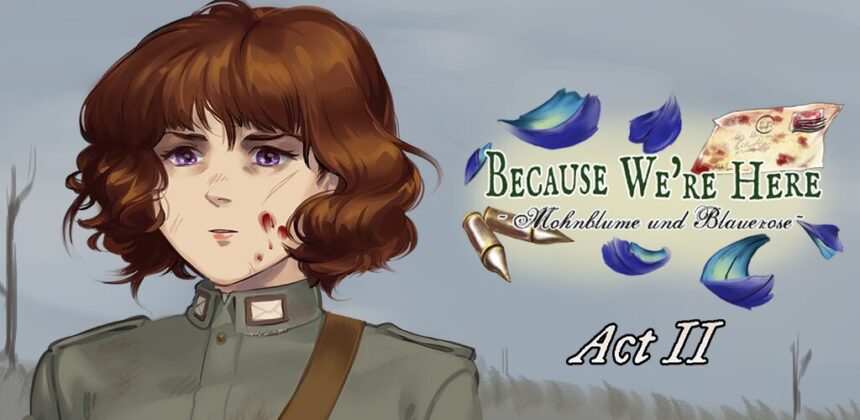
A month passes between Act I’s ending and this one’s opening. In that time Elfriede Rauss has gone from grieving on the sidelines to formally entering the war as a Postal Corps private, which is exactly the kind of escalation this series needed. Where the first act spent much of its runtime laying groundwork, Act II, subtitled Live and Let Live, delivers on everything that setup promised. It runs longer, denser, and considerably more willing to let its ensemble cast actually suffer the consequences the setting has been threatening since the opening tagline’s grim joke about being home by Christmas.
Nineteen characters have now been introduced across the two acts combined, eleven from Act I and eight new arrivals here, though only sixteen of them are actually available as romance options, Ethel Winter chief among the three who aren’t. The war itself traces back to a dispute over Vermorel, a fertile stretch of land claimed by both Elfriede’s home country of Wesslinger and the neighboring Leyland, and the returning cast gets real room to show how six months of war has reshaped them. August, Wolf, and Eugen in particular read as different people by the time Elfriede crosses paths with them again, not through some contrived personality flip but through the accumulated weight of specific, believable trauma. That character development gives weight to a structural choice the game commits to fully. This isn’t a story where romance exists to soften the horror around it. Major, beloved characters die here, repeatedly, and the writing never treats those losses as cheap shock value, instead building toward them with enough foreshadowing and emotional groundwork that each one lands as a real gut-punch rather than an arbitrary twist.
The dual-perspective structure adds real depth to that grief too. Stepping intermittently into Ethel Winter, a scornful telephonist working the Leyland side of the conflict, reframes Elfriede’s choices from an outside vantage point. It lets the story show consequences she never sees firsthand, reinforcing the war’s fundamental senselessness by humanizing the other side just as thoroughly as her own. It’s an ambitious structural choice for an otome dating sim to make, treating the war itself as a shared tragedy rather than a backdrop for one nation’s romance plot. Ethel’s own arc, tangled up with a man named Dory who’s using Elfriede as a stand-in for a version of Ethel he’s lost, gives the game one of its most quietly devastating threads.
Horst’s arc deserves particular mention too. His slow mental unraveling under the combined weight of his position and the war’s horrors builds with real patience across the act. A devastating misunderstanding involving Dory late in the story pushes him toward a breakdown that feels earned rather than melodramatic given everything leading into it. New medic characters Marius and Laurent join Eugen, who already held that role in Act I, rounding out a support cast that keeps the story’s wounded pouring in even as its romantic leads take center stage.
Studio Elfriede’s returning Battle of Wits system, framing tense confrontations as argumentative boss battles testing emotional read and persuasive skill rather than combat, continues to give the writing’s tension a mechanical outlet beyond pure dialogue choices. The studio has said in passing that branching stays minimal through the acts still to come. At least one particular route does carry an alternate ending near its close, though, a rare structural exception in a story otherwise committed to fixed, tragic outcomes regardless of which bachelor you pursue.
Presentation scales up meaningfully from Act I too, with 48 new pieces of CG art across a script running roughly 220,000 words over an estimated six to seven hours, substantial numbers for an indie visual novel operating on this scale. This act still ships without any spoken dialogue, and I found no composer credited anywhere for the release, leaving the writing and art to carry every emotional beat alone.
It’s worth being honest about the emotional cost of engaging with this act fully. Repeated character deaths wore on me more than I expected a visual novel to manage. I had to set the game aside between sessions on several occasions to actually sit with what had happened, and anyone particularly sensitive to grief and loss in fiction should go in with that expectation clearly set.
Verdict
Because We’re Here Act II delivers everything the first act only gestured toward, a substantially longer, more emotionally devastating chapter that lets its full cast breathe and suffer in equal measure. The addition of Ethel Winter’s perspective from the opposing side elevates the whole project from a strong wartime romance into something closer to a real anti-war statement, refusing to let any single nation’s grief matter more than another’s. Character deaths land with real, earned weight rather than shock value, and Horst’s slow mental collapse ranks among the strongest character writing in the whole series so far. It’s an emotionally exhausting read by design, and that’s precisely the point. This is a visual novel willing to make its romance cost something real, and it’s all the stronger for that commitment.