“Nothing to worry about, it’ll all be over by Christmas” makes for an unsettling tagline once you know even a little about how the actual First World War played out, and this otome visual novel clearly knows it too. Set in 1915 within a fictionalized version of that conflict, the First Lassallian War, the story drops Elfriede Rauss, a neurotic Postal Corps volunteer, straight into the trenches among a generation of young men who mostly won’t make it home. It then asks the story’s real question underneath all that horror. What does falling in love even look like when survival itself is never guaranteed.
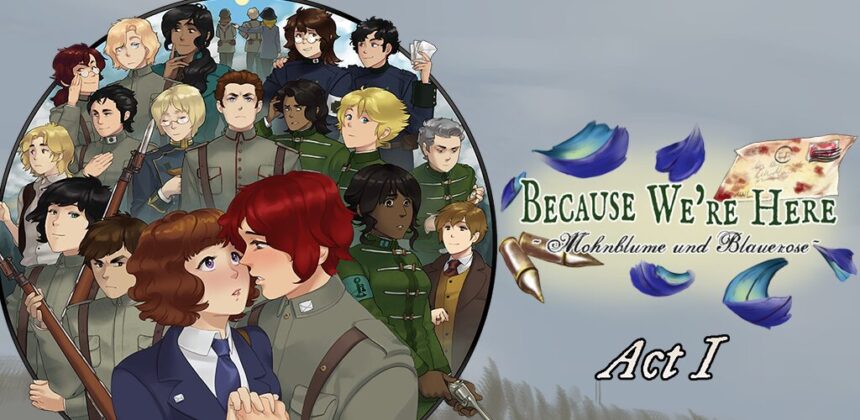
Elfriede herself is the game’s clearest strength this early on. She reads as anxious and imperfect rather than a blank stand-in for whoever’s playing, her reactions to the war around her landing as her own rather than performed for my benefit. Ten bachelors populate her home country of Wessling in this first act alone, and even here, individual personalities come through clearly enough to make picking a route feel like a real choice rather than an arbitrary one. Wolfgang Haussman, Wolf for short, worked the blue rose fields before the war, guarded and quick to fight, a title-relevant detail once you realize the game’s own name translates to poppy and blue rose. Eugen von Reinholdt, his former boss, comes from old aristocratic money and carries himself as spoiled and sophisticated in a way that somehow stays endearing rather than grating.
Studio Elfriede built this as an episodic visual novel split across four acts, this first one priced at $5.99 on its own. What sets it apart from most otome romance is the developer’s own stated structural approach. The war’s plot and its casualties are fixed regardless of which route you pick, closer in spirit to a slowly diminishing ensemble cast than a typical branching romance where choices reshape who lives or dies. That’s a bold choice for a genre built around personal agency, letting the romance exist within an unchangeable, tragic frame rather than around one. It signals a willingness to let real stakes and real loss define the story rather than softening the setting’s brutality for the sake of a guaranteed happy ending.
Twenty original pieces of CG art bring Act I to life, and the historical grounding around them deserves real credit too. Details about wartime bureaucracy, class divides among soldiers, and the specific textures of trench life are folded into the narrative naturally rather than delivered as dry exposition, giving the alternate-history setting a lived-in believability that a lot of war-inspired fiction reaches for and misses. Nothing in this release is voiced, and I couldn’t track down a composer credit anywhere, leaving the text and CG work alone to carry the emotional weight.
Where Act I stumbles is simply scope. A meaningful chunk of its runtime overlaps with content already available in the earlier free demo, and the individual romantic scene tied to a chosen love interest at this act’s close runs only a few minutes, an underwhelming payoff after the setup that precedes it. It’s the kind of thing that reads less as a flaw in the writing itself and more as evidence that this first act was always meant to function as a foundation for the acts still to come rather than a complete arc on its own.
The wider cast keeps growing past this opening act too. Act II introduces further named characters, August Weil, Gerhardt, and Floris among them, expanding a roster that already felt substantial by the end of Act I. Studio Elfriede later folded Acts III and IV together into a single release rather than shipping them separately, framing the two as enough of a two-part story that combining them made more sense than splitting the wait across an extra release.
Verdict
Because We’re Here ~Mohnblume und Blauerose~ Act I sets up an ambitious anti-war otome premise, giving its protagonist real interiority and its ensemble cast real stakes by refusing to let romance soften the war’s fixed, tragic outcomes. The historical grounding feels earned rather than performative, and Elfriede herself is a strong enough lead to carry real investment into whatever comes next. As a standalone experience, though, this first act is thin, leaning heavily on content shared with the earlier free demo and closing on a romantic payoff too brief to feel fully satisfying yet. It’s a promising foundation more than a complete statement, best approached with the later acts already available or on the way.