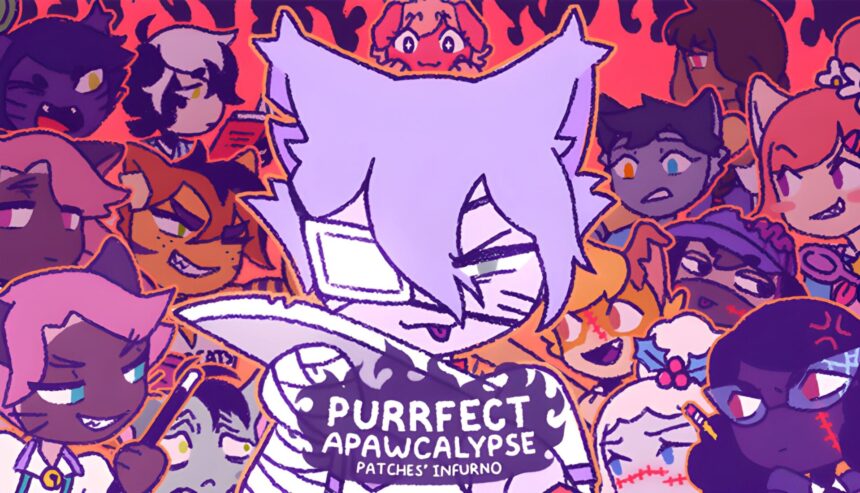
Setting out on my third journey through this particular blend of anthropomorphic cats, dogs, and casual gore, I wondered if Purrfect Apawcalypse: Patches’ Infurno would feel any less sharp than the first two entries. But after several hours of clicking through branching choices as this trilogy’s most chaotic lead, I’m pleasantly surprised to say it still lands, despite the basics not having changed much since the series kicked off back in 2019. This closing chapter does up the ante somewhat by handing the reins to Patches specifically, a character the first two games spent building up as a genuine threat rather than a hero. That’s as satisfying as it is unsettling, and it’s still tense to watch a wrong choice turn a lighthearted school day scene into something considerably darker. That’s a real accomplishment for a freeware trilogy that started as one person’s solo dev practice project.
Patches gets dragged to school for the first ever joint cat and dog attendance day, and he spends this closing chapter chasing one simple goal, get this stupid collar off and wreak as much havoc as possible. His classmates’ various distractions leave him more freedom than he probably should have. That freedom doesn’t come free either, since every distracted classmate is still just one wrong choice away from stumbling into whatever trouble Patches is currently causing. Coco and Brownie stay tied up in home ec class, Olive and Angel get absorbed in literature, and Sparky and Ginger spend the day occupied with gym, each pocket of distraction opening up more of the school for Patches to actually explore.
Each of those three distracted pairs runs its own small subplot in the background while Patches causes chaos elsewhere, home ec, literature class, and gym period all playing out with their own beats whether or not the player actively checks in on them. That structure gives the school setting a sense of a place actually happening in real time, rather than existing purely as a backdrop waiting for Patches to wander through it.
What makes Patches an effective lead for this particular finale is how unapologetically he leans into being the story’s chaos agent rather than a reluctant hero forced into circumstance. His scheme to remove his collar and cause trouble gives the game a clear, propulsive throughline, and watching him bounce between different corners of the school gives the setting real texture rather than treating it as a static backdrop. That collar itself carries real history too, a restraint the first two games established after Patches spent considerable effort trying to hurt the friends who eventually agreed to give him a second chance. Watching a character the series spent two prior games positioning as a real danger get handed the actual lead role is a real gamble. It pays off specifically because the writing never lets Patches fully off the hook for what he’s done. He stays fun to control even while carrying that weight.
Heart trackers monitor relationship health with each character along the way, and those relationships shape which of the game’s many endings actually play out, ranging from outright death to the series’ signature purrfect happy conclusions. That range keeps the stakes feeling real rather than decorative, since a poorly managed relationship can close off a happier outcome long before the story actually gets there. Building real trust with one character over the course of a single school day, rather than a longer campaign, keeps that relationship management tight and legible even for a first time player working through the choices quickly. Losing that trust doesn’t just close off one ending either, since the game tracks enough of these relationships simultaneously that neglecting one can ripple into how other characters react down the line.
Mittens, new to this closing chapter, adds a non-binary cat to the cast alongside her brother Whiskers, whose obvious crush on Patches gives the school day setting one more relationship thread to actually manage. That kind of new character addition this late in a trilogy could easily feel like padding, but Mittens and Whiskers both get folded into the existing cast dynamics naturally enough that they read as real additions rather than late game filler. Whiskers specifically gets positioned as one more relationship for Patches to actually navigate, which widens the cast of people whose reactions matter without diluting focus away from the returning core group.
The choose-your-own-adventure structure keeps decisions feeling consequential rather than cosmetic, and that’s really the backbone of the whole trilogy’s appeal. Choices here carry real weight, sometimes fatal weight, which gives even lighthearted scenes an undercurrent of tension that keeps me actually reading the options rather than clicking through on autopilot. That weight extends to how the game frames its own content warnings too, upfront enough about the violence on offer that nothing feels like it’s sneaking up on a reader who paid attention going in.
The blend of cartoon violence and dark comedy against an otherwise cute, colorful cast is clearly indebted to the Doki Doki Literature Club playbook of subverting a cozy premise. It earns that comparison rather than just borrowing the trick wholesale, finding its own irreverent, pun heavy voice throughout rather than chasing DDLC’s specific tone beat for beat. Even the content warnings lean into that same irreverence, listing things like bifurcated dogs and headless dogs alongside strong language in a tone that’s already winking at how absurd the premise sounds on paper. That’s a hard needle to thread for a small team working without a bigger studio’s resources, and the fact that it lands as its own thing rather than a copy speaks well of the writing specifically.
As the third and final entry in the series, this does work best with some familiarity with the returning cast, characters first introduced back in Love at Furst Bite before getting expanded on across Purrgatory Furever’s own zombie outbreak storyline. The school day framing gives Patches’ Infurno enough of a self contained hook that newcomers won’t be totally lost jumping straight in, though the emotional weight of watching Patches specifically get a shot at redemption lands harder with the context the first two games actually built. Series lore around Coco and Angel, a witch and the ghost she’s bonded to, and the golden endings each prior game eventually canonized, gives longtime readers extra context newcomers simply won’t have walking in cold. That context isn’t strictly required to follow Patches’ Infurno’s own plot, but it deepens why certain reactions from returning characters land the way they do.
Presentation stays consistent with the series’ established style, colorful, expressive character art that sells both the whimsy and the horror without either undercutting the other. Writer and artist Denny Truong handles that visual identity solo, and the shift between a character’s cute default expression and whatever considerably more disturbing state a bad choice puts them in stays legible without needing extra explanation. That legibility matters given how quickly the tone can shift within a single scene. Backgrounds shift subtly between the school’s different classrooms too, giving each distraction its own visual identity even within a single, contained setting.
Music from Lyon rounds out the presentation, tonally flexible enough to carry both the school day slice of life stretches and the sharper, more dread filled turns the story takes once Patches actually starts causing trouble. That range matters given how quickly this game shifts registers, sometimes within a single scene. Individual tracks lean cartoonish and bouncy during the calmer stretches, then pull back into something quieter and more unsettling once a scene’s stakes actually rise.
90% Studios, the two person Canadian team behind the whole trilogy, is Denny Truong and programmer Andy Schneider, working together since forming the studio in 2018. Patches’ Infurno itself was developed between October 2019 and June 2020 before releasing that summer, and the team has kept supporting the trilogy well past launch, adding Chinese, Japanese, and Polish translations to the Steam release years after the fact, plus physical merch for longtime fans. Andy Schneider’s programming work keeps that branching structure running cleanly across three separate games and several added languages without the series ever feeling held together by duct tape. That kind of continued support for a freeware turned commercial trilogy speaks to a small studio treating this series as more than a finished, forgotten project.
Verdict
Purrfect Apawcalypse: Patches’ Infurno closes out its trilogy by fully committing to its chaotic protagonist and the tension built into its branching, consequence heavy choices, using a deceptively cute cast of cats and dogs to sell both real comedy and dark turns without either one undercutting the other. Patches makes for a fun, mischief driven lead to close things out with, and the heart tracker system gives relationships real mechanical weight rather than just flavor text. It leans on prior familiarity with this cast more than a fully standalone entry would, but as the finale to a small, devoted indie trilogy, it delivers exactly the mix of sweetness and dread this series has built its whole identity around. For a series that began as a solo experiment, ending on this note of confidence is worth real credit.