In a genre where polyamorous relationships mostly show up as a punchline or a problem to fix by the credits, Why Not Both? might sound easy to scroll past for readers already burned out on solarpunk aesthetics layered over otherwise ordinary campus romance. However, if you’re the kind of reader drawn to slice of life stories that actually commit to an optimistic future instead of just decorating a dystopia with solar panels, this one might prove to be a small, sincere standout. It consistently impresses with how seriously it treats its central three way relationship as something worth building rather than resolving, even if that ambition is punctured somewhat by a small team’s limited resources and a still evolving, patch by patch release. That’s worth sitting with before writing the whole thing off as one more solarpunk aesthetic exercise.
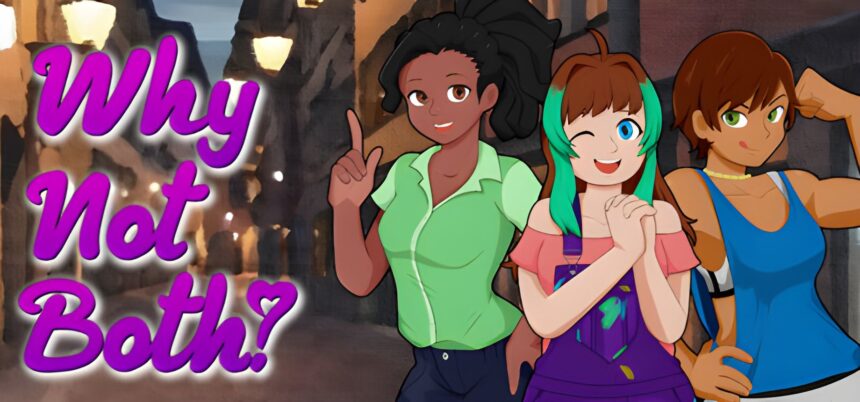
Rio, Jen, and Aspen spend their sophomore year at Silver Sire, a school the game frames as thriving rather than merely functional. Amid academic pressure and evolving feelings, the three of them work through questions of identity and desire that build toward a relationship among all three of them rather than a simple pair. That structure alone sets the story apart from how visual novel romance usually handles multiple love interests, where picking one is normally the entire point of the format. None of the three reads as a spare wheel waiting to be cut either, at least going by how the game frames its own premise, since the whole pitch rests on all three relationships mattering equally rather than one pairing carrying the emotional weight while the third person tags along. The relationship’s emotional throughline, three people learning to trust that room exists for all of them at once, sits at the center of a story that could easily have played the same beats as a more conventional love triangle instead.
Polyamorous representation in visual novels tends to be either absent entirely or handled as a source of conflict and jealousy resolved by picking one partner. Why Not Both? sets out to buck that pattern directly, presenting the relationship among its three leads as something worth building toward rather than a problem the story eventually corrects. That’s an underserved angle for the genre, and the game leans into it as its central selling point rather than a side detail. Even the decision to frame that structure explicitly, rather than let it emerge as a surprise twist partway through, signals how seriously the writing wants a reader to take the setup from the very first scene.
Solarpunk itself remains a rare backdrop for visual novel romance specifically, more common in short fiction and indie game jams than in longer narrative projects with this much production behind them. Most visual novels that reach for a hopeful future setting still default to a single, familiar aesthetic, clean tech and pastel skylines, without letting that optimism actually shape how characters relate to each other. Why Not Both? ties its setting’s optimism directly to its relationship structure instead, using one to reinforce the other rather than treating the backdrop as separate from the romance running through it. That distinction matters more than it might first appear, since a setting that only looks hopeful without actually functioning that way in how characters treat each other is really just a different coat of paint on the same old conflicts.
A slice of life setting gives the story room to let academic pressure, personal identity, and desire develop alongside the central relationship rather than treating romance as the only thing happening in these characters’ lives. The solarpunk backdrop itself does real thematic work too, since Silver Sire’s optimism, a school built around sustainability rather than scarcity, mirrors the same hopeful framing the story applies to its central relationship. Sustainability itself functions as more than backdrop dressing, since a setting built around abundance rather than scarcity removes one of the most common sources of conflict genre romances lean on, forcing the story to find its tension somewhere more personal instead. That approach asks more of the writing too. A story like this can’t lean on jealousy or a forced choice to generate stakes. Instead it has to find tension in smaller, more personal places, self doubt, timing, the ordinary friction of three people learning how to actually be together.
The soundtrack leans on curated chillhop tracks pulled from Dreamhop Music alongside contributions from Softy, Two Scents, and Spencer Hunt, an unusual choice for a visual novel that pays off given how well that genre’s relaxed, warm register matches the story’s own tone. Dreamhop Music in particular has built a reputation around exactly this kind of relaxed, lo-fi adjacent sound, which makes the pairing with a slice of life solarpunk story feel like a deliberate match rather than a stock license grabbed to fill space. That specificity, naming the actual artists behind the score rather than leaving the soundtrack as an unexamined background detail, is exactly the kind of presentation coverage a project this size doesn’t always get credited for.
Why Not Both? released on itch.io on May 15, 2025, and Studio Rally has kept refining it steadily since. Patch v1.01 followed within weeks, with v1.02 and v1.03 arriving through June and July, each round fixing misspellings, grammatical errors, and small stage direction issues rather than sitting on the initial release as finished. A v1.04 update in August added smoother character blinking on top of further typo corrections, alongside a newly available free demo for anyone wanting to sample the story before buying. A fifth patch that November added a proper quick menu next to the dialogue box and polished several sections of writing for clarity, with two more major updates confirmed as still in progress. The quick menu added in that fifth patch specifically addressed basic navigation, new buttons flanking the dialogue box rather than burying core functions in a separate menu screen, a small quality of life change that speaks to a team paying attention to how the game actually gets played rather than just adding content for its own sake. That pace of iteration, five patches within roughly six months of release, reads less like damage control and more like a team treating launch as the start of the project rather than its finish line.
Studio Rally launched a Kickstarter campaign specifically to fund full voice acting for the release, casting seven voice actors to bring Rio, Jen, Aspen, and the rest of the cast to life. The campaign didn’t reach its funding goal, but the team has said publicly it’s moving forward with voicing the cast anyway, funded through other means. Seven voice actors is a real commitment for a project this size to fund independently, especially after a crowdfunding shortfall. That shortfall could easily have justified scaling the ambition back instead of pushing forward with it anyway. That decision alone tells a reader something about the project’s priorities heading into its next stretch of development.
Studio Rally built and self published Why Not Both? for Windows, macOS, and Linux, keeping the whole project centered on itch.io rather than a larger storefront presence. Keeping distribution centered on itch.io rather than chasing a Steam listing early on is itself a deliberate choice a lot of small visual novel teams make. It keeps overhead lower while a project is still actively changing shape patch to patch. The team has been transparent about the release’s rocky patch history too, openly referring to some of its early updates as fixing “mishaps” rather than downplaying the rough edges a small, still growing studio inevitably runs into. The game has also seen repeat storefront discounts since launch, twenty percent off in the summer and thirty percent off around the following winter, the kind of ongoing promotional push that keeps a small release visible on a storefront as crowded as itch.io.
Verdict
Why Not Both? stakes out an underserved corner of visual novel romance, treating a polyamorous relationship as something to build toward with real optimism rather than as friction to resolve, set against a solarpunk backdrop that reinforces that hopeful tone rather than existing as mere set dressing. Its curated chillhop soundtrack, ongoing voice acting push, and steady patch history all point to a small team treating this release as a living project rather than a one and done launch. As a sincere, positively framed take on a relationship structure the genre rarely explores, backed by real continued support after release, it fills a real gap worth watching grow. For a small team working largely on its own, that combination of ambition and follow through is worth real credit.